Loading...
This comparison has not been analyzed yet.
One-time AI generation (~1 minute). Scores and timeline are already available below.
Alan Brooke vs Leonid Govorov
Alan Brooke leads by 3.5 pts · 2 figures compared
…
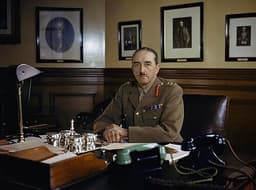
Alan Brooke
General · Modern
64.5Total
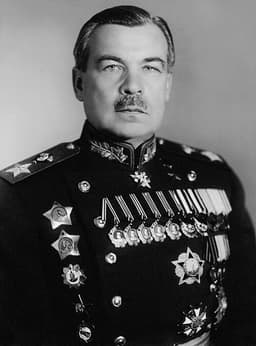
Leonid Govorov
General · Modern
61.0Total
Basic Information
Born
1883
1897
Died
1963
1955
Era
Modern
Modern
Nationality
United Kingdom
USSR
Occupation
General
General
Civilization
Western
Western
Score Comparison
Military (10%)
55.0
82.0
Political (20%)
72.0
46.6
Influence (20%)
61.0
59.0
Legacy (20%)
55.0
54.0
Leadership (15%)
80.0
71.0
Strategy (15%)
72.0
69.2
TOTAL
64.5
61.0
Alan Brooke — Complete Timeline
1941 AD
Appointed Chief of the Imperial General StaffOther◆ Major
In December 1941, Alan Brooke was appointed Chief of the Imperial General Staff (CIGS), the professional head of the British Army. He served in this role throughout World War II, overseeing military strategy and operations, and was a key member of the Chiefs of Staff Committee that advised Prime Minister Winston Churchill.
World War IIBritish ArmyMilitary Leadership
Impact: global
1943 AD
Participated in the Casablanca ConferenceOther◆ Major
In January 1943, Brooke attended the Casablanca Conference with Churchill and Roosevelt, where Allied strategy for the remainder of World War II was discussed. The conference agreed on the policy of 'unconditional surrender' for the Axis powers and the invasion of Sicily, with Brooke playing a key role in shaping military plans.
World War IIAllied StrategyCasablanca
Impact: global
Attended the Tehran ConferenceOther◆ Major
In November-December 1943, Brooke attended the Tehran Conference with Churchill, Roosevelt, and Stalin. The conference coordinated Allied military strategy against Germany, including the timing of the cross-channel invasion (Operation Overlord) and the Soviet offensive, with Brooke providing military advice on the feasibility of operations.
World War IIAllied StrategyTehran
Impact: global
1944 AD
Oversaw the D-Day PlanningOther◆ Major
As CIGS, Brooke was instrumental in planning the Normandy landings (D-Day) on June 6, 1944. He coordinated with Allied commanders to develop the invasion strategy, including the selection of landing beaches and the allocation of forces, which led to the successful liberation of Western Europe from Nazi occupation.
World War IID-DayNormandy Invasion
Impact: globalconstructive
Promoted to Field MarshalOther◆ Major
On January 1, 1944, Alan Brooke was promoted to the rank of Field Marshal, the highest rank in the British Army. This promotion recognized his exceptional service as CIGS and his contributions to Allied victory in World War II.
World War IIPromotionField Marshal
Impact: nationalconstructive
Leonid Govorov — Complete Timeline
1941 AD
Defense of LeningradWar◆ Major
Govorov commanded the artillery of the Leningrad Front from September 1941. He organized the city's artillery defenses, coordinating counter-battery fire and supporting infantry operations during the siege, preventing German capture of Leningrad.
World War IISiege of LeningradArtillery
Impact: regional
1943 AD
Operation IskraWar◆ Major
Govorov commanded the Leningrad Front in Operation Iskra, a joint offensive with the Volkhov Front that broke the German blockade of Leningrad in January 1943. The operation opened a narrow land corridor to the city, allowing supplies to reach the starving population.
World War IISiege of LeningradBreakthrough
Impact: regionalconstructive
1944 AD
Leningrad-Novgorod OffensiveWar◆ Major
Govorov led the Leningrad Front in the Leningrad-Novgorod Offensive from January to March 1944. The operation fully lifted the siege of Leningrad, pushed German forces back to the Baltic states, and liberated Novgorod.
World War IIEastern FrontLiberation
Impact: regionalconstructive
Appointed Marshal of the Soviet UnionPolitical Action◆ Major
Govorov was promoted to Marshal of the Soviet Union on June 18, 1944, in recognition of his successful command of the Leningrad Front and his role in breaking the siege. He was one of the youngest marshals of the war.
PromotionWorld War IISoviet Military
Impact: nationalconstructive
This comparison has not been analyzed yet.
One-time AI generation (~1 minute). Scores and timeline are already available below.
Rankings
🥇
Alan BrookeLeader
Mil: 55.0Pol: 72.0Inf: 61.0
64.5
🥈
Leonid Govorov
Mil: 82.0Pol: 46.6Inf: 59.0
61.0
+3.5 behind
How This Comparison Works
Algorithm
Each figure is scored on 6 dimensions (0—100 scale) based on structured historical data: Military (10%), Political (20%), Influence (20%), Legacy (20%), Leadership (15%), Strategy (15%). The weighted total produces the final ranking.
Data Sources
Scores are computed from structured sub-indicators in the database. Scale factors adjust for era (Ancient ×0.85, Modern ×1.0) and civilization size (Eastern ×1.05, Other ×0.80) to account for differences in population and military scale.
Maximum 3 Figures
Comparisons are limited to 2—3 figures to ensure readability and statistical meaningfulness.
Error Margins
±5 points per dimension — Sub-scores are derived from historical records with inherent uncertainty. Two figures within 5 points on a dimension should be considered roughly equivalent in that area.
Total Score Accuracy
±3 points overall — The weighted combination of 6 dimensions produces a total score with approximately ±3 points of uncertainty. Differences of less than 3 points are not statistically significant— the figures are effectively tied.
Known Limitations
- Historical records are incomplete and uneven across civilizations
- Figures from oral-tradition societies may be underrepresented
- Occupation labels can misclassify multi-role figures
- Scores measure capability and impact, not moral character
- Quantitative scoring is a comparison tool, not absolute truth
Capability Radar
Military (10%) — Battles & Warfare
Battles
60
75
Win Rate
55
80
Expansion
20
60
Political (20%) — Governance & Reform
Reform
60
30
Diplomacy
80
45
Economy
50
25
Influence (20%) — Cultural & Global Reach
Cultural
30
40
Global
65
45
Legacy (20%) — Historical Impact
Historical
75
65
Longevity
60
50
Leadership (15%) — Power & Stability
Tenure
70
40
Stability
85
50
Strategy (15%) — Tactics & Innovation
Strategy
90
82
Tactics
75
85
Reform
85
70
Similar Comparisons
Comments & Discussion
No comments yet. Be the first to share your thoughts!