Loading...
Alassane Ouattara vs Napoleon Bonaparte
Napoleon Bonaparte leads by 18.2 pts · 2 figures compared
…
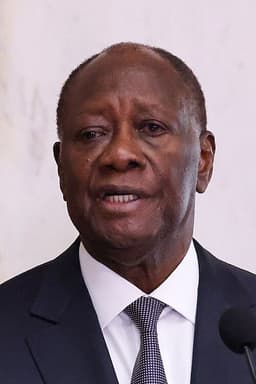
Alassane Ouattara
Politician · Modern
52.7Total

Napoleon Bonaparte
General · Modern
70.9Total
Basic Information
Born
1942
1769
Died
—
1821
Era
Modern
Modern
Nationality
Ivory Coast
France
Occupation
Politician
General
Civilization
Other
Western
Score Comparison
Military (10%)
23.0
94.0
Political (20%)
65.7
72.0
Influence (20%)
55.7
40.0
Legacy (20%)
45.8
80.0
Leadership (15%)
72.0
78.0
Strategy (15%)
43.9
90.0
TOTAL
52.7
70.9
Alassane Ouattara — Complete Timeline
1990 AD
Appointed Prime Minister of Ivory CoastPolitical Action◆ Major
Ouattara was appointed Prime Minister by President F
Prime MinisterEconomic ReformIvory Coast
Impact: nationalconstructive
2000 AD
Excluded from Presidential ElectionsPolitical Action◆ Major
Ouattara was barred from running for president due to a nationality law requiring both parents to be Ivorian. His exclusion fueled political tensions and contributed to the country's instability and civil war.
ExclusionNationality LawIvory Coast
Impact: nationaldestructive
2010 AD
Elected President of Ivory CoastPolitical Action
Ouattara won the presidential election against incumbent Laurent Gbagbo, but Gbagbo refused to step down. The disputed result led to a five-month civil war, ending with Ouattara assuming office after Gbagbo's arrest.
ElectionCivil WarIvory Coast
Impact: regionalconstructive
2015 AD
Re-elected President of Ivory CoastPolitical Action◆ Major
Ouattara won a second term with 83.7% of the vote in an election deemed peaceful and credible by observers. His victory reflected support for his economic recovery policies and post-war reconciliation efforts.
ElectionIvory CoastRe-election
Impact: nationalconstructive
2020 AD
Controversial Third Term BidPolitical Action◆ Major
Ouattara announced he would run for a third term after the death of his chosen successor, sparking opposition protests and violence. The election was boycotted by the opposition, and Ouattara won with 94% of the vote.
Third TermElectionIvory Coast
Impact: nationaldestructive
Napoleon Bonaparte — Complete Timeline
1799 AD
Coup of 18 BrumaireOther◆ Major
Napoleon Bonaparte, with support from his brother Lucien and key political figures, overthrew the Directory in a bloodless coup. He established the Consulate with himself as First Consul, effectively becoming the ruler of France. This event ended the French Revolution's most unstable period.
French RevolutionCoupRise to Power
Impact: regional
1804 AD
Promulgation of the Napoleonic CodeOther◆ Major
Napoleon enacted the Civil Code of the French, known as the Napoleonic Code, a comprehensive set of laws that replaced the fragmented feudal legal systems. The code established legal equality, protected property rights, and secularized law. It became the basis for legal systems in many European and world countries.
Legal ReformNapoleonic CodeCivil Law
Impact: globalconstructive
1805 AD
Battle of AusterlitzWar◆ Major
Napoleon's Grande Arm
Napoleonic WarsBattleDecisive Victory
Impact: global
1812 AD
Invasion of RussiaWar◆ Major
Napoleon led the Grande Arm
Napoleonic WarsInvasionDisaster
Impact: globaldestructive
1815 AD
Battle of WaterlooWar◆ Major
Napoleon's French army was defeated by the combined forces of the Duke of Wellington's Anglo-Allied army and Gebhard Leberecht von Bl
Napoleonic WarsBattleFinal Defeat
Impact: globaldestructive
Expert Analysis
alassane-ouattara-vs-napoleon-bonaparte
# The Emperor and the Economist
In the spring of 1815, Napoleon Bonaparte stood on the deck of a ship returning from exile on Elba, his eyes fixed on the French coast. He had been emperor, conqueror of Europe, master of a continent. Now he was a gambler staking everything on one final throw of the dice. Two hundred years later, in the winter of 2010, Alassane Ouattara sat in a hotel room in Abidjan, watching the results of a presidential election that would plunge his country into civil war. One man commanded armies; the other commanded spreadsheets. One built an empire; the other built a nation from the rubble of conflict. What separates a military genius from a political survivor? The answer lies not in their scores—Napoleon’s 94 for military against Ouattara’s 30—but in the worlds they inhabited and the choices those worlds demanded.
Origins
Napoleon Bonaparte was born in 1769 on the island of Corsica, a place that had only just become French. His family was minor nobility, poor enough to need the king’s favor, ambitious enough to send their son to military school in mainland France. There, the young Corsican was mocked for his accent and his height—a provincial outsider in a world of aristocrats. He devoured books on military history, on artillery, on the art of war. The French Revolution, which erupted when he was twenty, shattered the old order and opened doors that birth alone would never have unlocked. Napoleon was a child of chaos, and chaos would be his medium.
Alassane Ouattara was born in 1942 in the French colony of Ivory Coast, a world away from Corsica but equally shaped by empire. His family were Muslim traders, part of a merchant class that had long navigated the boundaries between African traditions and European power. Ouattara studied economics in the United States and France, earning a doctorate, then spent decades at the International Monetary Fund, analyzing the debts of nations. Where Napoleon learned from battles, Ouattara learned from balance sheets. The Revolution had made Napoleon; the post-colonial order made Ouattara—a technocrat in a world of strongmen, an economist in a continent of generals.
Rise to Power
Napoleon’s ascent was meteoric, a streak of fire across the sky. In 1793, at the age of twenty-four, he drove the British out of Toulon with a brilliant artillery plan. By 1796, he was commanding the Army of Italy, leading ragged soldiers to victories that stunned Europe. His Italian campaign was not just a military triumph but a political one—he negotiated treaties, extracted wealth, and sent dispatches that made him a hero in Paris. In 1799, he returned from a disastrous Egyptian expedition to find the Directory crumbling. With a coup d’état, he made himself First Consul, then Emperor in 1804. He was thirty-five. The path was clear because he had carved it himself.
Ouattara’s rise was slower, more patient. In 1990, President Félix Houphouët-Boigny, the aging father of Ivorian independence, appointed him Prime Minister—the first to hold the post. Ouattara brought IMF-style discipline to the economy, cutting spending and fighting corruption. But when Houphouët-Boigny died in 1993, Ouattara was pushed aside by rivals who saw him as an outsider, a northerner with foreign blood. In 2000, a new constitution barred him from running for president, requiring both parents to be Ivorian. Ouattara’s father was from Burkina Faso. For a decade, he watched from exile as Ivory Coast fractured along ethnic and religious lines. His rise was not a coup but a waiting game.
Leadership & Governance
Napoleon ruled through force and genius. He reorganized France into departments, centralized the bureaucracy, and created the Napoleonic Code—a legal system that enshrined equality before the law, property rights, and secular governance. It was a masterpiece of rational order, exported across Europe. On the battlefield, he was unmatched: the Battle of Austerlitz in 1805, where he destroyed a combined Russian and Austrian army with a feigned retreat, remains a textbook example of strategic deception. But Napoleon governed as he fought—by will alone. He demanded total loyalty, crushed dissent, and placed his brothers on thrones. The same ambition that drove him to victory drove him to overreach.
Ouattara governed through negotiation and economic leverage. When he finally won the presidency in 2010—defeating Laurent Gbagbo in a UN-certified election—Gbagbo refused to leave. The result was a brief but brutal civil war, ending with Gbagbo’s capture in 2011. Ouattara’s military score of 30 reflects not weakness but a different philosophy: he relied on French intervention and UN peacekeepers, not his own army. As president, he focused on what he knew best: economics. He rebuilt infrastructure, attracted foreign investment, and presided over one of Africa’s fastest-growing economies. The World Bank praised him; critics called him a neoliberal tool. Unlike Napoleon, he did not seek to conquer—he sought to stabilize.
Triumph & Tragedy
Napoleon’s greatest moment was Austerlitz, where he crushed the Third Coalition and crowned himself master of Europe. His greatest tragedy was the invasion of Russia in 1812. He marched 600,000 men into the vastness of the Russian winter; fewer than 100,000 returned. The Grande Armée was destroyed, and with it, his aura of invincibility. Exiled to Elba, he escaped, raised another army, and met defeat at Waterloo in 1815—a battle he might have won had his generals followed orders, had the rain stopped an hour earlier, had the Prussians arrived later. He died in 1821 on the remote island of Saint Helena, a prisoner of the British.
Ouattara’s triumph was his peaceful re-election in 2015, winning 83.7% of the vote in an election that observers called credible. Ivory Coast, once a symbol of African prosperity and then a symbol of civil war, was healing. But his tragedy came in 2020, when he announced a third-term bid after the death of his chosen successor. The opposition cried foul; protests erupted; dozens died. Napoleon’s tragedy was hubris; Ouattara’s was the same old story of African leaders who promise democracy but cannot let go. He won the election, but the legitimacy he had spent years building cracked.
Character & Destiny
Napoleon was restless, brilliant, and insatiable. He once said, “There is no such thing as a perfect man; but there are men who are great through their will.” His will was a force of nature, but it could not tolerate limits. He needed to conquer, to prove, to be everything. That hunger made him emperor; it also made him exile. Ouattara, by contrast, was a man of calculation. He had spent decades in meetings, not battles. He understood patience, timing, and the power of institutions. But calculation has its own weakness: it can mistake stability for justice. Napoleon’s tragedy was reaching too far; Ouattara’s was not knowing when to step back.
Legacy
Napoleon’s legacy is written across Europe—in the civil code, in the modern state, in the very idea of the nation. He is remembered as a genius and a tyrant, a liberator and a conqueror. His scores—82.4 overall, 94 for military—reflect a man who changed the world, for better and worse. Ouattara’s legacy is still forming. His score of 64.2 is modest, but it measures a different kind of achievement: not conquest, but reconstruction. He took a country torn by war and made it prosperous. Whether that prosperity will outlast him, whether democracy will deepen or decay, remains an open question.
Conclusion
Napoleon and Ouattara never met, never could have met. One was a god of war; the other a priest of economics. Yet both faced the same fundamental choice: how to wield power. Napoleon chose the sword; Ouattara chose the ledger. One ended in exile; the other clings to office. Their stories remind us that greatness is not a single number but a shape in time—a curve that rises, peaks, and falls. The question is not who was greater, but what each reveals about the age that made them. Napoleon’s age was one of revolution, where a man could reshape the world with cannon and code. Ouattara’s age is one of globalization, where power flows through banks and ballots. The emperor and the economist: two faces of modernity, each magnificent, each flawed, each a mirror held up to history.
Rankings
🥇
Napoleon BonaparteLeader
Mil: 94.0Pol: 72.0Inf: 40.0
70.9
🥈
Alassane Ouattara
Mil: 23.0Pol: 65.7Inf: 55.7
52.7
+18.2 behind
How This Comparison Works
Algorithm
Each figure is scored on 6 dimensions (0—100 scale) based on structured historical data: Military (10%), Political (20%), Influence (20%), Legacy (20%), Leadership (15%), Strategy (15%). The weighted total produces the final ranking.
Data Sources
Scores are computed from structured sub-indicators in the database. Scale factors adjust for era (Ancient ×0.85, Modern ×1.0) and civilization size (Eastern ×1.05, Other ×0.80) to account for differences in population and military scale.
Maximum 3 Figures
Comparisons are limited to 2—3 figures to ensure readability and statistical meaningfulness.
Error Margins
±5 points per dimension — Sub-scores are derived from historical records with inherent uncertainty. Two figures within 5 points on a dimension should be considered roughly equivalent in that area.
Total Score Accuracy
±3 points overall — The weighted combination of 6 dimensions produces a total score with approximately ±3 points of uncertainty. Differences of less than 3 points are not statistically significant— the figures are effectively tied.
Known Limitations
- Historical records are incomplete and uneven across civilizations
- Figures from oral-tradition societies may be underrepresented
- Occupation labels can misclassify multi-role figures
- Scores measure capability and impact, not moral character
- Quantitative scoring is a comparison tool, not absolute truth
Capability Radar
Military (10%) — Battles & Warfare
Battles
20
95
Win Rate
23
90
Expansion
27
95
Political (20%) — Governance & Reform
Reform
70
95
Diplomacy
68
80
Economy
75
85
Influence (20%) — Cultural & Global Reach
Cultural
30
85
Global
45
90
Legacy (20%) — Historical Impact
Historical
40
95
Longevity
35
90
Leadership (15%) — Power & Stability
Tenure
65
85
Stability
55
70
Strategy (15%) — Tactics & Innovation
Strategy
30
95
Tactics
32
98
Reform
38
92
Similar Comparisons
Comments & Discussion
Grenadier's Ghost6/17/2026
Calling this comparison "The Emperor and the Economist" is generous to Ouattara. Napoleon didn't just outscore him 94 to 30 on military metrics—he *invented* modern warfare with the corps system and mass conscription. Ouattara won a civil war because French special forces and UN helicopters did the heavy lifting. One led the Grand Armée to Moscow; the other had to wait in a hotel while foreign troops secured his presidency. These aren't comparable careers. It’s Alexander vs. a bank manager with
历史砝码6/17/2026
把拿破仑和瓦塔拉放在一起比,就像拿维纳斯雕像和塑料模特比美。拿破仑94分的军事评分建立在60多场战役上,从意大利到埃及,军政改革直接塑造了现代欧洲。瓦塔拉的30分虽符合科特迪瓦背景,但他本质上是个国际货币基金组织出身的技术官僚。别搞错了:瓦塔拉不是"政治幸存者",他是全球体系精心包装的产物。拿破仑是从混沌中自己杀出来的。这根本不是同一级别的较量。
The Iron Cipher6/17/2026
The real issue isn't military scores—it's context collapse. Napoleon's 94 reflects battlefield dominance; Ouattara's 30 reflects a fractured state where legitimacy mattered more than aggression. But the analysis whitewashes Ouattara's record: his 2010 victory triggered a post-electoral crisis that killed 3,000 people, and his government still struggles with structural corruption. Meanwhile, Napoleon's Napoleonic Code influenced half the world's legal systems. On lasting impact, that's code vs. c
数据解剖师6/17/2026
数据爱好者注意:拿破仑的94分军事评分对应的是1815年前的欧洲战场环境;瓦塔拉的30分对应的是21世纪西非的后殖民内战。表面差距3:1,但把拿破仑空降到2010年的科特迪瓦,他照样玩不转民兵组织、外国干预和选举认证系统。瓦塔拉的30分不是"低分",是转型期领导人的平均数。一个是从1到100的军国大师,一个是从0到1的国家建设者。别混淆了计量标尺。