Loading...
Albert II of Germany vs Napoleon Bonaparte
Napoleon Bonaparte leads by 26.4 pts · 2 figures compared
…
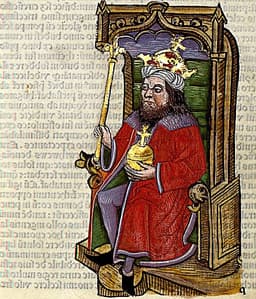
Albert II of Germany
Emperor · Medieval
44.5Total

Napoleon Bonaparte
General · Modern
70.9Total
Basic Information
Born
1397
1769
Died
1439
1821
Era
Medieval
Modern
Nationality
Holy Roman Empire
France
Occupation
Emperor
General
Civilization
Western
Western
Score Comparison
Military (10%)
50.0
94.0
Political (20%)
32.2
72.0
Influence (20%)
51.0
40.0
Legacy (20%)
44.2
80.0
Leadership (15%)
45.0
78.0
Strategy (15%)
41.0
90.0
TOTAL
44.5
70.9
Albert II of Germany — Complete Timeline
1438 AD
Elected King of the RomansPolitical Action◆ Major
Albert was elected King of the Romans, succeeding his father-in-law Sigismund. This election made him the first Habsburg to permanently hold the German crown, establishing the dynasty's long-term claim to the imperial title.
Habsburg DynastyImperial Election
Impact: regionalconstructive
Crowned King of HungaryPolitical Action◆ Major
Albert was crowned King of Hungary following the death of Sigismund. His rule was contested by Polish and Ottoman interests, but he secured the crown through his marriage to Sigismund's daughter Elizabeth.
HungarySuccession
Impact: regionalconstructive
Crowned King of BohemiaPolitical Action
Albert was crowned King of Bohemia, but his rule was challenged by Hussite factions. The Hussite Wars had left Bohemia divided, and Albert's Catholic alignment faced resistance from the Utraquist nobility.
BohemiaHussite Conflict
Impact: regional
1439 AD
Campaign against the Ottoman EmpireWar◆ Major
Albert led a military campaign against the Ottoman Empire in the Balkans. The campaign was cut short by his death from dysentery at Neszm
Ottoman WarsBalkans
Impact: regionaltragic
Napoleon Bonaparte — Complete Timeline
1799 AD
Coup of 18 BrumaireOther◆ Major
Napoleon Bonaparte, with support from his brother Lucien and key political figures, overthrew the Directory in a bloodless coup. He established the Consulate with himself as First Consul, effectively becoming the ruler of France. This event ended the French Revolution's most unstable period.
French RevolutionCoupRise to Power
Impact: regional
1804 AD
Promulgation of the Napoleonic CodeOther◆ Major
Napoleon enacted the Civil Code of the French, known as the Napoleonic Code, a comprehensive set of laws that replaced the fragmented feudal legal systems. The code established legal equality, protected property rights, and secularized law. It became the basis for legal systems in many European and world countries.
Legal ReformNapoleonic CodeCivil Law
Impact: globalconstructive
1805 AD
Battle of AusterlitzWar◆ Major
Napoleon's Grande Arm
Napoleonic WarsBattleDecisive Victory
Impact: global
1812 AD
Invasion of RussiaWar◆ Major
Napoleon led the Grande Arm
Napoleonic WarsInvasionDisaster
Impact: globaldestructive
1815 AD
Battle of WaterlooWar◆ Major
Napoleon's French army was defeated by the combined forces of the Duke of Wellington's Anglo-Allied army and Gebhard Leberecht von Bl
Napoleonic WarsBattleFinal Defeat
Impact: globaldestructive
Expert Analysis
Origins
**Albert II of Germany** was born on August 10, 1397, in Vienna, as the son of Albert IV, Duke of Austria, and Johanna of Bavaria. He inherited the Duchy of Austria at age seven after his father's death. His early life was shaped by the Habsburg tradition of consolidating power through marriage and diplomacy. He received a solid education in governance and warfare, typical for a medieval noble, and was deeply influenced by the ongoing conflicts with the Ottoman Empire and the Hussite Wars in Bohemia.
**Napoleon Bonaparte** was born on August 15, 1769, in Ajaccio, Corsica, to a minor noble family. His father, Carlo Buonaparte, was a lawyer who supported Corsican independence. Napoleon studied at the Royal Military School in Brienne and later the École Militaire in Paris, graduating as a second lieutenant in artillery. His early years were marked by the French Revolution, which opened opportunities for rapid advancement based on merit rather than birth.
Rise to Power
**Albert II** rose to prominence through strategic marriages and inheritance. In 1422, he married Elizabeth of Luxembourg, daughter of Emperor Sigismund. After Sigismund's death in 1437, Albert was elected King of the Romans (German king) in 1438, becoming the first Habsburg to permanently hold the title. He was crowned King of Hungary in 1438 and King of Bohemia in 1438, but his rule in Bohemia was contested by Hussite factions. His rise was largely dynastic, relying on family connections and the support of the electors.
**Napoleon Bonaparte** rose to power through military prowess and political cunning. He gained fame during the Siege of Toulon in 1793, where he led a successful assault. In 1795, he suppressed a royalist uprising in Paris, earning promotion to commander of the Army of Italy. His Italian campaign (1796-1797) defeated Austria and established his reputation. In 1799, he staged the Coup of 18 Brumaire, overthrowing the Directory and becoming First Consul. By 1804, he crowned himself Emperor of the French.
Leadership & Governance
**Albert II** governed as a medieval monarch, focusing on consolidating Habsburg power. He attempted to assert authority in Bohemia and Hungary but faced resistance from Hussites and Ottoman incursions. His leadership was reactive, dealing with immediate threats rather than implementing long-term reforms. He issued decrees to strengthen royal authority but lacked the resources to enforce them. His style was traditional, relying on feudal alliances and the support of the Church.
**Napoleon Bonaparte** was a modernizer who centralized government and implemented sweeping reforms. He created the Napoleonic Code, which standardized law across France and influenced legal systems worldwide. He reorganized education, established the Bank of France, and promoted meritocracy. His leadership was autocratic but efficient; he personally oversaw military campaigns and administrative details. He used propaganda to maintain popularity and suppressed dissent through secret police.
Triumph & Tragedy
**Albert II**'s greatest success was securing the German crown for the Habsburgs, a dynasty that would dominate Europe for centuries. He also managed to be crowned in Hungary and Bohemia, though his rule there was brief. His tragedy was his early death at age 42 from dysentery during a campaign against the Ottomans in 1439. His reign was too short to achieve lasting stability, and his territories were left to his infant son, leading to a regency and internal conflicts.
**Napoleon Bonaparte**'s triumphs include the Battle of Austerlitz (1805), where he defeated the combined Russo-Austrian army, and the Napoleonic Code, which remains foundational. He conquered most of Europe, spreading revolutionary ideals. His tragedies include the disastrous Invasion of Russia (1812), where he lost over 400,000 men, and the defeat at Waterloo (1815), which ended his rule. He died in exile on Saint Helena in 1821.
Character & Destiny
**Albert II** was cautious and diplomatic, but his short reign prevented him from making a deep impact. He scored 37.7 in military and 38.0 in leadership, reflecting his limited battlefield success. His character was shaped by the constraints of his era; he could not overcome the fragmentation of the Holy Roman Empire. Historians see him as a transitional figure who secured Habsburg succession but failed to expand power significantly.
**Napoleon Bonaparte** was ambitious, brilliant, and ruthless. His military score of 94.0 and strategy score of 90.0 highlight his tactical genius. He was driven by a desire for glory and control, which led to overextension. His character combined charisma with authoritarianism, inspiring loyalty but also fear. His destiny was tied to his inability to compromise, leading to his downfall after the Russian campaign.
Legacy
**Albert II**'s legacy is primarily dynastic: he established the Habsburgs as the dominant force in German politics, a position they held until 1806. His brief reign set the stage for his son Ladislaus the Posthumous and later Habsburg emperors. However, his individual impact is limited, reflected in his legacy score of 58.4.
**Napoleon Bonaparte**'s legacy is immense: the Napoleonic Code influenced legal systems across Europe and the Americas. He reshaped national boundaries, ended feudalism, and promoted nationalism. His military tactics are still studied. His legacy score of 80.0 underscores his lasting influence, though his reputation is mixed due to his authoritarianism and wars.
Conclusion
Napoleon Bonaparte had a far greater impact than Albert II of Germany. Napoleon's total score of 70.9 dwarfs Albert's 51.8, with decisive advantages in military (94.0 vs 37.7), leadership (78.0 vs 38.0), and strategy (90.0 vs 55.4). While Albert secured the Habsburg dynasty, his reign was too short to effect significant change. Napoleon transformed Europe politically, legally, and militarily, leaving a legacy that persists today. The score gap of 19.1 points reflects this disparity. Napoleon is a titan of modern history; Albert is a footnote in medieval dynastic politics.
Rankings
🥇
Napoleon BonaparteLeader
Mil: 94.0Pol: 72.0Inf: 40.0
70.9
🥈
Albert II of Germany
Mil: 50.0Pol: 32.2Inf: 51.0
44.5
+26.4 behind
How This Comparison Works
Algorithm
Each figure is scored on 6 dimensions (0—100 scale) based on structured historical data: Military (10%), Political (20%), Influence (20%), Legacy (20%), Leadership (15%), Strategy (15%). The weighted total produces the final ranking.
Data Sources
Scores are computed from structured sub-indicators in the database. Scale factors adjust for era (Ancient ×0.85, Modern ×1.0) and civilization size (Eastern ×1.05, Other ×0.80) to account for differences in population and military scale.
Maximum 3 Figures
Comparisons are limited to 2—3 figures to ensure readability and statistical meaningfulness.
Error Margins
±5 points per dimension — Sub-scores are derived from historical records with inherent uncertainty. Two figures within 5 points on a dimension should be considered roughly equivalent in that area.
Total Score Accuracy
±3 points overall — The weighted combination of 6 dimensions produces a total score with approximately ±3 points of uncertainty. Differences of less than 3 points are not statistically significant— the figures are effectively tied.
Known Limitations
- Historical records are incomplete and uneven across civilizations
- Figures from oral-tradition societies may be underrepresented
- Occupation labels can misclassify multi-role figures
- Scores measure capability and impact, not moral character
- Quantitative scoring is a comparison tool, not absolute truth
Capability Radar
Military (10%) — Battles & Warfare
Battles
20
95
Win Rate
25
90
Expansion
15
95
Political (20%) — Governance & Reform
Reform
25
95
Diplomacy
35
80
Economy
20
85
Influence (20%) — Cultural & Global Reach
Cultural
20
85
Global
15
90
Legacy (20%) — Historical Impact
Historical
35
95
Longevity
30
90
Leadership (15%) — Power & Stability
Tenure
30
85
Stability
25
70
Strategy (15%) — Tactics & Innovation
Strategy
20
95
Tactics
20
98
Reform
10
92
Similar Comparisons
Comments & Discussion
No comments yet. Be the first to share your thoughts!