Loading...
Alcuin of York vs Gao Panlong
Alcuin of York leads by 8.0 pts · 2 figures compared
…
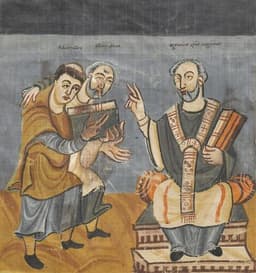
Alcuin of York
Politician · Medieval
53.2Total

Gao Panlong
Politician · Medieval
45.2Total
Basic Information
Born
735
1562
Died
804
1626
Era
Medieval
Medieval
Nationality
Frankish Empire
China
Occupation
Politician
Politician
Civilization
Western
Eastern
Score Comparison
Military (10%)
28.8
43.7
Political (20%)
62.7
37.9
Influence (20%)
65.0
53.3
Legacy (20%)
40.0
46.7
Leadership (15%)
72.0
41.5
Strategy (15%)
38.5
39.2
TOTAL
53.2
45.2
Alcuin of York — Complete Timeline
782 AD
Appointment as Head of the Palace School at AachenCultural◆ Major
Alcuin of York was invited by Charlemagne to lead the Palace School at Aachen. He established a curriculum based on the seven liberal arts, including grammar, rhetoric, and logic. This school became a center of learning and a model for education in the Carolingian Empire.
EducationCarolingian RenaissanceScholarship
Impact: regionalconstructive
789 AD
Compilation of the 'Admonitio Generalis'Cultural
Alcuin contributed to the 'Admonitio Generalis', a set of reforms issued by Charlemagne. The document promoted education, the correction of texts, and the standardization of religious practices. It was a key text of the Carolingian Renaissance, emphasizing the importance of learning.
ReformEducationCarolingian Renaissance
Impact: regionalconstructive
790 AD
Development of the Carolingian Minuscule ScriptCultural◆ Major
Alcuin oversaw the development of the Carolingian minuscule script at the Palace School. This clear, standardized script improved readability and facilitated the copying of manuscripts. It became the standard script in medieval Europe and influenced later handwriting styles.
ScriptManuscriptCarolingian Renaissance
Impact: globalconstructive
800 AD
Correspondence with Charlemagne on Theological MattersCultural
Alcuin engaged in extensive correspondence with Charlemagne on theological and philosophical issues. His letters advised the emperor on matters of doctrine, liturgy, and education. This correspondence helped shape the intellectual climate of the Carolingian court.
CorrespondenceTheologyCarolingian Renaissance
Impact: regionalconstructive
Gao Panlong — Complete Timeline
1604 AD
Co-founded the Donglin AcademyCultural◆ Major
Gao Panlong joined Gu Xiancheng in reestablishing the Donglin Academy in Wuxi. As a leading scholar, he helped shape the academy's curriculum emphasizing moral integrity and political responsibility, making it a hub for critics of Ming court corruption.
Donglin AcademyConfucianismMoral Integrity
Impact: nationalconstructive
1625 AD
Arrested by Wei Zhongxian's AgentsPolitical Action◆ Major
During Wei Zhongxian's purge of Donglin officials, Gao Panlong was arrested by the Eastern Depot. He was imprisoned and subjected to torture, as Wei sought to eliminate all opposition from the Donglin faction.
Wei ZhongxianDonglin PurgeImprisonment
Impact: nationaltragic
1626 AD
Drowned Himself in ProtestPolitical Action
Facing further torture and execution by Wei Zhongxian's eunuch regime, Gao Panlong drowned himself in a pond. His suicide was a protest against the persecution of Donglin scholars and became a symbol of resistance to tyranny in Chinese history.
SuicideProtestDonglinWei Zhongxian
Impact: nationaltragic
Expert Analysis
Origins
Alcuin of York was born around 735 AD into a noble Northumbrian family. He received his education at the cathedral school of York, which had a renowned library amassed by his mentor, Archbishop Ecgbert. Alcuin became a deacon and master of the school, developing expertise in the seven liberal arts. His intellectual reputation reached across Europe.
Gao Panlong was born in 1562 in Wuxi, Jiangsu province, during the late Ming dynasty. He came from a scholarly family and passed the imperial examinations, earning the jinshi degree in 1589. He served in various official posts, including as a censor, but his career was marked by conflicts with powerful eunuchs. His early experiences with corruption shaped his moral rigor.
Rise to Power
Alcuin's rise came through his connection to Charlemagne. In 781, while returning from Rome, Charlemagne met Alcuin in Parma and invited him to lead the Palace School at Aachen. Alcuin accepted and became the emperor's chief advisor on educational and religious matters. He organized the curriculum, attracted scholars, and produced texts that standardized learning. His influence grew as Charlemagne implemented reforms across the empire.
Gao Panlong rose through the Ming bureaucracy but faced setbacks due to his outspoken criticism of the eunuch Wei Zhongxian. In 1605, he retired from office and joined Gu Xiancheng in reestablishing the Donglin Academy in Wuxi (1604). The academy became a center for moral philosophy and political criticism. Gao's writings and lectures attracted a following of like-minded officials, forming the Donglin movement. The movement gained influence but also enmity from the eunuch faction.
Leadership & Governance
Alcuin's leadership was intellectual and advisory. He did not hold formal political office but shaped policy through his influence on Charlemagne. He advocated for educational reform, including the Admonitio Generalis (789), which required bishops to establish schools. Alcuin also oversaw the development of the Carolingian minuscule script, a clear, standardized handwriting that improved textual transmission. His approach was top-down, leveraging imperial authority to spread learning.
Gao Panlong's leadership was moral and confrontational. As a Donglin scholar, he emphasized ethical governance and criticized corruption. He believed in remonstrating with the emperor and opposing eunuch power. However, his movement lacked military or institutional power. When Wei Zhongxian launched a purge in 1625, Gao was arrested, tortured, and eventually drowned himself in a pond in 1626 to protest the persecution. His governance style was principled but ultimately ineffective against raw power.
Triumph & Tragedy
Alcuin's greatest triumph was the Carolingian Renaissance, a revival of learning that preserved classical texts and established educational standards. He compiled liturgical books, corrected the Vulgate Bible, and wrote numerous letters and treatises. His work directly influenced the development of medieval European education. However, his reforms were limited in scope; after his death in 804, the Renaissance waned. His political influence was dependent on Charlemagne's favor.
Gao Panlong's triumph was the creation of the Donglin Academy, which became a symbol of moral resistance. His suicide was a powerful act of protest that inspired later generations. However, the Donglin movement was crushed: many members were executed or exiled, and the academy was destroyed. Gao's tragedy was that his principled stand did not change the political system; the Ming dynasty continued its decline, and eunuch power persisted until the dynasty's fall in 1644.
Character & Destiny
Alcuin was pragmatic and diplomatic, focused on building institutions and spreading knowledge. He avoided direct political conflict and maintained good relations with Charlemagne and other nobles. His character was that of a scholar-advisor who shaped policy through persuasion. His destiny was to be remembered as a founder of medieval education, but his impact was tied to the Carolingian court's stability.
Gao Panlong was idealistic and uncompromising. He prioritized moral integrity over political survival. His decision to drown himself reflected a commitment to principle even in death. Historians often view him as a martyr, but his rigidity contributed to his failure. He scored 41.5 in leadership versus Alcuin's 72.0, indicating less ability to navigate power structures. His destiny was to become a symbol of resistance rather than a reformer who achieved systemic change.
Legacy
Alcuin's legacy is foundational. The Carolingian minuscule script became the basis for modern Western handwriting. His curriculum of the seven liberal arts influenced education for centuries. He is credited with preserving many classical texts. However, his legacy score of 40.0 reflects that his direct impact diminished after his era. Nonetheless, he is recognized as a key figure in the transmission of knowledge.
Gao Panlong's legacy is symbolic. He is revered in Chinese history as a model of Confucian integrity. The Donglin Academy was later rebuilt and remains a historical site. His story is taught as an example of resistance against tyranny. Yet his legacy score of 46.7 is slightly higher than Alcuin's, possibly because his sacrifice resonates in Chinese collective memory. However, his political and institutional impact was minimal.
Conclusion
Alcuin of York had greater overall impact. His total score of 53.2 versus Gao's 45.2 reflects his effectiveness in shaping education and culture across Europe. Alcuin's reforms were institutionalized and lasted beyond his lifetime, while Gao's martyrdom, though powerful, did not alter the Ming political system. Alcuin's work in standardizing script and curriculum had practical, enduring effects. Therefore, Alcuin is the more historically significant figure.
Rankings
🥇
Alcuin of YorkLeader
Mil: 28.8Pol: 62.7Inf: 65.0
53.2
🥈
Gao Panlong
Mil: 43.7Pol: 37.9Inf: 53.3
45.2
+8.0 behind
How This Comparison Works
Algorithm
Each figure is scored on 6 dimensions (0—100 scale) based on structured historical data: Military (10%), Political (20%), Influence (20%), Legacy (20%), Leadership (15%), Strategy (15%). The weighted total produces the final ranking.
Data Sources
Scores are computed from structured sub-indicators in the database. Scale factors adjust for era (Ancient ×0.85, Modern ×1.0) and civilization size (Eastern ×1.05, Other ×0.80) to account for differences in population and military scale.
Maximum 3 Figures
Comparisons are limited to 2—3 figures to ensure readability and statistical meaningfulness.
Error Margins
±5 points per dimension — Sub-scores are derived from historical records with inherent uncertainty. Two figures within 5 points on a dimension should be considered roughly equivalent in that area.
Total Score Accuracy
±3 points overall — The weighted combination of 6 dimensions produces a total score with approximately ±3 points of uncertainty. Differences of less than 3 points are not statistically significant— the figures are effectively tied.
Known Limitations
- Historical records are incomplete and uneven across civilizations
- Figures from oral-tradition societies may be underrepresented
- Occupation labels can misclassify multi-role figures
- Scores measure capability and impact, not moral character
- Quantitative scoring is a comparison tool, not absolute truth
Capability Radar
Military (10%) — Battles & Warfare
Battles
36
41
Win Rate
42
42
Expansion
43
42
Political (20%) — Governance & Reform
Reform
85
30
Diplomacy
75
25
Economy
60
15
Influence (20%) — Cultural & Global Reach
Cultural
85
40
Global
65
20
Legacy (20%) — Historical Impact
Historical
80
45
Longevity
75
35
Leadership (15%) — Power & Stability
Tenure
40
20
Stability
70
10
Strategy (15%) — Tactics & Innovation
Strategy
47
47
Tactics
51
52
Reform
53
51
Similar Comparisons
Comments & Discussion
No comments yet. Be the first to share your thoughts!