Loading...
Alcuin of York vs Liu Jin
Alcuin of York leads by 13.0 pts · 2 figures compared
…
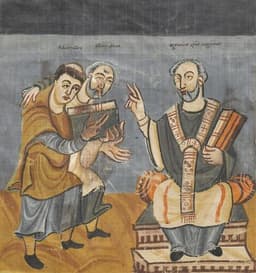
Alcuin of York
Politician · Medieval
53.2Total

Liu Jin
Politician · Medieval
40.2Total
Basic Information
Born
735
1451
Died
804
1510
Era
Medieval
Medieval
Nationality
Frankish Empire
China
Occupation
Politician
Politician
Civilization
Western
Eastern
Score Comparison
Military (10%)
28.8
34.6
Political (20%)
62.7
30.8
Influence (20%)
65.0
46.3
Legacy (20%)
40.0
36.7
Leadership (15%)
72.0
51.9
Strategy (15%)
38.5
36.2
TOTAL
53.2
40.2
Alcuin of York — Complete Timeline
782 AD
Appointment as Head of the Palace School at AachenCultural◆ Major
Alcuin of York was invited by Charlemagne to lead the Palace School at Aachen. He established a curriculum based on the seven liberal arts, including grammar, rhetoric, and logic. This school became a center of learning and a model for education in the Carolingian Empire.
EducationCarolingian RenaissanceScholarship
Impact: regionalconstructive
789 AD
Compilation of the 'Admonitio Generalis'Cultural
Alcuin contributed to the 'Admonitio Generalis', a set of reforms issued by Charlemagne. The document promoted education, the correction of texts, and the standardization of religious practices. It was a key text of the Carolingian Renaissance, emphasizing the importance of learning.
ReformEducationCarolingian Renaissance
Impact: regionalconstructive
790 AD
Development of the Carolingian Minuscule ScriptCultural◆ Major
Alcuin oversaw the development of the Carolingian minuscule script at the Palace School. This clear, standardized script improved readability and facilitated the copying of manuscripts. It became the standard script in medieval Europe and influenced later handwriting styles.
ScriptManuscriptCarolingian Renaissance
Impact: globalconstructive
800 AD
Correspondence with Charlemagne on Theological MattersCultural
Alcuin engaged in extensive correspondence with Charlemagne on theological and philosophical issues. His letters advised the emperor on matters of doctrine, liturgy, and education. This correspondence helped shape the intellectual climate of the Carolingian court.
CorrespondenceTheologyCarolingian Renaissance
Impact: regionalconstructive
Liu Jin — Complete Timeline
1505 AD
Became chief eunuch of the Zhengde EmperorPolitical Action◆ Major
Liu Jin gained the trust of the young Zhengde Emperor and became the most powerful eunuch in the court. He controlled access to the emperor and used his position to amass wealth and eliminate rivals.
Ming DynastyEunuchZhengde Reign
Impact: nationaldestructive
1506 AD
Established the Eastern DepotPolitical Action◆ Major
Liu Jin revived and expanded the Eastern Depot, a secret police force under eunuch control. He used it to spy on officials and suppress dissent, creating a climate of fear in the Ming court.
Ming DynastySecret PoliceEastern Depot
Impact: nationaldestructive
1510 AD
Executed by slow slicingPolitical Action◆ Major
After a rebellion against his rule, Liu Jin was arrested and sentenced to death by slow slicing. His execution marked the end of his dominance and was carried out publicly in Beijing.
Ming DynastyExecutionEunuch
Impact: nationaltragic
Expert Analysis
Origins
Alcuin of York (c. 735–804) was born into a noble Northumbrian family in England. Educated at the cathedral school of York, he became a deacon and master of the school, where he developed a deep knowledge of the seven liberal arts. His early life was shaped by the intellectual tradition of Bede and the Northumbrian Renaissance.
Liu Jin (1451–1510) was born in Xingping, Shaanxi, China. He entered the Ming imperial palace as a eunuch, likely from a poor family. He rose through the eunuch hierarchy by serving the Hongzhi Emperor, but his real ascent began under the Zhengde Emperor, whom he tutored and entertained.
Rise to Power
Alcuin's rise came through his reputation as a scholar. In 781, on a trip to Rome, he met Charlemagne in Parma and was invited to lead the Palace School at Aachen. He became the emperor's chief advisor on religious and educational matters, wielding influence through intellectual authority rather than political maneuvering. His key turning point was the establishment of the Palace School, which attracted scholars from across Europe.
Liu Jin gained power by ingratiating himself with the young Zhengde Emperor, who ascended in 1505. He became chief eunuch in 1506, controlling access to the emperor and manipulating palace affairs. He revived the Eastern Depot, a secret police force, to spy on officials and eliminate rivals. His power peaked around 1508, when he effectively ruled the empire through the emperor's indulgence.
Leadership & Governance
Alcuin's leadership was educational and reformist. He designed the curriculum at the Palace School based on the trivium (grammar, rhetoric, logic) and quadrivium (arithmetic, geometry, music, astronomy). He oversaw the development of Carolingian minuscule script, which standardized handwriting and facilitated communication across the empire. He also compiled the 'Admonitio Generalis' (789), a set of reforms promoting education, correct texts, and clerical morality. His governance was indirect, shaping policy through Charlemagne.
Liu Jin's governance was authoritarian and corrupt. He used the Eastern Depot to imprison and torture officials who opposed him, demanding bribes and crushing dissent. He imposed heavy taxes and confiscated land for his own benefit. He also attempted military campaigns against Mongol tribes but failed due to incompetence. His rule created widespread fear and resentment among the bureaucracy and populace.
Triumph & Tragedy
Alcuin's greatest triumph was the Carolingian Renaissance, which revived learning and culture in Western Europe. His educational reforms laid the groundwork for medieval universities. He also produced numerous theological works and letters that influenced church doctrine. His tragedy was that much of his work was undone by later Viking invasions and political instability, and he died in 804 seeing only partial success.
Liu Jin's triumph was his absolute control over the Ming court from 1506 to 1510. He amassed immense wealth and power, with even high officials bowing to him. His tragedy came in 1510 when a rebellion by Prince Zhu Chenhao (which he had provoked) was crushed, and the emperor turned against him. He was arrested, tried, and executed by slow slicing (lingchi), a gruesome death that symbolized his fall. His legacy is one of corruption and tyranny.
Character & Destiny
Alcuin was a devout scholar, known for his piety, humility, and dedication to learning. He maintained good relations with Charlemagne and other scholars, avoiding political intrigue. His character led him to become a trusted advisor and educator, but his lack of ambition limited his direct political power. He scored 72.0 in leadership, reflecting his ability to inspire and organize.
Liu Jin was ambitious, cunning, and ruthless. He exploited the emperor's trust for personal gain, showing no scruples in eliminating enemies. His character led to his rise but also his downfall, as his tyranny united opposition. He scored 51.9 in leadership, indicating his skill in manipulation but failure in sustainable governance.
Legacy
Alcuin's legacy endures through the Carolingian minuscule, which evolved into modern Latin scripts, and his educational reforms that influenced Western education for centuries. He is remembered as a key figure in the preservation of classical knowledge. His influence score of 65.0 reflects his lasting impact on European culture.
Liu Jin's legacy is negative: he is remembered as a corrupt eunuch who epitomized the abuses of eunuch power in Ming China. His Eastern Depot set a precedent for secret police that continued under later emperors. His influence score of 46.3 indicates his impact was significant but largely destructive. He is often cited as a cautionary tale in Chinese history.
Conclusion
Alcuin of York had a greater and more positive impact than Liu Jin. His total score of 53.2 versus Liu Jin's 40.2 reflects his superior contributions in political, influence, and leadership categories. While Liu Jin wielded more immediate power, his rule was short-lived and destructive. Alcuin's work shaped European education and culture for centuries, while Liu Jin's legacy is one of corruption and failure. The scholar's enduring influence on literacy and learning far outweighs the eunuch's temporary tyranny.
Rankings
🥇
Alcuin of YorkLeader
Mil: 28.8Pol: 62.7Inf: 65.0
53.2
🥈
Liu Jin
Mil: 34.6Pol: 30.8Inf: 46.3
40.2
+13.0 behind
How This Comparison Works
Algorithm
Each figure is scored on 6 dimensions (0—100 scale) based on structured historical data: Military (10%), Political (20%), Influence (20%), Legacy (20%), Leadership (15%), Strategy (15%). The weighted total produces the final ranking.
Data Sources
Scores are computed from structured sub-indicators in the database. Scale factors adjust for era (Ancient ×0.85, Modern ×1.0) and civilization size (Eastern ×1.05, Other ×0.80) to account for differences in population and military scale.
Maximum 3 Figures
Comparisons are limited to 2—3 figures to ensure readability and statistical meaningfulness.
Error Margins
±5 points per dimension — Sub-scores are derived from historical records with inherent uncertainty. Two figures within 5 points on a dimension should be considered roughly equivalent in that area.
Total Score Accuracy
±3 points overall — The weighted combination of 6 dimensions produces a total score with approximately ±3 points of uncertainty. Differences of less than 3 points are not statistically significant— the figures are effectively tied.
Known Limitations
- Historical records are incomplete and uneven across civilizations
- Figures from oral-tradition societies may be underrepresented
- Occupation labels can misclassify multi-role figures
- Scores measure capability and impact, not moral character
- Quantitative scoring is a comparison tool, not absolute truth
Capability Radar
Military (10%) — Battles & Warfare
Battles
36
38
Win Rate
42
40
Expansion
43
44
Political (20%) — Governance & Reform
Reform
85
20
Diplomacy
75
15
Economy
60
10
Influence (20%) — Cultural & Global Reach
Cultural
85
10
Global
65
5
Legacy (20%) — Historical Impact
Historical
80
20
Longevity
75
10
Leadership (15%) — Power & Stability
Tenure
40
40
Stability
70
5
Strategy (15%) — Tactics & Innovation
Strategy
47
48
Tactics
51
53
Reform
53
52
Similar Comparisons
Comments & Discussion
No comments yet. Be the first to share your thoughts!