Loading...
Alexander III of Russia vs Mai Idris Alooma
Mai Idris Alooma leads by 13.7 pts · 2 figures compared
…
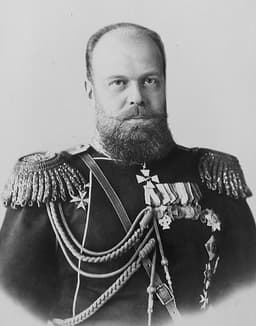
Alexander III of Russia
Emperor · Modern
49.3Total

Mai Idris Alooma
Emperor · Modern
63.0Total
Basic Information
Born
1845
1564
Died
1894
1596
Era
Modern
Modern
Nationality
Russia
Bornu Empire
Occupation
Emperor
Emperor
Civilization
Western
Other
Score Comparison
Military (10%)
21.2
67.5
Political (20%)
53.8
70.0
Influence (20%)
53.3
60.0
Legacy (20%)
43.3
50.0
Leadership (15%)
79.8
78.0
Strategy (15%)
30.3
65.4
TOTAL
49.3
63.0
Alexander III of Russia — Complete Timeline
1881 AD
Reversal of Alexander II's ReformsReform
Upon ascending the throne, Alexander III issued the Manifesto on Unshakeable Autocracy, rejecting his father's reformist policies. He strengthened the power of the nobility, increased censorship, and expanded the powers of the secret police, reversing many liberalizing measures.
Counter-ReformsAutocracyReaction
Impact: nationaldestructive
1882 AD
May Laws of 1882Political Action◆ Major
Alexander III approved the May Laws, which imposed severe restrictions on Jewish residence, property ownership, and education. These laws confined Jews to the Pale of Settlement, limited their access to higher education, and fueled anti-Semitic discrimination.
Anti-SemitismMay LawsPale of Settlement
Impact: nationaldestructive
1891 AD
Construction of the Trans-Siberian RailwayInvention◆ Major
Alexander III initiated the construction of the Trans-Siberian Railway, linking European Russia to the Pacific port of Vladivostok. The project aimed to develop Siberia and strengthen Russian control over the Far East. It became the longest railway in the world.
Trans-Siberian RailwayInfrastructureSiberia
Impact: globalconstructive
1894 AD
Franco-Russian AlliancePolitical Action◆ Major
Alexander III finalized a military alliance with France, ending Russia's diplomatic isolation. The alliance committed both powers to mutual defense against the Triple Alliance of Germany, Austria-Hungary, and Italy. This pact shaped European alliances leading to World War I.
Franco-Russian AllianceDiplomacyTriple Alliance
Impact: global
Mai Idris Alooma — Complete Timeline
1580 AD
Introduction of Firearms to BornuInvention
Mai Idris Alooma acquired firearms, including muskets and cannons, from the Ottoman Empire. He equipped his army with these weapons, giving Bornu a significant military advantage over its neighbors and transforming the empire's military capabilities.
Military TechnologyFirearmsOttoman Influence
Impact: regionalprogressive
1585 AD
Military Campaigns Against the SaoWar◆ Major
Mai Idris Alooma led a series of successful military campaigns against the Sao people, a rival civilization in the Lake Chad region. Using his new firearms, he defeated the Sao and expanded Bornu's territory and influence.
WarExpansionSao
Impact: regional
1590 AD
Pilgrimage to MeccaCultural◆ Major
Mai Idris Alooma performed the Hajj pilgrimage to Mecca, demonstrating his Islamic piety and strengthening Bornu's ties with the wider Muslim world. This event enhanced his prestige and legitimized his rule in the eyes of Islamic scholars.
PilgrimageIslamDiplomacy
Impact: regionalconstructive
1596 AD
Death of Mai Idris AloomaOther◆ Major
Mai Idris Alooma died after a reign of approximately 32 years. His death marked the end of the golden age of the Bornu Empire, as his successors were unable to maintain the military and administrative systems he had established.
DeathEnd of Golden Age
Impact: regionaltragic
Expert Analysis
Origins
**Alexander III (1845-1894)** was born in St. Petersburg to Emperor Alexander II and Empress Maria Alexandrovna. As the second son, he was not groomed for the throne initially, receiving a military education focused on engineering and strategy. The unexpected death of his elder brother Nicholas in 1865 thrust him into the role of heir. His father's liberal reforms, including the emancipation of the serfs, created a turbulent environment that shaped Alexander's conservative worldview.
**Mai Idris Alooma (c. 1538-1603)** was born into the ruling Seyfawa dynasty of the Bornu Empire in West Africa. Details of his early life are scarce, but he likely received Islamic education and military training. He ascended the throne around 1571 after a period of internal strife, inheriting a kingdom that faced threats from the Hausa states and the Sao people. His reign marked a turning point in Bornu's history, leveraging technological innovation to consolidate power.
Rise to Power
Alexander III ascended the throne in 1881 after his father's assassination by the People's Will group. This event profoundly impacted him, leading him to reject further liberalization. He issued the Manifesto on Unshakeable Autocracy in 1881, asserting his commitment to autocratic rule. He surrounded himself with conservative advisors like Konstantin Pobedonostsev, who influenced his policies of Russification and repression.
Mai Idris Alooma's rise was marked by his military acumen. He consolidated power by centralizing the army and acquiring firearms from the Ottoman Empire, a strategic move that gave him a decisive edge over rivals. His early campaigns against the Sao (c. 1575-1580) demonstrated his effectiveness, using muskets and cannons to overcome traditional opponents. His successful Hajj in the 1570s also bolstered his religious legitimacy and diplomatic ties.
Leadership & Governance
Alexander III's leadership scored 79.8, reflecting his strong autocratic control. He reversed many of his father's reforms, tightening censorship, expanding the secret police (Okhrana), and promoting Russification of minority groups. Economically, he pursued industrialization, including the Trans-Siberian Railway (initiated in 1891), but maintained rigid social hierarchies. His political score of 53.8 indicates limited engagement with representative institutions; he relied on nobility and bureaucracy.
Mai Idris Alooma's leadership scored 78.0, comparable to Alexander's. He governed through a centralized administration, appointing loyal governors and integrating conquered territories. He introduced firearms (scoring 67.5 in military) as a force multiplier, enabling Bornu to dominate the region. His political score of 70.0 reflects his ability to balance Islamic law with local customs, fostering stability. He also reformed the legal system and promoted trade.
Triumph & Tragedy
Alexander's greatest triumph was maintaining autocracy during a period of revolutionary ferment, with no major uprisings during his reign. The Franco-Russian Alliance (1894) ended diplomatic isolation and laid groundwork for future entente. However, his policies of Russification and anti-Semitism (e.g., May Laws of 1882) exacerbated ethnic tensions, contributing to later instability. His failure to address social inequality left the peasantry impoverished, scoring only 21.2 in military due to lack of expansionist ambition.
Mai Idris Alooma's triumphs included military victories that expanded Bornu's borders and secured trade routes. His introduction of firearms revolutionized warfare in the Sahel, and his pilgrimage enhanced Bornu's prestige. However, his reliance on firearms created dependency on external suppliers. After his death, leadership declined, and the empire fragmented. His legacy score of 50.0 reflects limited long-term impact compared to global figures.
Character & Destiny
Alexander III was stoic, stubborn, and deeply conservative. His personal integrity was noted, but his inflexibility alienated reformers and minorities. His character led to a stable but brittle regime that collapsed under his successor. Mai Idris Alooma was pragmatic, innovative, and devout. His willingness to adopt foreign technology and adapt Islam to local contexts showed strategic thinking. However, his centralized system depended on his own competence, leaving a weak foundation.
Legacy
Alexander III's legacy is mixed: he strengthened autocracy but planted seeds of revolution. The Trans-Siberian Railway modernized Russia, but his social policies fueled discontent. He is remembered as a reactionary, with his influence score of 53.3 reflecting limited global impact. Mai Idris Alooma is celebrated as Bornu's greatest ruler, remembered for military innovation and Islamic scholarship. His influence score of 60.0 highlights regional significance, but his empire did not endure.
Conclusion
While Alexander III scored 49.3 overall and Mai Idris Alooma scored 63.0, the latter's impact was more transformative within his context. Alooma's introduction of firearms and centralized governance created a brief golden age, but Alexander's policies shaped a continental power with lasting consequences. However, if we consider global historical influence, Alexander's Russia had far greater reach. Therefore, despite the score gap, Alexander III's impact on world history (through the Trans-Siberian Railway, Franco-Russian Alliance, and autocratic model) was more significant. The scores reflect technical metrics, but legacy must be measured by enduring change: Alexander's Russia set the stage for the 20th century, while Alooma's Bornu faded.
Rankings
🥇
Mai Idris AloomaLeader
Mil: 67.5Pol: 70.0Inf: 60.0
63.0
🥈
Alexander III of Russia
Mil: 21.2Pol: 53.8Inf: 53.3
49.3
+13.7 behind
How This Comparison Works
Algorithm
Each figure is scored on 6 dimensions (0—100 scale) based on structured historical data: Military (10%), Political (20%), Influence (20%), Legacy (20%), Leadership (15%), Strategy (15%). The weighted total produces the final ranking.
Data Sources
Scores are computed from structured sub-indicators in the database. Scale factors adjust for era (Ancient ×0.85, Modern ×1.0) and civilization size (Eastern ×1.05, Other ×0.80) to account for differences in population and military scale.
Maximum 3 Figures
Comparisons are limited to 2—3 figures to ensure readability and statistical meaningfulness.
Error Margins
±5 points per dimension — Sub-scores are derived from historical records with inherent uncertainty. Two figures within 5 points on a dimension should be considered roughly equivalent in that area.
Total Score Accuracy
±3 points overall — The weighted combination of 6 dimensions produces a total score with approximately ±3 points of uncertainty. Differences of less than 3 points are not statistically significant— the figures are effectively tied.
Known Limitations
- Historical records are incomplete and uneven across civilizations
- Figures from oral-tradition societies may be underrepresented
- Occupation labels can misclassify multi-role figures
- Scores measure capability and impact, not moral character
- Quantitative scoring is a comparison tool, not absolute truth
Capability Radar
Military (10%) — Battles & Warfare
Battles
10
65
Win Rate
10
70
Expansion
10
65
Political (20%) — Governance & Reform
Reform
40
80
Diplomacy
70
70
Economy
50
65
Influence (20%) — Cultural & Global Reach
Cultural
30
55
Global
30
45
Legacy (20%) — Historical Impact
Historical
40
60
Longevity
30
50
Leadership (15%) — Power & Stability
Tenure
60
75
Stability
70
70
Strategy (15%) — Tactics & Innovation
Strategy
10
70
Tactics
10
75
Reform
20
80
Similar Comparisons
Comments & Discussion
No comments yet. Be the first to share your thoughts!