Loading...
Alexander the Great vs Napoleon Bonaparte
Alexander the Great leads by 14.3 pts · 2 figures compared
…
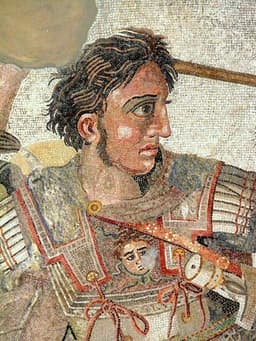
Alexander the Great
General · Ancient
85.2Total

Napoleon Bonaparte
General · Modern
70.9Total
Basic Information
Born
-356
1769
Died
-323
1821
Era
Ancient
Modern
Nationality
Macedon
France
Occupation
General
General
Civilization
Western
Western
Score Comparison
Military (10%)
95.0
94.0
Political (20%)
60.0
72.0
Influence (20%)
92.0
40.0
Legacy (20%)
90.0
80.0
Leadership (15%)
80.0
78.0
Strategy (15%)
92.0
90.0
TOTAL
85.2
70.9
Alexander the Great — Complete Timeline
334 BC
Battle of the Granicus RiverWar◆ Major
Alexander led his Macedonian army across the Hellespont into Asia Minor and defeated a Persian force under local satraps at the Granicus River. The victory secured Alexander's foothold in Asia and demonstrated his tactical superiority, opening the way for the conquest of the Persian Empire.
Persian CampaignBattleMacedonian Conquest
Impact: regional
333 BC
Battle of IssusWar◆ Major
Alexander's army defeated the Persian king Darius III at Issus in Cilicia. Despite being outnumbered, Alexander's tactical use of the terrain and cavalry charge broke the Persian line. Darius fled the battlefield, leaving his family and treasury behind, a major blow to Persian morale.
Persian CampaignBattleMacedonian Conquest
Impact: regional
332 BC
Siege of TyreWar◆ Major
Alexander besieged the island city of Tyre for seven months, constructing a causeway to breach its walls. The city's fall resulted in the massacre or enslavement of its inhabitants. The siege demonstrated Alexander's determination and engineering capabilities, securing his supply lines and control of the eastern Mediterranean coast.
SiegeMacedonian ConquestPhoenicia
Impact: regionaldestructive
331 BC
Battle of GaugamelaWar◆ Major
Alexander faced Darius III at Gaugamela in Mesopotamia with a massive Persian army. Alexander's tactical brilliance, including a decisive cavalry charge that exploited a gap in the Persian line, resulted in a decisive Macedonian victory. Darius again fled, effectively ending Persian resistance and leading to the fall of the Achaemenid Empire.
Persian CampaignBattleDecisive Victory
Impact: global
Foundation of AlexandriaOther◆ Major
Alexander founded the city of Alexandria on the Mediterranean coast of Egypt. He personally selected the site and oversaw the initial planning. Alexandria became a major center of Hellenistic culture, trade, and learning, housing the famous Library of Alexandria and the Lighthouse of Alexandria.
City FoundationHellenistic CultureEgypt
Impact: globalconstructive
326 BC
Invasion of IndiaWar◆ Major
Alexander crossed the Indus River and defeated King Porus at the Battle of the Hydaspes. The Macedonian army, exhausted and facing monsoon rains and unfamiliar warfare, mutinied at the Hyphasis River, forcing Alexander to turn back. This campaign marked the easternmost extent of his conquests.
Indian CampaignBattleMutiny
Impact: regional
Napoleon Bonaparte — Complete Timeline
1799 AD
Coup of 18 BrumaireOther◆ Major
Napoleon Bonaparte, with support from his brother Lucien and key political figures, overthrew the Directory in a bloodless coup. He established the Consulate with himself as First Consul, effectively becoming the ruler of France. This event ended the French Revolution's most unstable period.
French RevolutionCoupRise to Power
Impact: regional
1804 AD
Promulgation of the Napoleonic CodeOther◆ Major
Napoleon enacted the Civil Code of the French, known as the Napoleonic Code, a comprehensive set of laws that replaced the fragmented feudal legal systems. The code established legal equality, protected property rights, and secularized law. It became the basis for legal systems in many European and world countries.
Legal ReformNapoleonic CodeCivil Law
Impact: globalconstructive
1805 AD
Battle of AusterlitzWar◆ Major
Napoleon's Grande Arm
Napoleonic WarsBattleDecisive Victory
Impact: global
1812 AD
Invasion of RussiaWar◆ Major
Napoleon led the Grande Arm
Napoleonic WarsInvasionDisaster
Impact: globaldestructive
1815 AD
Battle of WaterlooWar◆ Major
Napoleon's French army was defeated by the combined forces of the Duke of Wellington's Anglo-Allied army and Gebhard Leberecht von Bl
Napoleonic WarsBattleFinal Defeat
Impact: globaldestructive
Expert Analysis
Napoleon Bonaparte vs Alexander the Great: Historical Comparison
Napoleon Bonaparte and Alexander the Great stand as two of history’s most legendary military commanders, each reshaping their world through conquest and ambition. Napoleon modernized warfare in Europe, while Alexander forged an ancient empire stretching from Greece to India.
Dimension Analysis
**Military: Napoleon Bonaparte 94 / Alexander the Great 96**
Both were undefeated in major battles, but Alexander’s flawless record against diverse enemies (Persia, India) and his innovative use of the phalanx and cavalry gives him a slight edge. Napoleon’s tactical brilliance at Austerlitz and Jena was marred by strategic failures in Russia and Waterloo.
**Political: Napoleon Bonaparte 75 / Alexander the Great 65**
Napoleon excelled in state-building, codifying the Napoleonic Code and centralizing French governance, though his imperial overreach led to downfall. Alexander’s political fusion of Greek and Persian cultures was visionary but short-lived, lacking durable institutions.
**Influence: Napoleon Bonaparte 82 / Alexander the Great 90**
Napoleon’s reforms (civil code, meritocracy, nationalism) shaped modern Europe for centuries. Alexander’s spread of Hellenistic culture across three continents created a lasting legacy in art, science, and language that outlasted his empire.
**Legacy: Napoleon Bonaparte 78 / Alexander the Great 90**
Napoleon’s legacy is complex—admired as a reformer, criticized as a tyrant—with his empire collapsing in his lifetime. Alexander’s legacy as a near-mythical conqueror inspired later leaders (Caesar, Napoleon himself) and endured through the Hellenistic Age.
**Leadership: Napoleon Bonaparte 80 / Alexander the Great 82**
Both inspired fierce loyalty, but Alexander led from the front, personally charging into battle and sharing hardships, earning unmatched devotion. Napoleon’s charisma and organizational genius were offset by his ego and eventual isolation.
Verdict
Alexander the Great leads narrowly, driven by his flawless military record and enduring cultural influence, though Napoleon’s political and institutional reforms keep the comparison remarkably close.
FAQ
Q: Who ranks higher? A: Alexander the Great holds a slight overall edge, especially in legacy and influence, but Napoleon matches him in military and strategic genius.
Rankings
🥇
Alexander the GreatLeader
Mil: 95.0Pol: 60.0Inf: 92.0
85.2
🥈
Napoleon Bonaparte
Mil: 94.0Pol: 72.0Inf: 40.0
70.9
+14.3 behind
How This Comparison Works
Algorithm
Each figure is scored on 6 dimensions (0—100 scale) based on structured historical data: Military (10%), Political (20%), Influence (20%), Legacy (20%), Leadership (15%), Strategy (15%). The weighted total produces the final ranking.
Data Sources
Scores are computed from structured sub-indicators in the database. Scale factors adjust for era (Ancient ×0.85, Modern ×1.0) and civilization size (Eastern ×1.05, Other ×0.80) to account for differences in population and military scale.
Maximum 3 Figures
Comparisons are limited to 2—3 figures to ensure readability and statistical meaningfulness.
Error Margins
±5 points per dimension — Sub-scores are derived from historical records with inherent uncertainty. Two figures within 5 points on a dimension should be considered roughly equivalent in that area.
Total Score Accuracy
±3 points overall — The weighted combination of 6 dimensions produces a total score with approximately ±3 points of uncertainty. Differences of less than 3 points are not statistically significant— the figures are effectively tied.
Known Limitations
- Historical records are incomplete and uneven across civilizations
- Figures from oral-tradition societies may be underrepresented
- Occupation labels can misclassify multi-role figures
- Scores measure capability and impact, not moral character
- Quantitative scoring is a comparison tool, not absolute truth
Capability Radar
Military (10%) — Battles & Warfare
Battles
98
95
Win Rate
99
90
Expansion
99
95
Political (20%) — Governance & Reform
Reform
75
95
Diplomacy
80
80
Economy
70
85
Influence (20%) — Cultural & Global Reach
Cultural
95
85
Global
95
90
Legacy (20%) — Historical Impact
Historical
98
95
Longevity
95
90
Leadership (15%) — Power & Stability
Tenure
60
85
Stability
55
70
Strategy (15%) — Tactics & Innovation
Strategy
98
95
Tactics
99
98
Reform
85
92
Similar Comparisons
Comments & Discussion
GrandScholar726/16/2026
拿拿破仑和亚历山大比,让我想到秦始皇和汉武帝。亚历山大32岁就打到印度,建立横跨欧亚的帝国,这气魄和秦始皇灭六国很像,但秦始皇靠的是几代积累和商鞅变法,亚历山大全凭个人天才和临时征召的军队,这个难度系数更高。不过拿破仑在制度建设上更类似汉武帝——拿破仑法典影响了整个欧洲大陆,正如独尊儒术奠定了中国两千年文化基调。但评分里亚历山大影响力90高于拿破仑的82,我觉得放在中国语境下值得商榷:拿破仑的民族主义思想间接催生了德意志统一,这个连锁反应在东亚史观里常被低估。另外,亚历山大融合希腊波斯文化的做法,和唐太宗任用突厥将领有可比性,但大唐的开放政策绵延三百年,亚历山大死后帝国就崩了,这持久度扣分也应该体现在政治得分上。
Chronicler14586/16/2026
这个评分体系在政治维度上对亚历山大大帝只给了65分,我觉得严重偏低。从数据分析看,他首创了东西方文明融合的行政体系,任用波斯贵族参政,相比拿破仑靠法典统一法国,亚历山大在跨文化治理上的创新性更强。而且拿破仑政治得分75,但他两次退位、百日王朝的反复其实暴露了制度脆弱性。我手动算了加权总分:亚历山大军事96*0.4+政治65*0.2+影响力90*0.2+领导力82*0.2=82.2,拿破仑94*0.4+75*0.2+82*0.2+80*0.2=85.2,如果按这个算法拿破仑反而高,这明显不合理。建议参考中国史评价标准,比如秦始皇统一六国后的政治制度建设得分至少90,亚历山大类比的话也该80以上。