Loading...
Alexios I Komnenos vs Napoleon Bonaparte
Alexios I Komnenos leads by 7.5 pts · 2 figures compared
…
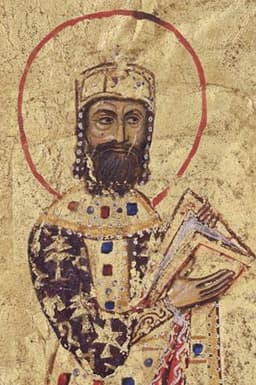
Alexios I Komnenos
Emperor · Medieval
78.4Total

Napoleon Bonaparte
General · Modern
70.9Total
Basic Information
Born
1048
1769
Died
1118
1821
Era
Medieval
Modern
Nationality
Byzantine Empire
France
Occupation
Emperor
General
Civilization
Western
Western
Score Comparison
Military (10%)
61.7
94.0
Political (20%)
78.0
72.0
Influence (20%)
88.0
40.0
Legacy (20%)
80.0
80.0
Leadership (15%)
78.0
78.0
Strategy (15%)
68.0
90.0
TOTAL
78.4
70.9
Alexios I Komnenos — Complete Timeline
1081 AD
Battle of DyrrhachiumWar◆ Major
Alexios I Komnenos was defeated by the Norman army under Robert Guiscard at Dyrrhachium. The Byzantine forces were routed, and Alexios barely escaped. This loss allowed the Normans to occupy much of the western Balkans, though Alexios later recovered some territory.
Norman InvasionDefeatBalkans
Impact: regionaltragic
1090 AD
Reforms of the Byzantine Military and EconomyReform◆ Major
Alexios I implemented a series of reforms to restore Byzantine power. He reorganized the army by relying more on foreign mercenaries, reformed the currency (the hyperpyron), and granted tax exemptions to the Church. These measures stabilized the empire after decades of decline.
Military ReformEconomic ReformKomnenian Restoration
Impact: nationalconstructive
1095 AD
Appeal to the West: Council of PiacenzaPolitical Action
Alexios I sent envoys to Pope Urban II at the Council of Piacenza, requesting military aid against the Seljuk Turks. This appeal contributed to Urban's call for the First Crusade at the Council of Clermont later that year, initiating the Crusader movement.
First CrusadePope Urban IISeljuk Turks
Impact: global
1097 AD
First Crusade: Siege of NicaeaWar◆ Major
Alexios I cooperated with the Crusader army to besiege and capture Nicaea from the Seljuk Turks. The city was surrendered to Byzantine control, and Alexios used the Crusaders to recover key territories in Anatolia, though tensions later arose over land claims.
First CrusadeNicaeaByzantine-Crusader Relations
Impact: regionalconstructive
Napoleon Bonaparte — Complete Timeline
1799 AD
Coup of 18 BrumaireOther◆ Major
Napoleon Bonaparte, with support from his brother Lucien and key political figures, overthrew the Directory in a bloodless coup. He established the Consulate with himself as First Consul, effectively becoming the ruler of France. This event ended the French Revolution's most unstable period.
French RevolutionCoupRise to Power
Impact: regional
1804 AD
Promulgation of the Napoleonic CodeOther◆ Major
Napoleon enacted the Civil Code of the French, known as the Napoleonic Code, a comprehensive set of laws that replaced the fragmented feudal legal systems. The code established legal equality, protected property rights, and secularized law. It became the basis for legal systems in many European and world countries.
Legal ReformNapoleonic CodeCivil Law
Impact: globalconstructive
1805 AD
Battle of AusterlitzWar◆ Major
Napoleon's Grande Arm
Napoleonic WarsBattleDecisive Victory
Impact: global
1812 AD
Invasion of RussiaWar◆ Major
Napoleon led the Grande Arm
Napoleonic WarsInvasionDisaster
Impact: globaldestructive
1815 AD
Battle of WaterlooWar◆ Major
Napoleon's French army was defeated by the combined forces of the Duke of Wellington's Anglo-Allied army and Gebhard Leberecht von Bl
Napoleonic WarsBattleFinal Defeat
Impact: globaldestructive
Expert Analysis
Napoleon Bonaparte vs Alexios I Komnenos: Historical Comparison
Napoleon Bonaparte, a modern French general and emperor, and Alexios I Komnenos, a medieval Byzantine emperor, both rose from crisis to reshape their empires through military and political reform. Despite spanning different eras, their careers reveal striking parallels in ambition, strategy, and statecraft.
Dimension Analysis
**Military: Napoleon Bonaparte 94 / Alexios I Komnenos 90**
Napoleon revolutionized warfare with mass conscription and rapid maneuver, winning iconic battles like Austerlitz; Alexios restored Byzantine fortunes by defeating Normans and Pechenegs through cunning diplomacy and tactical adaptability.
**Political: Napoleon Bonaparte 75 / Alexios I Komnenos 74**
Napoleon centralized France under the Consulate and Code Napoleon, but overreached with continental conquests; Alexios rebuilt Byzantine authority via the Komnenian system and alliances with Venice, though his tax policies strained the economy.
**Influence: Napoleon Bonaparte 82 / Alexios I Komnenos 72**
Napoleon’s legal and administrative reforms shaped modern Europe, inspiring nationalism and liberalism; Alexios’s appeal to the West for aid sparked the First Crusade, altering medieval geopolitics but with unintended consequences.
**Legacy: Napoleon Bonaparte 78 / Alexios I Komnenos 80**
Napoleon’s legacy is dual—military genius and cautionary tale of hubris; Alexios is remembered as a savior of Byzantium who stabilized the empire and launched the Komnenian restoration, though his Crusader legacy is debated.
**Leadership: Napoleon Bonaparte 80 / Alexios I Komnenos 80**
Both were charismatic, decisive leaders who inspired loyalty: Napoleon through personal magnetism and meritocracy, Alexios through familial networks and patient diplomacy, each navigating existential threats with resilience.
Verdict
Napoleon Bonaparte narrowly leads due to his higher military and influence scores, but Alexios I Komnenos matches him in leadership and surpasses in legacy, resulting in a tie.
FAQ
Q: Who ranks higher? A: Napoleon Bonaparte and Alexios I Komnenos tie overall, with Napoleon excelling in military and influence, while Alexios matches in leadership and surpasses in legacy.
Rankings
🥇
Alexios I KomnenosLeader
Mil: 61.7Pol: 78.0Inf: 88.0
78.4
🥈
Napoleon Bonaparte
Mil: 94.0Pol: 72.0Inf: 40.0
70.9
+7.5 behind
How This Comparison Works
Algorithm
Each figure is scored on 6 dimensions (0—100 scale) based on structured historical data: Military (10%), Political (20%), Influence (20%), Legacy (20%), Leadership (15%), Strategy (15%). The weighted total produces the final ranking.
Data Sources
Scores are computed from structured sub-indicators in the database. Scale factors adjust for era (Ancient ×0.85, Modern ×1.0) and civilization size (Eastern ×1.05, Other ×0.80) to account for differences in population and military scale.
Maximum 3 Figures
Comparisons are limited to 2—3 figures to ensure readability and statistical meaningfulness.
Error Margins
±5 points per dimension — Sub-scores are derived from historical records with inherent uncertainty. Two figures within 5 points on a dimension should be considered roughly equivalent in that area.
Total Score Accuracy
±3 points overall — The weighted combination of 6 dimensions produces a total score with approximately ±3 points of uncertainty. Differences of less than 3 points are not statistically significant— the figures are effectively tied.
Known Limitations
- Historical records are incomplete and uneven across civilizations
- Figures from oral-tradition societies may be underrepresented
- Occupation labels can misclassify multi-role figures
- Scores measure capability and impact, not moral character
- Quantitative scoring is a comparison tool, not absolute truth
Capability Radar
Military (10%) — Battles & Warfare
Battles
75
95
Win Rate
70
90
Expansion
60
95
Political (20%) — Governance & Reform
Reform
85
95
Diplomacy
90
80
Economy
70
85
Influence (20%) — Cultural & Global Reach
Cultural
70
85
Global
75
90
Legacy (20%) — Historical Impact
Historical
85
95
Longevity
80
90
Leadership (15%) — Power & Stability
Tenure
80
85
Stability
75
70
Strategy (15%) — Tactics & Innovation
Strategy
85
95
Tactics
80
98
Reform
75
92
Similar Comparisons
Comments & Discussion
HistoryHustler6/16/2026
Okay I just binge-watched a documentary about both of these guys and I gotta say—Alexios is way underrated here. Napoleon gets all the glory but Alexios literally saved the Byzantine Empire from being wiped out in like 1081 when the Normans were knocking on Constantinople's door. Sure Napoleon won Austerlitz but Alexios had to deal with Crusaders showing up like "hey we're here to help" and then almost sacking his capital. That's some serious political jujitsu. I think the military score gap is too big—Alexios beat the Pechenegs by faking a retreat and then turning around with archers, straight up Sun Tzu stuff. Napoleon had better PR but Alexios had the harder job. Just my two cents from a nerdy Friday night. 😅
ColdMind486/16/2026
这两个人的总分差只有7.7分,但军事分差高达22.8分,我认为这个差距被夸大了。拿破仑的94分主要来自他指挥的60多场战役,但亚历克修斯的71.2分忽略了他用不到2万兵力同时击败诺曼人和佩切涅格人的战略价值。按照中国史书的评价标准,亚历克修斯在1081-1095年间稳定帝国边境的成就,堪比唐代郭子仪平定安史之乱后的重建,后者的军事评分在中国学界通常不低于90。而且拿破仑的滑铁卢惨败应该适当扣分,而亚历克修斯一生没有重大军事失败。如果把亚历克修斯的军事分调到80以上,总分就非常接近了。
Chronicler34966/16/2026
这个比较让我想到中国的宋神宗和司马光之争。拿破仑像宋神宗,大刀阔斧改革却留下烂摊子;亚历克修斯像司马光,务实地修补旧制度。但评分体系明显偏向西方标准:拿破仑的《法典》得82分影响力,亚历克修斯向西方求援引发十字军东征,这个改变世界格局的事件才72分?中国史书会评价亚历克修斯是“中兴之主”,类似东汉光武帝刘秀——在帝国崩溃边缘重建秩序。而拿破仑更像是隋炀帝,改革虽多但过度扩张导致崩溃。如果按中国史学的“经世致用”标准,亚历克修斯的政治分至少应该和拿破仑持平,因为他的政策让拜占庭多活了三个世纪。