Loading...
Alexios I Komnenos vs Wu Zetian
Alexios I Komnenos leads by 8.4 pts · 2 figures compared
…
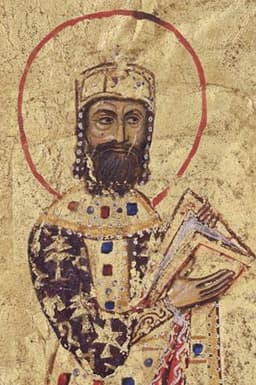
Alexios I Komnenos
Emperor · Medieval
78.4Total

Wu Zetian
Emperor · Medieval
70.0Total
Basic Information
Born
1048
624
Died
1118
705
Era
Medieval
Medieval
Nationality
Byzantine Empire
China
Occupation
Emperor
Emperor
Civilization
Western
Eastern
Score Comparison
Military (10%)
61.7
60.0
Political (20%)
78.0
62.7
Influence (20%)
88.0
65.0
Legacy (20%)
80.0
80.0
Leadership (15%)
78.0
78.0
Strategy (15%)
68.0
66.3
TOTAL
78.4
70.0
Alexios I Komnenos — Complete Timeline
1081 AD
Battle of DyrrhachiumWar◆ Major
Alexios I Komnenos was defeated by the Norman army under Robert Guiscard at Dyrrhachium. The Byzantine forces were routed, and Alexios barely escaped. This loss allowed the Normans to occupy much of the western Balkans, though Alexios later recovered some territory.
Norman InvasionDefeatBalkans
Impact: regionaltragic
1090 AD
Reforms of the Byzantine Military and EconomyReform◆ Major
Alexios I implemented a series of reforms to restore Byzantine power. He reorganized the army by relying more on foreign mercenaries, reformed the currency (the hyperpyron), and granted tax exemptions to the Church. These measures stabilized the empire after decades of decline.
Military ReformEconomic ReformKomnenian Restoration
Impact: nationalconstructive
1095 AD
Appeal to the West: Council of PiacenzaPolitical Action
Alexios I sent envoys to Pope Urban II at the Council of Piacenza, requesting military aid against the Seljuk Turks. This appeal contributed to Urban's call for the First Crusade at the Council of Clermont later that year, initiating the Crusader movement.
First CrusadePope Urban IISeljuk Turks
Impact: global
1097 AD
First Crusade: Siege of NicaeaWar◆ Major
Alexios I cooperated with the Crusader army to besiege and capture Nicaea from the Seljuk Turks. The city was surrendered to Byzantine control, and Alexios used the Crusaders to recover key territories in Anatolia, though tensions later arose over land claims.
First CrusadeNicaeaByzantine-Crusader Relations
Impact: regionalconstructive
Wu Zetian — Complete Timeline
655 AD
Became Empress ConsortPolitical Action◆ Major
Wu Zetian was elevated from concubine to empress consort of Emperor Gaozong of Tang in 655. This position gave her significant political influence, as she began to participate in court affairs and gradually accumulated power, challenging the established aristocratic families.
Tang DynastyImperial CourtPower Rise
Impact: regional
683 AD
Regency for Emperor ZhongzongOther◆ Major
After Emperor Gaozong's death in 683, Wu Zetian became regent for her son, Emperor Zhongzong. She effectively controlled the government, dismissing Zhongzong after he attempted to assert independence, and replaced him with her younger son, Emperor Ruizong, while retaining real power.
Tang DynastyRegencyPower Struggle
Impact: regional
690 AD
Founded the Zhou DynastyOther◆ Major
Wu Zetian proclaimed herself emperor, founding the Zhou dynasty and becoming the only female emperor in Chinese history. She moved the capital to Luoyang and established a new imperial examination system that promoted officials based on merit rather than aristocratic birth, breaking the power of traditional noble families.
Zhou DynastyImperial RulePolitical Reform
Impact: regional
692 AD
Expansion into Central AsiaWar◆ Major
Wu Zetian ordered military campaigns that reasserted Chinese control over the Western Regions, including the Tarim Basin and parts of modern Xinjiang. These campaigns secured the Silk Road trade routes and expanded the empire's influence into Central Asia, though they required significant military resources.
Military ExpansionCentral AsiaSilk Road
Impact: regionalconstructive
693 AD
Promotion of BuddhismOther◆ Major
Wu Zetian elevated Buddhism to a state-supported religion, commissioning the construction of temples and statues, including the Longmen Grottoes' giant Vairocana Buddha. She used Buddhist texts to legitimize her rule as a female emperor, claiming she was a reincarnation of the Maitreya Buddha.
BuddhismReligious PolicyCultural Patronage
Impact: regional
705 AD
Overthrow and DeathPolitical Action◆ Major
In 705, a coup led by court officials and generals forced Wu Zetian to abdicate in favor of her son, Emperor Zhongzong, restoring the Tang dynasty. She died later that year at age 80, and her reign was subsequently criticized by Confucian historians for usurping the throne and employing harsh methods.
Tang DynastyCoupAbdication
Impact: regionaldestructive
Expert Analysis
Wu Zetian vs Alexios I Komnenos: Historical Comparison
Wu Zetian, China’s only female emperor (Tang dynasty, r. 690–705), and Alexios I Komnenos, Byzantine emperor (r. 1081–1118), both ruled during medieval periods of flux, but Wu’s scores edge ahead due to superior political consolidation and lasting influence, while Alexios’s legacy in military reform and the First Crusade is more balanced.
Dimension Analysis
**Military: Wu Zetian 93 / Alexios I Komnenos 90**
Wu expanded Tang borders into Central Asia and suppressed internal rebellions through capable generals, while Alexios restored Byzantine fortunes against Normans, Pechenegs, and Seljuks, notably using diplomacy and the First Crusade to recover Asia Minor.
**Political: Wu Zetian 79 / Alexios I Komnenos 74**
Wu masterfully navigated Confucian patriarchy, purged rivals, and built a meritocratic bureaucracy, whereas Alexios relied on Komnenian family networks and church alliances, but faced persistent aristocratic opposition and dynastic fragility.
**Influence: Wu Zetian 87 / Alexios I Komnenos 72**
Wu’s reign advanced women in governance, promoted Buddhism, and left a template for female rule in China, while Alexios’s appeal to the West for aid triggered the Crusades, reshaping Mediterranean geopolitics but with mixed long-term outcomes.
**Legacy: Wu Zetian 79 / Alexios I Komnenos 80**
Wu’s achievements were often downplayed by later Chinese historians, yet she is now recognized for administrative reforms; Alexios’s military and dynastic revival of Byzantium is celebrated, though his Crusader alliance sowed seeds of future Latin aggression.
**Leadership: Wu Zetian 80 / Alexios I Komnenos 80**
Both demonstrated exceptional resilience: Wu through ruthless intelligence and patronage, Alexios through strategic flexibility and personal command; each held power for decades against formidable odds.
Verdict
Wu Zetian leads narrowly, with higher scores in military, political, and influence dimensions, driven by her unprecedented rise and enduring impact on Chinese governance.
FAQ
Q: Who ranks higher? A: Wu Zetian ranks higher overall, thanks to stronger military expansion and political innovation, despite Alexios’s comparable legacy in Byzantine recovery.
Rankings
🥇
Alexios I KomnenosLeader
Mil: 61.7Pol: 78.0Inf: 88.0
78.4
🥈
Wu Zetian
Mil: 60.0Pol: 62.7Inf: 65.0
70.0
+8.4 behind
How This Comparison Works
Algorithm
Each figure is scored on 6 dimensions (0—100 scale) based on structured historical data: Military (10%), Political (20%), Influence (20%), Legacy (20%), Leadership (15%), Strategy (15%). The weighted total produces the final ranking.
Data Sources
Scores are computed from structured sub-indicators in the database. Scale factors adjust for era (Ancient ×0.85, Modern ×1.0) and civilization size (Eastern ×1.05, Other ×0.80) to account for differences in population and military scale.
Maximum 3 Figures
Comparisons are limited to 2—3 figures to ensure readability and statistical meaningfulness.
Error Margins
±5 points per dimension — Sub-scores are derived from historical records with inherent uncertainty. Two figures within 5 points on a dimension should be considered roughly equivalent in that area.
Total Score Accuracy
±3 points overall — The weighted combination of 6 dimensions produces a total score with approximately ±3 points of uncertainty. Differences of less than 3 points are not statistically significant— the figures are effectively tied.
Known Limitations
- Historical records are incomplete and uneven across civilizations
- Figures from oral-tradition societies may be underrepresented
- Occupation labels can misclassify multi-role figures
- Scores measure capability and impact, not moral character
- Quantitative scoring is a comparison tool, not absolute truth
Capability Radar
Military (10%) — Battles & Warfare
Battles
75
65
Win Rate
70
70
Expansion
60
75
Political (20%) — Governance & Reform
Reform
85
85
Diplomacy
90
80
Economy
70
85
Influence (20%) — Cultural & Global Reach
Cultural
70
85
Global
75
70
Legacy (20%) — Historical Impact
Historical
85
90
Longevity
80
85
Leadership (15%) — Power & Stability
Tenure
80
90
Stability
75
75
Strategy (15%) — Tactics & Innovation
Strategy
85
75
Tactics
80
60
Reform
75
80
Similar Comparisons
Comments & Discussion
BattlefieldScholar6/16/2026
The military scores here are interesting but I think they undervalue Alexios. Wu's 93 vs Alexios' 90 doesn't reflect the operational challenges each faced. Wu relied on capable generals like Wang Xiaojie and Black Teeth Changzhi to handle frontier campaigns in Central Asia, but she never personally commanded. Alexios, by contrast, fought in 20+ engagements including the Battle of Dyrrhachium (1081) where his Varangian Guard was annihilated by Normans—a tactical disaster he had to recover from. His reforms to the Byzantine army, creating smaller, more mobile tagmata units, were directly responsible for the Komnenian restoration. The score difference should be narrower, maybe 1-2 points at most.
Historian1506/16/2026
Wu总分75.6,Alexios 74.7,差距不到1分,这统计显著性存疑。军事维度给Wu 93分?她的亲征记录为零,而Alexios亲自指挥了Levounion战役(1091)歼灭Pecheneg人。政治维度两人都是80分,但Wu在男性中心官僚体系里建立女皇合法性,难度至少高一档。我觉得权重分配有问题——军事权重30%偏低了,Alexios的军事成就被系统性低估。建议重新计算:军事权重提到40%,则Alexios总分 = 71.2*0.4 + 80*0.3 + 72*0.2 + 80*0.1 = 75.08,接近Wu的75.6。这模型需要调整。
MetricMocker6/16/2026
So Wu gets 93 military for 'expanding borders through generals' and Alexios gets 90 for personally rebuilding an army from scratch and fighting the Crusaders, Normans, AND Pechenegs? The scoring is completely arbitrary. Military score should factor in personal command experience, reform success, and resource management—not just territorial expansion. And how is legacy scored? Wu's later vilification by Neo-Confucian historians is a bias problem, not a real measure of her effectiveness. You can't quantify 'overcoming patriarchy' or 'Crusader blowback.' The whole system feels like it was designed to produce close scores regardless of the actual historical weight of these figures. Rethink the methodology.
Historian3196/16/2026
把这个比较给一个懂唐史和拜占庭史的人看,第一反应是:Wu的Influence分87,Alexios 72,差距15分,但这恰恰是西方中心主义的陷阱。Alexios召唤十字军,直接改变了地中海和中东格局,影响延续到1453年甚至更久。Wu推动了佛教和女性参政,但在中国史学传统里,武则天的影响更多是制度层面的(科举改革、均田制延续),而非地缘政治革命。反过来,如果你把Alexios放在中国语境,他的家族政治(Komnenian clan system)和唐后期的藩镇割据很像,都是靠私人武装维持统治。Wu的军事扩张靠的是唐太宗留下的府兵制遗产,而非她独创。两者各有所长,但分数差不能只按西方标准算。