Loading...
Alfonso III of Asturias vs Napoleon Bonaparte
Napoleon Bonaparte leads by 16.3 pts · 2 figures compared
…
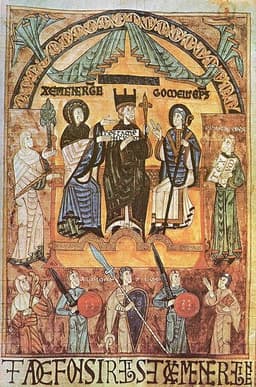
Alfonso III of Asturias
Emperor · Medieval
54.6Total

Napoleon Bonaparte
General · Modern
70.9Total
Basic Information
Born
852
1769
Died
910
1821
Era
Medieval
Modern
Nationality
Asturias
France
Occupation
Emperor
General
Civilization
Western
Western
Score Comparison
Military (10%)
70.0
94.0
Political (20%)
48.0
72.0
Influence (20%)
54.9
40.0
Legacy (20%)
47.5
80.0
Leadership (15%)
64.0
78.0
Strategy (15%)
52.5
90.0
TOTAL
54.6
70.9
Alfonso III of Asturias — Complete Timeline
868 AD
Expansion to the Duero RiverWar◆ Major
Alfonso III led military campaigns that pushed the Asturian frontier south to the Duero River, capturing key fortresses such as Zamora and Toro. This expansion doubled the size of the kingdom and established a defensible border against the Emirate of Cordoba.
ReconquistaTerritorial ExpansionDuero
Impact: regionalconstructive
870 AD
Repopulation of Braga and PortoReform◆ Major
Alfonso III ordered the repopulation of the abandoned cities of Braga and Porto in northern Portugal, granting land and privileges to settlers from Galicia and Asturias. This initiative strengthened Christian control over the region and laid the groundwork for the future Kingdom of Portugal.
RepopulationPortugalSettlement
Impact: regionalconstructive
883 AD
Chronicle of Alfonso IIICultural◆ Major
Alfonso III commissioned the Chronicle of Alfonso III, a historical work that chronicled the kings of Asturias from Pelagius to his own reign. The chronicle served as a foundational text for Asturian and Leonese historiography, shaping the narrative of the Reconquista.
ChronicleHistoriographyReconquista
Impact: regionalconstructive
910 AD
Deposition by SonsPolitical Action◆ Major
Alfonso III was deposed by his three sons, Garcia, Ordo
DepositionDivision of KingdomSuccession Crisis
Impact: nationaltragic
Napoleon Bonaparte — Complete Timeline
1799 AD
Coup of 18 BrumaireOther◆ Major
Napoleon Bonaparte, with support from his brother Lucien and key political figures, overthrew the Directory in a bloodless coup. He established the Consulate with himself as First Consul, effectively becoming the ruler of France. This event ended the French Revolution's most unstable period.
French RevolutionCoupRise to Power
Impact: regional
1804 AD
Promulgation of the Napoleonic CodeOther◆ Major
Napoleon enacted the Civil Code of the French, known as the Napoleonic Code, a comprehensive set of laws that replaced the fragmented feudal legal systems. The code established legal equality, protected property rights, and secularized law. It became the basis for legal systems in many European and world countries.
Legal ReformNapoleonic CodeCivil Law
Impact: globalconstructive
1805 AD
Battle of AusterlitzWar◆ Major
Napoleon's Grande Arm
Napoleonic WarsBattleDecisive Victory
Impact: global
1812 AD
Invasion of RussiaWar◆ Major
Napoleon led the Grande Arm
Napoleonic WarsInvasionDisaster
Impact: globaldestructive
1815 AD
Battle of WaterlooWar◆ Major
Napoleon's French army was defeated by the combined forces of the Duke of Wellington's Anglo-Allied army and Gebhard Leberecht von Bl
Napoleonic WarsBattleFinal Defeat
Impact: globaldestructive
Expert Analysis
alfonso-iii-of-asturias-vs-napoleon-bonaparte
# The Emperor and the King: Two Paths to Power, Two Destinies
In the summer of 1815, Napoleon Bonaparte stood on the deck of the HMS *Bellerophon*, watching the coast of France recede into the Atlantic mist. He was a prisoner, bound for a rocky island in the South Atlantic from which no escape would come. A thousand years earlier, in the autumn of 910, another ruler—Alfonso III of Asturias—faced his own end, not at the hands of foreign enemies but betrayed by his own sons, who forced him to abdicate and then carved his kingdom into three pieces. Both men had built kingdoms through conquest. Both had seen their life’s work shattered. But the differences between them—in scale, in ambition, in the very nature of their power—tell us something profound about how history measures greatness, and how it punishes overreach.
Origins
Napoleon Bonaparte was born in 1769 on the island of Corsica, a place that had only recently become French. His family was minor nobility, but they were not wealthy, and the young Napoleon grew up speaking Italian-accented French, an outsider in the very nation he would one day rule. The French Revolution, which erupted when he was twenty, shattered the old order and created opportunities unimaginable under the Bourbon monarchy. For a brilliant artillery officer with nothing to lose, the Revolution was a ladder.
Alfonso III, by contrast, was born into a throne—the kingdom of Asturias, a small, mountainous Christian kingdom in northern Iberia that had survived the Muslim conquest of 711. His father, Ordoño I, had already begun the slow work of pushing southward into the lands the Muslims called Al-Andalus. Alfonso was raised in a world where kingship was sacred, where the Reconquista was a holy duty, and where the kingdom’s survival depended on constant vigilance. He had no revolution to exploit, no old order to overturn. His path was inheritance, not ambition.
Rise to Power
Napoleon’s rise was meteoric. In 1793, at the age of twenty-four, he drove the British out of Toulon and was promoted to brigadier general. By 1796, he was commanding the Army of Italy, where his lightning campaigns forced Austria to the peace table. In 1799, he returned from Egypt to a France desperate for order, seized power in a coup, and made himself First Consul. By 1804, he was Emperor of the French. Every step was a gamble, every victory a foundation for the next.
Alfonso III became king in 866, at the age of fourteen, after his father’s death. His rise was not a matter of genius but of survival. He faced internal revolts from the Asturian nobility—who saw a boy king as an opportunity—and external threats from the Emirate of Córdoba. His first major campaign, in 868, pushed the frontier to the Duero River, capturing fortresses that had been abandoned for generations. Where Napoleon conquered entire kingdoms in months, Alfonso spent years consolidating a single river line.
Leadership & Governance
Napoleon ruled through sheer force of will. He reorganized French law into the Napoleonic Code, a system that still shapes European jurisprudence. He centralized the state, created a system of lycées for education, and made peace with the Catholic Church through the Concordat of 1801. But his governance was inseparable from his wars. He demanded total loyalty, and he rewarded it with titles, lands, and power. His marshals were his creatures, and he never trusted them fully.
Alfonso III ruled differently. He was a king of a small, poor kingdom, and his power was limited by the nobility and the Church. His great reform was not a legal code but a demographic one: in 870, he ordered the repopulation of the abandoned cities of Braga and Porto, granting land and privileges to settlers willing to live on the frontier. He also commissioned the *Chronicle of Alfonso III* in 883, a historical work that traced the Asturian monarchy back to the Visigothic kings, giving his dynasty a legitimacy that conquest alone could not provide. He built his kingdom not through revolution but through memory and settlement.
Triumph & Tragedy
Napoleon’s greatest moment came in 1805, at Austerlitz, where he crushed the combined armies of Russia and Austria in a battle so perfect that it is still studied in military academies. His tragedy was the invasion of Russia in 1812, where he lost half a million men to winter, disease, and Russian stubbornness. He never recovered. Exiled to Elba in 1814, he escaped in 1815, rallied France, and was finally defeated at Waterloo. His end was a prisoner’s death on Saint Helena in 1821, at the age of fifty-one.
Alfonso III’s triumph was the expansion of Asturias to the Duero River, a line that would become the foundation of the future kingdoms of León and Castile. His tragedy was his own family. In 910, his three sons—García, Ordoño, and Fruela—deposed him and forced him to abdicate. The kingdom was divided among them: García took León, Ordoño took Galicia, and Fruela took Asturias. Alfonso died the same year, a broken man. His kingdom, unlike Napoleon’s, did not collapse; it fragmented, and the fragments would eventually reunite into the Kingdom of León. But the personal betrayal was complete.
Character & Destiny
Napoleon’s character was ambition incarnate. He once said, “I am not a man, but a thing.” He saw himself as an instrument of fate, a force of nature that could not be stopped. This belief drove him to conquer Europe, but it also blinded him to the limits of his power. He could not compromise, could not stop, could not accept that some enemies—like the British navy or the Russian winter—were beyond his reach.
Alfonso III was a different kind of man. He was a builder, not a conqueror. He understood that a kingdom is made not just by battles but by people living on the land, by chronicles that tell a story, by churches that mark a frontier. His tragedy was that he built a kingdom for his sons, and they repaid him with betrayal. But he did not fight them. He abdicated. He accepted that his time was over. Napoleon could never have done that.
Legacy
Napoleon’s legacy is immense. The Napoleonic Code, the modern French state, the spread of nationalism across Europe, the sale of Louisiana to the United States—all of it bears his mark. He is remembered as a military genius and a tyrant, a liberator and a conqueror. His name is synonymous with ambition and its costs.
Alfonso III is remembered, if at all, by historians of medieval Spain. His *Chronicle* shaped the identity of the Reconquista. His repopulation policies laid the groundwork for the kingdoms that would eventually drive the Muslims out of Iberia. But he is not a household name. He did not change the world; he built a foundation on which others would build.
Conclusion
Napoleon and Alfonso III lived a thousand years apart, but both faced the same question: What does it mean to rule? Napoleon answered with conquest, with glory, with empire. Alfonso answered with patience, with settlement, with memory. One burned across Europe like a comet and vanished. The other dug into the soil of Iberia and endured. Perhaps the difference is not in their achievements but in their understanding of time. Napoleon thought in years. Alfonso thought in centuries. And in the end, the centuries won.
Rankings
🥇
Napoleon BonaparteLeader
Mil: 94.0Pol: 72.0Inf: 40.0
70.9
🥈
Alfonso III of Asturias
Mil: 70.0Pol: 48.0Inf: 54.9
54.6
+16.3 behind
How This Comparison Works
Algorithm
Each figure is scored on 6 dimensions (0—100 scale) based on structured historical data: Military (10%), Political (20%), Influence (20%), Legacy (20%), Leadership (15%), Strategy (15%). The weighted total produces the final ranking.
Data Sources
Scores are computed from structured sub-indicators in the database. Scale factors adjust for era (Ancient ×0.85, Modern ×1.0) and civilization size (Eastern ×1.05, Other ×0.80) to account for differences in population and military scale.
Maximum 3 Figures
Comparisons are limited to 2—3 figures to ensure readability and statistical meaningfulness.
Error Margins
±5 points per dimension — Sub-scores are derived from historical records with inherent uncertainty. Two figures within 5 points on a dimension should be considered roughly equivalent in that area.
Total Score Accuracy
±3 points overall — The weighted combination of 6 dimensions produces a total score with approximately ±3 points of uncertainty. Differences of less than 3 points are not statistically significant— the figures are effectively tied.
Known Limitations
- Historical records are incomplete and uneven across civilizations
- Figures from oral-tradition societies may be underrepresented
- Occupation labels can misclassify multi-role figures
- Scores measure capability and impact, not moral character
- Quantitative scoring is a comparison tool, not absolute truth
Capability Radar
Military (10%) — Battles & Warfare
Battles
55
95
Win Rate
60
90
Expansion
70
95
Political (20%) — Governance & Reform
Reform
45
95
Diplomacy
50
80
Economy
40
85
Influence (20%) — Cultural & Global Reach
Cultural
40
85
Global
30
90
Legacy (20%) — Historical Impact
Historical
50
95
Longevity
35
90
Leadership (15%) — Power & Stability
Tenure
65
85
Stability
30
70
Strategy (15%) — Tactics & Innovation
Strategy
65
95
Tactics
50
98
Reform
40
92
Similar Comparisons
Comments & Discussion
MonarchMetrics6/17/2026
Napoleon’s rise from Corsican nobody to Emperor of Europe is a story of revolutionary opportunity; Alfonso III inherited a throne and fought to keep it. But let’s get real—Napoleon’s empire lasted a decade and collapsed under his own hubris (invading Russia in winter? Seriously?), while Alfonso’s Asturian kingdom held for generations. Napoleon’s exile was poetic; Alfonso’s abdication was tragic betrayal by his own blood. Scale doesn’t equal substance.
征服者之眼6/17/2026
拿破仑就是个小矮子,靠大炮和运气炸出一条血路——他征服了欧洲,却管不住自己的野心。阿尔方索三世才是真硬汉,在基督教和王国的废墟上硬撑了五十年,把阿斯图里亚斯从弹丸之地扩展到莱昂。拿破仑败在滑铁卢,阿尔方索败在儿子背叛。历史的讽刺在于:枪炮打不赢血亲的刀。
古典文献学家6/17/2026
拿俄罗斯的冰天雪地跟阿尔方索的宫廷阴谋比?简直是鸡同鸭讲。拿破仑读凯撒,阿尔方索读伊西多尔——一个学打仗,一个学治国。拿破仑的滑铁卢是史诗级的败仗,阿尔方索的退位是默然的父权崩塌。若论遗产,拿破仑留下法典和神话,阿尔方索留下圣詹姆斯之路和绵延千年的反抗。谁更“伟大”?看你想死得快还是活得久。
渔阳鼙鼓6/17/2026
讲真,拿破仑的悲剧在于他以为自己能像凯撒一样重塑世界,结果被全世界联合起来打脸。阿尔方索三世呢?他面对的是摩尔人的重压和儿子的背叛,却硬是让阿斯图里亚斯成了西班牙的摇篮。拿破仑的帝国是烟花,阿尔方索的王国是熔炉。历史不会同情野心家,只会记住那些在黑暗里点火的人。拿破仑炸了欧洲,阿尔方索点亮了伊比利亚。
Historian4576/17/2026
Let’s talk numbers: Napoleon commanded armies of 600,000 men; Alfonso III ruled a kingdom that might have had 200,000 people. Napoleon’s wars killed 3.5 million; Alfonso’s skirmishes, maybe 50,000. Yet Alfonso’s reconquista preserved Christian Iberia for centuries, while Napoleon’s conquests were undone in a decade. The body count argument favors Alfonso’s efficiency: less death, more lasting impact. Napoleon’s stats are just bigger, not better.