Loading...
Alfonso VI of Leon vs Napoleon Bonaparte
Napoleon Bonaparte leads by 10.7 pts · 2 figures compared
…
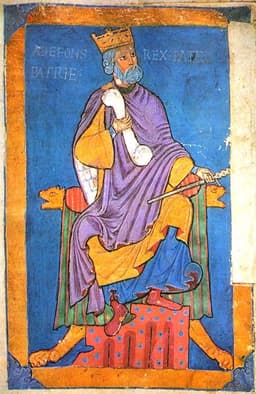
Alfonso VI of Leon
Emperor · Medieval
60.2Total

Napoleon Bonaparte
General · Modern
70.9Total
Basic Information
Born
1040
1769
Died
1109
1821
Era
Medieval
Modern
Nationality
Leon
France
Occupation
Emperor
General
Civilization
Western
Western
Score Comparison
Military (10%)
65.0
94.0
Political (20%)
45.0
72.0
Influence (20%)
62.0
40.0
Legacy (20%)
56.0
80.0
Leadership (15%)
72.0
78.0
Strategy (15%)
66.3
90.0
TOTAL
60.2
70.9
Alfonso VI of Leon — Complete Timeline
1077 AD
Title of 'Emperor of Spain'Political Action◆ Major
Alfonso VI claimed the title 'Imperator totius Hispaniae' (Emperor of all Spain) in 1077, asserting his supremacy over other Christian rulers. This title was used in diplomatic correspondence and reflected his ambition to unify Iberia.
Medieval IberiaImperial TitleHegemony
Impact: regional
1085 AD
Capture of ToledoWar◆ Major
Alfonso VI captured the city of Toledo from the Taifa of Toledo in May 1085. This was a major victory in the Reconquista, as Toledo was a historic capital of the Visigothic kingdom and a cultural center of Islamic Iberia.
ReconquistaToledoConquest
Impact: regionalconstructive
1086 AD
Battle of SagrajasWar◆ Major
Alfonso VI was defeated by the Almoravid army under Yusuf ibn Tashfin at the Battle of Sagrajas (Zallaqa). This defeat halted Christian expansion and forced Alfonso to seek help from other Christian kingdoms, marking a turning point in the Reconquista.
ReconquistaBattleAlmoravid
Impact: regionaltragic
1091 AD
Marriage to ZaidaPolitical Action
Alfonso VI married Zaida, a Muslim princess from Seville, who converted to Christianity and took the name Isabel. This marriage was a political alliance to secure peace with the Taifa of Seville and strengthen his position against the Almoravids.
Medieval IberiaMarriage AllianceDiplomacy
Impact: regional
Napoleon Bonaparte — Complete Timeline
1799 AD
Coup of 18 BrumaireOther◆ Major
Napoleon Bonaparte, with support from his brother Lucien and key political figures, overthrew the Directory in a bloodless coup. He established the Consulate with himself as First Consul, effectively becoming the ruler of France. This event ended the French Revolution's most unstable period.
French RevolutionCoupRise to Power
Impact: regional
1804 AD
Promulgation of the Napoleonic CodeOther◆ Major
Napoleon enacted the Civil Code of the French, known as the Napoleonic Code, a comprehensive set of laws that replaced the fragmented feudal legal systems. The code established legal equality, protected property rights, and secularized law. It became the basis for legal systems in many European and world countries.
Legal ReformNapoleonic CodeCivil Law
Impact: globalconstructive
1805 AD
Battle of AusterlitzWar◆ Major
Napoleon's Grande Arm
Napoleonic WarsBattleDecisive Victory
Impact: global
1812 AD
Invasion of RussiaWar◆ Major
Napoleon led the Grande Arm
Napoleonic WarsInvasionDisaster
Impact: globaldestructive
1815 AD
Battle of WaterlooWar◆ Major
Napoleon's French army was defeated by the combined forces of the Duke of Wellington's Anglo-Allied army and Gebhard Leberecht von Bl
Napoleonic WarsBattleFinal Defeat
Impact: globaldestructive
Expert Analysis
alfonso-vi-of-leon-vs-napoleon-bonaparte
### The Emperor and the King: Two Visions of Power in the West
In the summer of 1085, Alfonso VI of León and Castile rode into Toledo, the ancient Visigothic capital, after centuries of Muslim rule. It was a moment of quiet triumph, the kind that builds a kingdom slowly, stone by stone. Less than two decades later, in the winter of 1805, Napoleon Bonaparte stood on a hill at Austerlitz, watching the sun rise over a frozen battlefield where his Grande Armée would shatter the armies of two empires in a single day. One man reclaimed a city; the other rewrote the map of Europe. Both were monarchs, both were warriors, and both sought to shape the world in their image. Yet their stories reveal two radically different answers to the same question: What does it mean to rule?
### Origins: The Corsican and the Leonese
Napoleon Bonaparte was born in 1769 on the island of Corsica, a year after it became French territory. His family was minor nobility, but they were not wealthy. He spoke Italian before French, and his early life was shaped by the tension of a conquered island struggling to find its identity. This outsider status would fuel his ambition. He attended military school in mainland France, where he was mocked for his accent and small stature. The French Revolution, which erupted when he was twenty, shattered the old order and opened a path for a man of talent, not birth.
Alfonso VI, born in 1040, was the son of King Ferdinand I of León, one of the fractious Christian kingdoms of northern Iberia. His world was one of borders drawn by blood and faith. The Reconquista—the centuries-long effort to reclaim the peninsula from Muslim rule—was not a single war but a slow, grinding struggle. Alfonso’s inheritance was not a unified kingdom but a divided one: upon his father’s death, León, Castile, and Galicia were split among his brothers. He had to fight for what he would eventually rule.
The difference in their eras is stark. Napoleon was a child of the Enlightenment and the Revolution, of mass armies and nationalism. Alfonso was a medieval king, his power measured in oaths of fealty and the silver of tribute. One man’s world was being remade by cannons and constitutions; the other’s by the slow rhythm of siege and surrender.
### Rise to Power: The Siege and the Coup
Napoleon’s ascent was meteoric. He first gained fame in 1793 at the Siege of Toulon, where his artillery tactics forced the British fleet to withdraw. He was just twenty-four. By 1796, he was commanding the French army in Italy, where his speed and daring won a series of stunning victories. He was not merely a general; he was a political actor. In 1799, he returned from a failed campaign in Egypt to stage a coup, installing himself as First Consul of France. Five years later, he crowned himself Emperor.
Alfonso’s rise was slower, more conventional. He spent years consolidating power after his father’s death, fighting his brothers for control of Castile and Galicia. By 1077, he felt secure enough to claim the title *Imperator totius Hispaniae*—Emperor of all Spain. This was not an empty boast. It was a political statement, asserting that León was the heir to the Visigothic kingdom that had ruled Iberia before the Muslim conquest. Alfonso understood that power in the Middle Ages was not just about armies; it was about legitimacy, lineage, and the blessing of the Church.
### Leadership & Governance: The Code and the Crusade
Napoleon’s greatest domestic achievement was the Napoleonic Code, a comprehensive system of civil law that abolished feudal privileges, protected property rights, and established equality before the law. It was a product of the Revolution, but it was also a tool of control. Napoleon centralized the state, created a meritocratic bureaucracy, and imposed his will from Paris to the Rhine. His military genius was undeniable—at Austerlitz in 1805, he destroyed the combined armies of Austria and Russia with a feigned retreat and a devastating flank attack. His strategy was based on speed, deception, and the concentration of force at the decisive point.
Alfonso’s governance was more personal, more fragile. His capture of Toledo in 1085 was a masterstroke of medieval statecraft. He offered the city’s Muslim inhabitants generous terms—they could keep their property and practice their religion—a pragmatic policy that encouraged other towns to surrender. But his victory also provoked a response. The Muslim rulers of Iberia, fearing his advance, called for help from the Almoravids, a fierce Berber dynasty from North Africa. In 1086, at the Battle of Sagrajas (Zallaqa), Alfonso was crushed by Yusuf ibn Tashfin. The defeat was a brutal reminder that the Reconquista was not a straight line. Alfonso survived, but his momentum was broken.
Napoleon’s military score of 94 dwarfs Alfonso’s 55, and rightly so. Napoleon commanded armies of hundreds of thousands, orchestrated campaigns across a continent, and invented modern warfare. Alfonso fought in a world of small armies, seasonal campaigns, and shifting alliances. But political scores tell a different story: Napoleon’s 75 versus Alfonso’s 74. Both men understood that conquest alone was not enough. Napoleon codified law; Alfonso married a Muslim princess named Zaida in 1091, a political union meant to bind Christian and Muslim elites. Both were ruthless, but Alfonso’s ruthlessness was tempered by the limitations of his age.
### Triumph & Tragedy
Napoleon’s triumph was Austerlitz, where he destroyed the Third Coalition. His tragedy was the invasion of Russia in 1812, where his Grande Armée was swallowed by the vastness of the steppe and the cold of winter. He returned to Paris a diminished man, his aura of invincibility shattered. Exiled to Elba, he escaped, raised another army, and was finally defeated at Waterloo in 1815. He died in 1821 on the remote island of Saint Helena, a prisoner of the British.
Alfonso’s triumph was Toledo, the jewel of the Reconquista. His tragedy was Sagrajas, where his army was routed by a force he had underestimated. He died in 1109, his kingdom intact but his ambitions checked. He never saw the final reconquest of Spain—that would take another four centuries—but he had planted the seed.
### Character & Destiny
Napoleon was a man of boundless ambition and restless energy. He believed in destiny, in his own star. He once said, “Impossible is a word to be found only in the dictionary of fools.” His personality drove him to overreach, to conquer more than he could hold. He could not stop.
Alfonso was more cautious, more aware of limits. He claimed the title of Emperor, but he did not try to conquer all of Iberia in a single campaign. He built alliances, made marriages, and accepted defeat when it came. He was a survivor, not a visionary. His personality was shaped by the constraints of his time, when kings were not absolute but first among equals.
### Legacy
Napoleon’s legacy is immense. The Napoleonic Code influenced legal systems across Europe and the Americas. He reshaped the map of Europe, destroyed the Holy Roman Empire, and spread the ideals of nationalism and meritocracy. He is remembered as both a liberator and a tyrant, a genius and a warmonger.
Alfonso’s legacy is more localized. He is remembered as a key figure in the Reconquista, the king who took Toledo and began the slow march toward a unified Spain. His claim to the imperial title was a precedent for later Spanish monarchs. He is not a household name, but his achievements were real.
### Conclusion
Standing on the hill at Austerlitz, Napoleon saw a continent at his feet. Standing on the walls of Toledo, Alfonso saw a city that had been lost for centuries. Both were conquerors, but they conquered different worlds. Napoleon’s world was one of rapid change, where a man could rise from obscurity to dominate a continent in a decade. Alfonso’s world was one of slow accumulation, where a kingdom was built over a lifetime and a single defeat could undo years of work. Their stories remind us that greatness is not a single measure but a reflection of the age that produces it. Napoleon’s ambition consumed him; Alfonso’s caution preserved him. In the end, both were emperors, but only one knew when to stop.
Rankings
🥇
Napoleon BonaparteLeader
Mil: 94.0Pol: 72.0Inf: 40.0
70.9
🥈
Alfonso VI of Leon
Mil: 65.0Pol: 45.0Inf: 62.0
60.2
+10.7 behind
How This Comparison Works
Algorithm
Each figure is scored on 6 dimensions (0—100 scale) based on structured historical data: Military (10%), Political (20%), Influence (20%), Legacy (20%), Leadership (15%), Strategy (15%). The weighted total produces the final ranking.
Data Sources
Scores are computed from structured sub-indicators in the database. Scale factors adjust for era (Ancient ×0.85, Modern ×1.0) and civilization size (Eastern ×1.05, Other ×0.80) to account for differences in population and military scale.
Maximum 3 Figures
Comparisons are limited to 2—3 figures to ensure readability and statistical meaningfulness.
Error Margins
±5 points per dimension — Sub-scores are derived from historical records with inherent uncertainty. Two figures within 5 points on a dimension should be considered roughly equivalent in that area.
Total Score Accuracy
±3 points overall — The weighted combination of 6 dimensions produces a total score with approximately ±3 points of uncertainty. Differences of less than 3 points are not statistically significant— the figures are effectively tied.
Known Limitations
- Historical records are incomplete and uneven across civilizations
- Figures from oral-tradition societies may be underrepresented
- Occupation labels can misclassify multi-role figures
- Scores measure capability and impact, not moral character
- Quantitative scoring is a comparison tool, not absolute truth
Capability Radar
Military (10%) — Battles & Warfare
Battles
65
95
Win Rate
60
90
Expansion
70
95
Political (20%) — Governance & Reform
Reform
65
95
Diplomacy
70
80
Economy
60
85
Influence (20%) — Cultural & Global Reach
Cultural
60
85
Global
50
90
Legacy (20%) — Historical Impact
Historical
65
95
Longevity
55
90
Leadership (15%) — Power & Stability
Tenure
75
85
Stability
55
70
Strategy (15%) — Tactics & Innovation
Strategy
70
95
Tactics
55
98
Reform
50
92
Similar Comparisons
Comments & Discussion
AUSTERLITZ_APOLOGIST6/17/2026
"Alfonso VI reconquered a city in three years of siege; Napoleon crushed two empires in three hours at Austerlitz. That's the difference between medieval 'campaigns' that moved at a crawl and modern warfare that changed continents in an afternoon. Alfonso played checkers while Napoleon played speed chess with entire nations as pawns. One built a kingdom; the other built an empire that still shapes European borders today."
圣战统计员6/17/2026
"别被十字军浪漫主义骗了。阿方索六世1085年攻占托莱多时,手下只有约2,000名骑士和杂牌步兵;拿破仑在奥斯特里茨指挥的是73,000人的职业化大军,配备标准化炮兵体系。一个是部落联盟式的封建领主,另一个是让普鲁士军事体系崩溃的现代统帅。把两人相提并论,就像拿村口械斗和世界大战比。"
CLASSICS_SCHOLAR6/17/2026
"Call me old-fashioned, but Alfonso did something Napoleon never could: he absorbed a pluralistic society. Toledo under his rule became the *translatio studii*—the center where Muslim, Jewish, and Christian scholars translated Aristotle and Euclid. Napoleon exported the Napoleonic Code by force; Alfonso fostered a culture that preserved classical knowledge. One wrote decrees, the other built bridges between civilizations. Which legacy actually lasts?"
文艺复兴回潮派6/17/2026
"拿破仑吹嘘自己'将欧洲从封建泥沼中解放',但他治下法国死亡150万士兵,俄国远征损失超50万。反观阿方索,他的征服本质上是一次'文化整合实验'——保留托莱多的清真寺,雇佣穆斯林官员,甚至铸造带阿拉伯文的金币。拿破仑只会用炮火推广启蒙运动,阿方索用务实包容实现了真正的文明交流。谁才是更聪明的统治者?"
RURAL_ARCHIVIST6/17/2026
"Let's talk logistics, not glory. Alfonso's 1085 campaign to Toledo moved at maybe 20 km per day, limited by ox-drawn supply carts and the need to forage. Napoleon's Grande Armée could force-march 30 km daily with an organized supply system, magazines, and corps structure. The real difference isn't genius—it's that Napoleon had a state apparatus capable of sustained military operations. Alfonso's kingdom barely functioned as a unified administration outside León itself."