Loading...
Alfonso X of Castile vs Joanna of Castile
Alfonso X of Castile leads by 19.3 pts · 2 figures compared
…
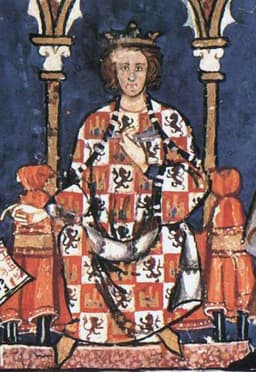
Alfonso X of Castile
Emperor · Medieval
54.6Total

Joanna of Castile
Emperor · Medieval
35.3Total
Basic Information
Born
1221
1479
Died
1284
1555
Era
Medieval
Medieval
Nationality
Holy Roman Empire
Spain
Occupation
Emperor
Emperor
Civilization
Western
Western
Score Comparison
Military (10%)
45.0
14.8
Political (20%)
53.8
25.0
Influence (20%)
65.0
49.4
Legacy (20%)
40.0
40.8
Leadership (15%)
65.0
31.2
Strategy (15%)
60.0
28.4
TOTAL
54.6
35.3
Alfonso X of Castile — Complete Timeline
1252 AD
Commissioned the Alfonsine TablesCultural◆ Major
Alfonso X commissioned the Alfonsine Tables, a set of astronomical tables based on Ptolemaic models. These tables were used by European astronomers for centuries and became a standard reference in medieval science.
AstronomyScienceCultural Patronage
Impact: globalconstructive
1257 AD
Elected King of GermanyPolitical Action◆ Major
Alfonso X of Castile was elected King of Germany by a faction of prince-electors, opposing Richard of Cornwall. This election was part of the Great Interregnum, with Alfonso receiving support from the Hohenstaufen loyalists and the Papacy.
ElectionGreat InterregnumCastilian Claim
Impact: regional
Never Visited GermanyPolitical Action◆ Major
Alfonso X never traveled to Germany to assert his claim to the throne. His absence weakened his authority, and he was unable to secure effective control over the German kingdom, leaving the title contested.
AbsenceGreat InterregnumRival Claimant
Impact: regional
1275 AD
Renounced Claim to German ThronePolitical Action◆ Major
Alfonso X formally renounced his claim to the German throne in favor of Rudolf of Habsburg. This renunciation ended the Great Interregnum and allowed Rudolf to be recognized as the legitimate king of Germany.
RenunciationGreat InterregnumRudolf of Habsburg
Impact: regional
Joanna of Castile — Complete Timeline
1506 AD
Death of Philip I of CastilePolitical Action
After the death of her husband Philip I, Joanna of Castile became the nominal queen of Castile. However, her father Ferdinand II of Aragon and later her son Charles I of Spain assumed regency, citing her mental instability. Joanna was confined to the castle of Tordesillas for the rest of her life.
RegencyImprisonment
Impact: nationaltragic
1507 AD
Refusal to remarryPolitical Action
After the death of her husband Philip I, Joanna refused to remarry, despite pressure from her father Ferdinand II and other nobles. Her refusal was interpreted as a sign of mental instability, but it also reflected her deep attachment to Philip and her desire to maintain her independence.
Personal choicePolitical pressure
Impact: national
1509 AD
Confinement at TordesillasPolitical Action◆ Major
Joanna of Castile was confined to the Royal Palace of Tordesillas by order of her father Ferdinand II, who declared her unfit to rule. She remained imprisoned there for 46 years, isolated from political affairs, while her son Charles I governed Castile in her name.
ImprisonmentMental health
Impact: nationaltragic
Expert Analysis
Origins
Alfonso X of Castile was born on November 23, 1221, in Toledo, the eldest son of Ferdinand III of Castile and Elisabeth of Swabia. His father conquered much of Andalusia, and Alfonso was raised in a court steeped in the Reconquista and Christian-Muslim cultural exchange. He received an extensive education in law, science, and the arts, learning Latin, Castilian, and Arabic. His mother's lineage connected him to the Hohenstaufen dynasty of the Holy Roman Empire, which later fueled his imperial ambitions.
Joanna of Castile was born on November 6, 1479, in Toledo, the third child of Ferdinand II of Aragon and Isabella I of Castile. She was educated in the royal court, learning Latin, French, and courtly etiquette, but her upbringing was overshadowed by the political machinations of her parents, who used their children as pawns in marriage alliances. Joanna was particularly close to her mother but was often separated from her siblings. Her marriage to Philip the Handsome in 1496 was arranged to forge an alliance with the Habsburgs.
Rise to Power
Alfonso X ascended to the throne of Castile and León in 1252 upon his father's death. His early reign focused on continuing the Reconquista, capturing cities like Jerez and Niebla. However, his greatest political ambition emerged in 1256 when he was elected King of the Romans (Germany) by a faction of prince-electors opposed to Richard of Cornwall. This election was part of the Great Interregnum, and Alfonso never visited Germany to press his claim. He spent vast sums on diplomacy and bribes, but his absence weakened his authority. In 1275, after Richard's death, Pope Gregory X pressured Alfonso to renounce his claim, which he did in 1277 in favor of Rudolf of Habsburg, ending the interregnum.
Joanna's rise was more tragic. She became heir to Castile after the deaths of her elder siblings John, Isabella, and Michael. Upon her mother Isabella's death in 1504, Joanna became Queen of Castile, but her husband Philip asserted his own authority. Philip's sudden death in 1506 left Joanna nominal ruler, but her father Ferdinand II of Aragon quickly moved to control her. Ferdinand had Joanna declared insane and confined her to the Royal Palace of Tordesillas in 1509, where she remained until her death in 1555. Her son Charles later became Holy Roman Emperor Charles V, but Joanna was never allowed to rule.
Leadership & Governance
Alfonso X's leadership was marked by intellectual ambition rather than military prowess. He scored 45.0 in military and 60.0 in strategy, reflecting his limited success in conquest. His governance focused on legal codification: he oversaw the creation of the Siete Partidas, a comprehensive legal code that influenced Spanish law for centuries. He also promoted the translation of Arabic scientific works into Latin, fostering the Toledo School of Translators. Politically, he scored 53.8, as his attempt to claim the German throne drained Castilian resources and alienated nobles. His administrative reforms centralized royal power but faced resistance from the nobility.
Joanna's governance was non-existent due to her confinement. She scored 25.0 in political and 31.2 in leadership, reflecting her lack of agency. Her father and son ruled in her stead. However, her refusal to remarry after Philip's death (despite pressure) demonstrated a stubborn independence. Her confinement was justified by claims of insanity, but modern historians argue she was a victim of political manipulation. Her only act of governance was signing documents under duress. Her legacy is one of passive resistance.
Triumph & Tragedy
Alfonso X's greatest triumph was the Alfonsine Tables, commissioned in 1272. These astronomical tables, based on Ptolemaic models, were used by European astronomers for over 200 years and represented a major contribution to science. He also completed the Cantigas de Santa Maria, a collection of 420 poems in Galician-Portuguese, showcasing cultural patronage. His tragedy was his failed imperial ambition: he spent enormous sums on the German throne, leading to economic strain and rebellion by his son Sancho. He died in 1284, estranged from his family, with his kingdom in turmoil.
Joanna's triumph was the birth of her son Charles, who became the most powerful ruler in Europe. Her tragedy was her 46-year confinement at Tordesillas, where she was kept in a small, windowless room, often neglected and abused. She was used as a political tool by her father and son, who kept her imprisoned to legitimize their rule. Her mental health deteriorated, but her defiance—refusing to remarry and clinging to her royal identity—became a symbol of resistance.
Character & Destiny
Alfonso X was a scholar-king, more interested in books than battles. His epithet 'the Wise' reflects his intellectual pursuits, but he lacked the pragmatism to rule effectively. His decision to pursue the German throne was a strategic error, driven by pride and ambition rather than realistic assessment. He scored 65.0 in leadership and 60.0 in strategy, but his political score of 53.8 shows his inability to manage noble factions. His character—idealistic, learned, but indecisive—shaped his destiny of unfulfilled potential.
Joanna's character is shrouded in myth. She was likely deeply attached to her husband, and his death triggered a grief that was exploited as madness. Her refusal to remarry was seen as irrational, but it was also a political act. She was stubborn and proud, refusing to be a pawn. Her destiny—confinement and erasure from history—was shaped by the ambitions of the men around her. She scored 49.4 in influence, but her legacy is as a tragic figure rather than a ruler.
Legacy
Alfonso X's legacy is cultural and intellectual. The Siete Partidas became the foundation of Spanish law, influencing Latin American legal systems. The Alfonsine Tables advanced astronomy, and his patronage of translations preserved classical knowledge. He is remembered as a pioneer of the Castilian language, promoting its use in administration and literature. His influence score of 65.0 reflects this enduring impact.
Joanna's legacy is more symbolic. She represents the victimization of women in power, and her story has been romanticized in art and literature. Her confinement at Tordesillas is a cautionary tale about political manipulation. However, her direct influence on governance was minimal; her scores of 40.8 in legacy and 49.4 in influence reflect her passive role. Her son Charles V built an empire, but Joanna was a footnote.
Conclusion
Alfonso X of Castile had a greater impact than Joanna of Castile. His total score of 54.6 versus Joanna's 35.3 reflects his substantial contributions to law, science, and culture. While Joanna's tragic story resonates emotionally, her political influence was negligible. Alfonso's reforms shaped Spanish governance for centuries, while Joanna's legacy is one of personal suffering. The Wise king's intellectual achievements outweigh the Mad queen's symbolic power. Alfonso X is the more significant historical figure.
Rankings
🥇
Alfonso X of CastileLeader
Mil: 45.0Pol: 53.8Inf: 65.0
54.6
🥈
Joanna of Castile
Mil: 14.8Pol: 25.0Inf: 49.4
35.3
+19.3 behind
How This Comparison Works
Algorithm
Each figure is scored on 6 dimensions (0—100 scale) based on structured historical data: Military (10%), Political (20%), Influence (20%), Legacy (20%), Leadership (15%), Strategy (15%). The weighted total produces the final ranking.
Data Sources
Scores are computed from structured sub-indicators in the database. Scale factors adjust for era (Ancient ×0.85, Modern ×1.0) and civilization size (Eastern ×1.05, Other ×0.80) to account for differences in population and military scale.
Maximum 3 Figures
Comparisons are limited to 2—3 figures to ensure readability and statistical meaningfulness.
Error Margins
±5 points per dimension — Sub-scores are derived from historical records with inherent uncertainty. Two figures within 5 points on a dimension should be considered roughly equivalent in that area.
Total Score Accuracy
±3 points overall — The weighted combination of 6 dimensions produces a total score with approximately ±3 points of uncertainty. Differences of less than 3 points are not statistically significant— the figures are effectively tied.
Known Limitations
- Historical records are incomplete and uneven across civilizations
- Figures from oral-tradition societies may be underrepresented
- Occupation labels can misclassify multi-role figures
- Scores measure capability and impact, not moral character
- Quantitative scoring is a comparison tool, not absolute truth
Capability Radar
Military (10%) — Battles & Warfare
Battles
30
6
Win Rate
25
8
Expansion
30
13
Political (20%) — Governance & Reform
Reform
70
5
Diplomacy
55
15
Economy
65
5
Influence (20%) — Cultural & Global Reach
Cultural
85
20
Global
60
15
Legacy (20%) — Historical Impact
Historical
80
30
Longevity
75
25
Leadership (15%) — Power & Stability
Tenure
60
10
Stability
40
5
Strategy (15%) — Tactics & Innovation
Strategy
40
15
Tactics
35
18
Reform
45
21
Similar Comparisons
Comments & Discussion
No comments yet. Be the first to share your thoughts!