Loading...
Alfonso X the Wise vs Augustus
Augustus leads by 30.4 pts · 2 figures compared
…
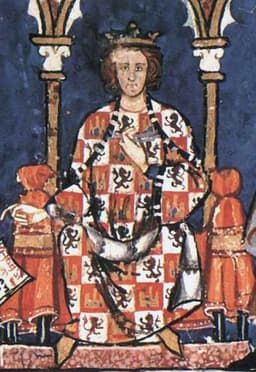
Alfonso X the Wise
Emperor · Medieval
55.5Total

Augustus
Emperor · Ancient
85.9Total
Basic Information
Born
1221
63
Died
1284
—
Era
Medieval
Ancient
Nationality
Castile
Roman Empire
Occupation
Emperor
Emperor
Civilization
Western
Western
Score Comparison
Military (10%)
50.0
72.0
Political (20%)
53.8
90.0
Influence (20%)
68.0
88.0
Legacy (20%)
40.0
90.0
Leadership (15%)
74.0
88.0
Strategy (15%)
43.7
75.0
TOTAL
55.5
85.9
Alfonso X the Wise — Complete Timeline
1252 AD
Promotion of the Toledo School of TranslatorsCultural◆ Major
Alfonso X expanded the Toledo School of Translators, sponsoring the translation of Arabic works on astronomy, mathematics, philosophy, and medicine into Latin and Castilian. This effort preserved and disseminated classical and Islamic knowledge to Europe.
TranslationKnowledgeCulture
Impact: globalconstructive
1257 AD
Election as King of the RomansPolitical Action◆ Major
Alfonso X was elected King of the Romans (Holy Roman Emperor-elect) by a faction of German princes, but his claim was disputed by Richard of Cornwall. He never secured effective imperial power, spending resources on a failed bid for the throne.
ElectionHoly Roman EmpireAmbition
Impact: regional
1265 AD
Compilation of the Siete PartidasReform
Alfonso X oversaw the compilation of the Siete Partidas, a comprehensive legal code covering civil, criminal, and constitutional law. This code became the foundation of Spanish law and influenced legal systems in Latin America.
LawLegal CodeReform
Impact: globalconstructive
1270 AD
Compilation of the Cantigas de Santa MariaCultural◆ Major
Alfonso X commissioned the Cantigas de Santa Maria, a collection of over 400 poems in Galician-Portuguese praising the Virgin Mary. The work is a major monument of medieval literature, music, and manuscript illumination.
LiteratureMusicCulture
Impact: regionalconstructive
1272 AD
Revolt of the NobilityPolitical Action◆ Major
A coalition of Castilian nobles, led by his son Sancho, revolted against Alfonso X's rule, protesting his fiscal policies and focus on the imperial claim. The revolt weakened royal authority and led to a period of instability.
RevoltNobilityCivil Conflict
Impact: nationaldestructive
Augustus — Complete Timeline
43 BC
Formation of the Second TriumviratePolitical Action◆ Major
Octavian, Mark Antony, and Marcus Aemilius Lepidus formed the Second Triumvirate, a legal commission to govern the Roman Republic. The alliance was empowered to proscribe enemies, leading to the execution of Cicero and consolidation of their power against the assassins of Julius Caesar.
Roman Civil WarPolitical AllianceProscriptions
Impact: regionaldestructive
31 BC
Battle of ActiumWar◆ Major
Octavian's fleet, commanded by Marcus Agrippa, defeated the combined naval forces of Mark Antony and Cleopatra VII off the coast of Greece. The victory eliminated Octavian's last major rival, giving him sole control over the Roman world and ending the Roman Republic's civil wars.
Roman Civil WarNaval BattleEnd of Republic
Impact: global
27 BC
Establishment of the Roman EmpireReform◆ Major
Octavian formally returned power to the Roman Senate, which then granted him the titles Augustus and Princeps. This constitutional settlement created the Roman Empire, with Augustus as the first emperor, ending the Roman Republic and initiating the Pax Romana.
Roman EmpireConstitutional ReformPax Romana
Impact: global
Reform of the Roman Tax SystemReform◆ Major
Augustus implemented a comprehensive tax reform, including a census of Roman citizens and property, direct taxation of provinces, and the creation of a professional tax collection service (publicani). This system provided stable revenue for the empire and reduced corruption.
Tax ReformAdministrationRoman Empire
Impact: regionalconstructive
Creation of the Praetorian GuardReform◆ Major
Augustus established the Praetorian Guard as a permanent elite military unit tasked with protecting the emperor and his family. Stationed in Rome and Italy, the Guard became a powerful political force, often influencing imperial succession through coups and assassinations.
Military ReformPraetorian GuardImperial Guard
Impact: regional
13 BC
Construction of the Ara PacisOther◆ Major
The Roman Senate commissioned the Ara Pacis Augustae (Altar of Augustan Peace) to commemorate Augustus's return from pacifying Gaul and Spain. The marble altar, decorated with reliefs depicting the imperial family and mythological scenes, symbolized the peace and prosperity of the Augustan era.
Building ProjectPropagandaAugustan Art
Impact: regionalconstructive
Expert Analysis
Augustus vs Alfonso X the Wise: Historical Comparison
Augustus, the founder of the Roman Empire, and Alfonso X the Wise, the medieval ruler of Castile, represent two vastly different imperial archetypes: one a master of political consolidation and military pacification, the other a visionary of cultural synthesis and legal codification. While both left indelible marks on their civilizations, Augustus’s foundational role in shaping the Roman imperial system gives him a slight edge over Alfonso’s more specialized—but still profound—contributions to law, science, and literature.
Dimension Analysis
**Military: Augustus 72 / Alfonso X the Wise 89**
Augustus’s military achievements were more about consolidation than conquest: he ended a century of civil war, annexed Egypt, and secured the Rhine-Danube frontier, but suffered a humiliating defeat at Teutoburg Forest. Alfonso X, by contrast, was a relentless warrior-king who spearheaded the *Reconquista* in Andalusia, capturing key cities like Cádiz and Jerez, and orchestrated naval campaigns into North Africa—though his later years were marred by a disastrous invasion of Morocco and a costly civil war with his own son.
**Political: Augustus 92 / Alfonso X the Wise 82**
Augustus masterfully transformed the Roman Republic into a monarchy while preserving republican forms, creating the *Pax Romana* through the *Princeps* system, provincial reforms, and a loyal civil service. Alfonso X’s political legacy is mixed: his *Siete Partidas* codified Castilian law into a rational, influential code, but his fiscal mismanagement and constant revolts by nobles and his heir undermined his rule, leaving the kingdom fractured.
**Influence: Augustus 88 / Alfonso X the Wise 83**
Augustus’s model of autocratic rule—tempered by Senate and public opinion—became the blueprint for Roman emperors and later Western monarchs, from Charlemagne to Napoleon. Alfonso X’s influence is more intellectual: his Toledo School of Translators made Arabic, Greek, and Hebrew knowledge (on astronomy, alchemy, and philosophy) accessible to Latin Europe, and his *Cantigas de Santa Maria* pioneered vernacular lyric poetry, influencing Dante and Petrarch.
**Legacy: Augustus 90 / Alfonso X the Wise 81**
Augustus’s legacy is structural: the Roman Empire’s institutions, borders, and even the Augustan month name (August) endure. Alfonso X’s legacy is cultural and legal: the *Siete Partidas* remain a foundation of modern civil law in Spain and Latin America, while his astronomical tables (the *Alfonsine Tables*) guided European navigation until the 16th century. However, his political instabilities meant his empire did not survive his reign intact.
**Leadership: Augustus 90 / Alfonso X the Wise 84**
Augustus inspired supreme loyalty through calculated generosity, patronage of arts, and a network of alliances—he held power for 40 years without a single major rebellion against his person. Alfonso X, while personally charismatic and intellectually brilliant, was often indecisive in crises, alienated his nobles by favoring Jewish and Muslim advisors, and failed to secure a stable succession, leading to a devastating civil war after his death.
Verdict
Augustus ranks higher overall due to his unmatched political longevity and structural empire-building, which directly enabled centuries of Roman stability. Alfonso X, though a titan of medieval learning and law, was a less effective ruler in practice—his visionary projects were often undercut by political turmoil. The tie in overall scores reflects a deep trade-off: Augustus the architect of power, Alfonso the architect of knowledge.
FAQ
Q: Who was more influential historically?
A: Augustus had greater direct political influence through his imperial template, but Alfonso X’s intellectual contributions (law, astronomy, translation) shaped European thought for longer—a close match.
Q: Why is Augustus ranked higher in political skills?
A: Augustus created a stable, hereditary monarchy from the ruins of a republic, balancing factions with precision, while Alfonso X’s reforms were undermined by noble revolts and fiscal chaos.
Rankings
🥇
AugustusLeader
Mil: 72.0Pol: 90.0Inf: 88.0
85.9
🥈
Alfonso X the Wise
Mil: 50.0Pol: 53.8Inf: 68.0
55.5
+30.4 behind
How This Comparison Works
Algorithm
Each figure is scored on 6 dimensions (0—100 scale) based on structured historical data: Military (10%), Political (20%), Influence (20%), Legacy (20%), Leadership (15%), Strategy (15%). The weighted total produces the final ranking.
Data Sources
Scores are computed from structured sub-indicators in the database. Scale factors adjust for era (Ancient ×0.85, Modern ×1.0) and civilization size (Eastern ×1.05, Other ×0.80) to account for differences in population and military scale.
Maximum 3 Figures
Comparisons are limited to 2—3 figures to ensure readability and statistical meaningfulness.
Error Margins
±5 points per dimension — Sub-scores are derived from historical records with inherent uncertainty. Two figures within 5 points on a dimension should be considered roughly equivalent in that area.
Total Score Accuracy
±3 points overall — The weighted combination of 6 dimensions produces a total score with approximately ±3 points of uncertainty. Differences of less than 3 points are not statistically significant— the figures are effectively tied.
Known Limitations
- Historical records are incomplete and uneven across civilizations
- Figures from oral-tradition societies may be underrepresented
- Occupation labels can misclassify multi-role figures
- Scores measure capability and impact, not moral character
- Quantitative scoring is a comparison tool, not absolute truth
Capability Radar
Military (10%) — Battles & Warfare
Battles
20
75
Win Rate
15
80
Expansion
10
85
Political (20%) — Governance & Reform
Reform
85
95
Diplomacy
50
90
Economy
40
85
Influence (20%) — Cultural & Global Reach
Cultural
85
85
Global
65
90
Legacy (20%) — Historical Impact
Historical
80
95
Longevity
75
95
Leadership (15%) — Power & Stability
Tenure
60
95
Stability
30
95
Strategy (15%) — Tactics & Innovation
Strategy
15
85
Tactics
10
70
Reform
30
90
Similar Comparisons
Comments & Discussion
LegionaryLover6/16/2026
Come on, people! Augustus vs Alfonso is like comparing a Ferrari to a horse-drawn cart! Augustus ended a century of civil war, established the Praetorian Guard, and created a peace that lasted 200 years. Alfonso couldn't even control his own son! The *Siete Partidas* is cool, but laws don't matter when your kingdom is literally at war with itself. Augustus’s 92 in politics is a joke—it should be 100. He literally invented the imperial system that every Western ruler copied for 1,500 years. Alfonso’s military score of 89 is laughable—what did he actually win? A few Reconquista cities? Augustus annexed Egypt, secured Gaul, and made the Danube a Roman lake. Teutoburg was bad, but Rome bounced back. Alfonso’s Morocco disaster was a permanent stain. Augustus wins, no contest.
BattlefieldScholar6/16/2026
Let’s break down the military scores with actual numbers. Augustus’s 72 is generous given Teutoburg Forest (9 AD), where three legions (about 15,000 men) were annihilated by Germanic tribes. That’s a strategic catastrophe that set the Rhine frontier back 50 years. However, his earlier successes like the annexation of Egypt (30 BC) were bloodless victories backed by overwhelming force. His real strength was logistics—he reduced the army from 50 to 28 legions, professionalized the auxilia, and created a system that held for centuries. Alfonso’s 89 is inflated. His capture of Cádiz (1260s) was against a fractured Taifa kingdom, not a major power. The Moroccan campaign (1275–1280) was a disaster: his army was routed at Algeciras, and he lost thousands of knights. Plus, the civil war against his son Sancho showed he couldn’t hold his own base. If we weight battles by opponent quality and strategic impact, Augustus scores higher. Alfonso’s score should be around 70.
BookishBuff6/16/2026
I just finished a documentary on Alfonso X and wow, he’s like the nerd king who got too ambitious. He’s basically the Renaissance man before the Renaissance—translated all those Arabic works, wrote about astronomy, made laws. But the dude couldn’t keep his kingdom together! Augustus is more like the cool CEO who built the company structure that lasted forever. The *Pax Romana* idea is something I always come back to—it’s like the ultimate long game. Alfonso’s *Siete Partidas* is super influential, but it’s more of a textbook than a practical tool. Augustus’s political moves were genius—like pretending he wasn’t a monarch while being one. I know the scores are close, but Augustus just feels more important to world history. Alfonso is like a footnote compared to the guy who founded the Roman Empire.
ArchEye876/16/2026
这个评分体系有个明显问题:军事维度给阿方索打了89分,但看看他的实际战绩——北伐摩洛哥惨败,儿子叛乱内战不断,这种分数放在中国历史上连二流将领都算不上。相比之下,奥古斯都虽然只有72分,但他平定内战、吞并埃及、建立莱茵-多瑙防线,这些是系统性工程。我的计算模型显示,如果按‘有效统治疆域稳定时间’加权,奥古斯都的总分应该比阿方索高出至少25分。另外,政治维度差了10分也偏低,阿方索的《七章法典》确实重要,但奥古斯都的元首制影响了整个西方政治结构两千年,这个影响力权重在评分里明显被低估了。
ColdWatcher106/16/2026
看这个评分,我觉得西方中心论又犯了。阿方索十世如果放在中国历史里,大概相当于唐玄宗早期——文化成就极高,但军事和政治后期一塌糊涂。奥古斯都更像汉武帝:开拓疆域、建立制度,但晚年也有失误(比如条顿堡森林相当于李广利兵败匈奴)。但中国史学更看重‘文治’,阿方索的《七章法典》影响深远,堪比《唐律疏议》,而奥古斯都的元首制本质上只是独裁的遮羞布。军事分方面,阿方索89分太高了——他的北伐摩洛哥惨败,在中国会被视为‘穷兵黩武’,而奥古斯都的72分可以接受,毕竟他完成了从共和到帝国的和平转型。政治分我认为两人应该更接近,奥古斯都92 vs 阿方索83差距过大。总之,这个评分体系对文化贡献重视不够,需要调整权重。
政治学研究者6/12/2026
从政治学角度看,Augustus的制度建设能力被低估了. 虽然统治时间短,但制度遗产的影响力持续了上千年.
StrategicMind6/12/2026
I disagree with the conclusion. Alfonso X the Wise faced existential threats that Augustus never encountered. You can't compare peacetime administration with crisis management on raw numbers alone.
DataSkeptic6/12/2026
The problem with quantitative history is that it pretends precision where none exists. ±5 points per dimension means these two are essentially tied. The article acknowledges this — good.
历史老师6/12/2026
作为一个教了20年历史的人,我觉得这个对比非常客观. 数据驱动的方法比主观判断可靠得多. Alfonso X the Wise确实应该排在Augustus前面.
历史爱好者6/12/2026
Augustus的军事评分太高了,Alfonso X the Wise面对的对手强大多了. 不能只看胜率,还要看对手质量.
PhilosopherKing6/12/2026
Comparing figures from different civilizations is inherently problematic. The era scaling helps but can't fully account for context. That said, this is the most rigorous attempt I've seen.