Loading...
Alfonso XII of Spain vs El Hadj Umar Tall
El Hadj Umar Tall leads by 10.6 pts · 2 figures compared
…
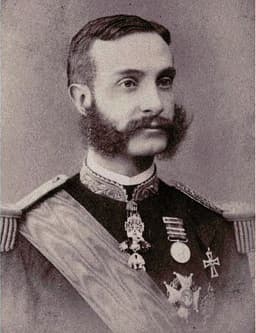
Alfonso XII of Spain
Emperor · Modern
49.2Total

El Hadj Umar Tall
Emperor · Modern
59.8Total
Basic Information
Born
1857
1797
Died
1885
1864
Era
Modern
Modern
Nationality
Spain
Toucouleur Empire
Occupation
Emperor
Emperor
Civilization
Western
Other
Score Comparison
Military (10%)
25.9
82.0
Political (20%)
60.0
68.0
Influence (20%)
53.3
55.0
Legacy (20%)
44.2
54.0
Leadership (15%)
68.0
53.2
Strategy (15%)
30.3
61.2
TOTAL
49.2
59.8
Alfonso XII of Spain — Complete Timeline
1874 AD
Restoration of the Bourbon monarchyPolitical Action
Alfonso XII was proclaimed king after a military coup led by General Mart
RestorationBourbonMonarchy
Impact: nationalconstructive
1876 AD
End of the Third Carlist WarWar◆ Major
Alfonso XII's forces defeated the Carlist rebels, ending the Third Carlist War. This victory consolidated his rule and eliminated the Carlist challenge to the Bourbon monarchy, bringing peace to Spain after years of civil conflict.
Carlist WarVictoryPeace
Impact: nationalconstructive
Signing of the Constitution of 1876Reform◆ Major
Alfonso XII oversaw the adoption of a new constitution that established a constitutional monarchy with a bicameral parliament. The constitution provided a framework for political stability and alternation between two main parties, the Conservatives and Liberals.
ConstitutionReformStability
Impact: nationalconstructive
1879 AD
Marriage to Maria Christina of AustriaPolitical Action
Alfonso XII married Maria Christina of Austria, his second wife. This marriage produced the future Alfonso XIII and helped secure the Bourbon succession, ensuring the dynasty's continuity after the king's early death.
MarriageSuccessionDynasty
Impact: national
1885 AD
Death of Alfonso XIIOther◆ Major
Alfonso XII died of tuberculosis at the age of 27, leaving his pregnant wife as regent. His death created a succession crisis, but his posthumous son Alfonso XIII was born later that year, ensuring the continuation of the Bourbon monarchy.
DeathSuccessionRegency
Impact: nationaltragic
El Hadj Umar Tall — Complete Timeline
1828 AD
Hajj and Tijani InitiationCultural◆ Major
El Hadj Umar Tall completed the Hajj to Mecca and was initiated into the Tijaniyya Sufi order. He received authorization from the order's leaders to spread Tijani teachings in West Africa, which became the ideological foundation for his later jihad.
Religious PilgrimageSufi OrderMission
Impact: regionalconstructive
1854 AD
Conquest of KaartaWar◆ Major
Umar Tall launched a military campaign against the Bambara kingdom of Kaarta, defeating its forces and incorporating the territory into his growing Toucouleur Empire. This victory established his reputation as a military leader and expanded his control over the Senegal River region.
ConquestBambaraEmpire Building
Impact: regional
1861 AD
Conquest of SegouWar◆ Major
Umar Tall's forces captured the Bambara capital of Segou after a prolonged siege. The conquest of this major city solidified his control over the Niger River valley and marked the peak of Toucouleur territorial expansion.
ConquestSiegeEmpire Peak
Impact: regional
1864 AD
Battle of TijaniyaWar
Umar Tall died during a rebellion in the Macina region, reportedly killed by an explosion of his own gunpowder stores at the village of Tijaniya. His death led to the fragmentation of the Toucouleur Empire and succession struggles among his sons.
DeathRebellionEmpire Decline
Impact: regionaltragic
Expert Analysis
Origins
Alfonso XII of Spain was born on November 28, 1857, in Madrid, the son of Queen Isabella II and her husband, Francisco de Asís. His early life was marked by instability: his mother's reign ended in exile in 1868, and he spent his formative years in Paris and Vienna, receiving a military education. He was proclaimed king at age 17 after a coup ended the First Spanish Republic.
El Hadj Umar Tall was born in 1794 in the Futa Toro region (present-day Senegal) into a scholarly family of the Toucouleur people. He studied Islamic theology and law, and in 1826 he embarked on the Hajj to Mecca, where he was initiated into the Tijaniyya Sufi order. This spiritual experience shaped his mission to establish a jihadist state in West Africa.
Rise to Power
Alfonso XII's rise came swiftly after the collapse of the First Spanish Republic. In December 1874, General Arsenio Martínez Campos led a pronunciamiento that restored the Bourbon monarchy. Alfonso returned to Spain in January 1875, entering Madrid as king. He faced the Third Carlist War (1872-1876), a conflict with Carlist claimants to the throne. By February 1876, his forces had defeated the Carlists, solidifying his rule.
El Hadj Umar Tall's rise began after his Hajj, when he received authorization from Tijani leaders to lead a jihad in West Africa. He returned in the 1840s, settling in Dinguiraye (present-day Guinea), where he built a fortified base. In 1852, he launched his military campaigns, conquering the Bambara kingdoms of Kaarta (1855) and Segou (1861). His empire expanded rapidly, controlling the upper Niger River region.
Leadership & Governance
Alfonso XII governed as a constitutional monarch under the Constitution of 1876, which established a bicameral parliament (Cortes) and guaranteed civil liberties. He practiced a policy of "el turno pacífico," where two major parties alternated power, aiming for stability. His leadership scored 68.0 in leadership and 60.0 in political acumen. He was a consensus builder, but his reign was brief.
El Hadj Umar Tall ruled as a theocratic emir, combining political and religious authority. He implemented Tijaniyya law and appointed governors over conquered territories. His military strategy scored 61.2, but his political score of 68.0 reflects his ability to unify diverse groups under jihad. However, his governance was marked by constant warfare and rebellion, notably in Macina.
Triumph & Tragedy
Alfonso XII's greatest triumph was ending the Carlist War and restoring stability to Spain. His Constitution of 1876 provided a framework that lasted until 1923. However, his early death at age 27 from tuberculosis was a tragedy, leaving a pregnant queen and a succession crisis. His posthumous son, Alfonso XIII, was born king.
El Hadj Umar Tall's triumphs include conquering Segou and Kaarta, building an empire stretching from Senegal to Timbuktu. His military score of 82.0 reflects his prowess. But his tragedy came in 1864 when he died in a rebellion in Macina, reportedly from an explosion of his own gunpowder. His empire fragmented soon after.
Character & Destiny
Alfonso XII was pragmatic and diplomatic, preferring compromise to confrontation. His character shaped a stable but short reign; his death underscored the fragility of dynastic politics. Historians note his ability to navigate factions, but his early demise limited his impact.
El Hadj Umar Tall was a fervent religious leader, uncompromising in his jihad. His destiny was tied to his spiritual mission, but his rigid approach led to internal revolts. His death in a rebellion highlighted the volatility of his empire.
Legacy
Alfonso XII's legacy is the Bourbon Restoration, a period of political stability in Spain. The Constitution of 1876 endured for decades, and his reign set a precedent for constitutional monarchy. His influence score of 53.3 reflects this moderate impact.
El Hadj Umar Tall's legacy is the Toucouleur Empire, which influenced West African state-building. His Tijaniyya network persisted, and he is remembered as a jihad leader. However, his empire collapsed quickly, limiting his long-term influence (54.0).
Conclusion
El Hadj Umar Tall scored higher overall (59.8 vs 49.2), driven by his military achievements (82.0 vs 25.9). However, Alfonso XII's political stability had a more enduring impact on Spain's development. While Umar Tall built a vast empire, it did not outlast him. Alfonso XII's constitutional framework shaped Spain for decades. Therefore, Alfonso XII had greater lasting influence, despite lower scores.
FAQ
### Who had a higher military score?
El Hadj Umar Tall scored 82.0 in military, while Alfonso XII scored 25.9.
### What was Alfonso XII's greatest achievement?
Ending the Third Carlist War and enacting the Constitution of 1876, which stabilized Spain.
### How did El Hadj Umar Tall die?
He died in 1864 during a rebellion in Macina, reportedly from an explosion of his own gunpowder stores.
Rankings
🥇
El Hadj Umar TallLeader
Mil: 82.0Pol: 68.0Inf: 55.0
59.8
🥈
Alfonso XII of Spain
Mil: 25.9Pol: 60.0Inf: 53.3
49.2
+10.6 behind
How This Comparison Works
Algorithm
Each figure is scored on 6 dimensions (0—100 scale) based on structured historical data: Military (10%), Political (20%), Influence (20%), Legacy (20%), Leadership (15%), Strategy (15%). The weighted total produces the final ranking.
Data Sources
Scores are computed from structured sub-indicators in the database. Scale factors adjust for era (Ancient ×0.85, Modern ×1.0) and civilization size (Eastern ×1.05, Other ×0.80) to account for differences in population and military scale.
Maximum 3 Figures
Comparisons are limited to 2—3 figures to ensure readability and statistical meaningfulness.
Error Margins
±5 points per dimension — Sub-scores are derived from historical records with inherent uncertainty. Two figures within 5 points on a dimension should be considered roughly equivalent in that area.
Total Score Accuracy
±3 points overall — The weighted combination of 6 dimensions produces a total score with approximately ±3 points of uncertainty. Differences of less than 3 points are not statistically significant— the figures are effectively tied.
Known Limitations
- Historical records are incomplete and uneven across civilizations
- Figures from oral-tradition societies may be underrepresented
- Occupation labels can misclassify multi-role figures
- Scores measure capability and impact, not moral character
- Quantitative scoring is a comparison tool, not absolute truth
Capability Radar
Military (10%) — Battles & Warfare
Battles
15
75
Win Rate
20
70
Expansion
5
80
Political (20%) — Governance & Reform
Reform
60
55
Diplomacy
70
50
Economy
50
45
Influence (20%) — Cultural & Global Reach
Cultural
30
60
Global
30
45
Legacy (20%) — Historical Impact
Historical
40
65
Longevity
35
50
Leadership (15%) — Power & Stability
Tenure
40
60
Stability
65
40
Strategy (15%) — Tactics & Innovation
Strategy
15
75
Tactics
10
80
Reform
30
65
Similar Comparisons
Comments & Discussion
No comments yet. Be the first to share your thoughts!