Loading...
Alfonso XII of Spain vs Mwene Muji
Alfonso XII of Spain leads by 12.7 pts · 2 figures compared
…
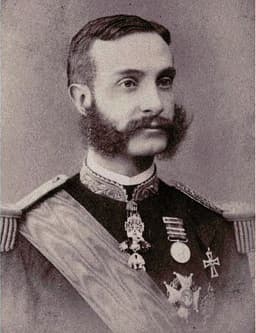
Alfonso XII of Spain
Emperor · Modern
49.2Total

Mwene Muji
Emperor · Modern
36.5Total
Basic Information
Born
1857
1650
Died
1885
1700
Era
Modern
Modern
Nationality
Spain
DR Congo
Occupation
Emperor
Emperor
Civilization
Western
Other
Score Comparison
Military (10%)
25.9
20.0
Political (20%)
60.0
27.9
Influence (20%)
53.3
45.5
Legacy (20%)
44.2
33.3
Leadership (15%)
68.0
34.6
Strategy (15%)
30.3
54.3
TOTAL
49.2
36.5
Alfonso XII of Spain — Complete Timeline
1874 AD
Restoration of the Bourbon monarchyPolitical Action
Alfonso XII was proclaimed king after a military coup led by General Mart
RestorationBourbonMonarchy
Impact: nationalconstructive
1876 AD
End of the Third Carlist WarWar◆ Major
Alfonso XII's forces defeated the Carlist rebels, ending the Third Carlist War. This victory consolidated his rule and eliminated the Carlist challenge to the Bourbon monarchy, bringing peace to Spain after years of civil conflict.
Carlist WarVictoryPeace
Impact: nationalconstructive
Signing of the Constitution of 1876Reform◆ Major
Alfonso XII oversaw the adoption of a new constitution that established a constitutional monarchy with a bicameral parliament. The constitution provided a framework for political stability and alternation between two main parties, the Conservatives and Liberals.
ConstitutionReformStability
Impact: nationalconstructive
1879 AD
Marriage to Maria Christina of AustriaPolitical Action
Alfonso XII married Maria Christina of Austria, his second wife. This marriage produced the future Alfonso XIII and helped secure the Bourbon succession, ensuring the dynasty's continuity after the king's early death.
MarriageSuccessionDynasty
Impact: national
1885 AD
Death of Alfonso XIIOther◆ Major
Alfonso XII died of tuberculosis at the age of 27, leaving his pregnant wife as regent. His death created a succession crisis, but his posthumous son Alfonso XIII was born later that year, ensuring the continuation of the Bourbon monarchy.
DeathSuccessionRegency
Impact: nationaltragic
Expert Analysis
Origins
Alfonso XII of Spain was born on November 28, 1857, in Madrid, the son of Queen Isabella II and King Francis of Assisi. His early life was marked by political turmoil: his mother's reign ended in exile in 1868 after the Glorious Revolution, and Alfonso spent his formative years in Paris and Vienna, receiving a military education at the Theresian Military Academy. This cosmopolitan upbringing exposed him to constitutional ideas but also instilled a sense of dynastic duty.
Mwene Muji, also known as Mwene Muji or Mwene Muji, was a ruler of the Boma people in what is now the Democratic Republic of the Congo, active in the late 19th century. Details of his early life are scarce due to the lack of written records from the region at the time. He likely inherited his position through traditional Boma kinship structures, which were matrilineal in some aspects. The Boma kingdom was a small polity along the Congo River, primarily engaged in trade and local governance.
Rise to Power
Alfonso XII's path to the throne was paved by the collapse of the First Spanish Republic. On December 29, 1874, General Arsenio Martínez Campos led a pronunciamiento in Sagunto, proclaiming Alfonso king and restoring the Bourbon monarchy. The new king arrived in Spain in January 1875, quickly consolidating support from conservative and moderate factions. His rise was less a personal conquest and more a restoration orchestrated by military and political elites, notably the architect of the Restoration, Antonio Cánovas del Castillo.
Mwene Muji's rise to power is not documented in European sources. As a Boma ruler, he likely ascended through customary succession, possibly involving councils of elders or lineage claims. The Boma people had a centralized chieftaincy, but Mwene Muji's specific path is unknown. His influence was limited to the Congo River basin, and he did not engage in major external conflicts or alliances that would be recorded in colonial archives.
Leadership & Governance
Alfonso XII governed as a constitutional monarch under the 1876 Constitution, which established a bicameral Cortes (Senate and Congress) and guaranteed civil liberties. His leadership style was conciliatory: he sought to end the Carlist Wars by granting amnesties and integrating former enemies. For instance, he personally intervened to pacify the Carlist stronghold of Navarre. He also worked to stabilize the military by reducing its political role. His governance score of 68.0 reflects his effectiveness in managing a transition from republic to monarchy without major upheaval.
Mwene Muji's governance is inferred from general Boma practices. The Boma kingdom was a small, agrarian state with a ruler who served as a judge and redistributor of resources. There is no evidence of major reforms or administrative innovations. His leadership score of 34.6 suggests limited impact beyond his immediate domain. The Boma had no written laws or bureaucracy; governance was personal and based on oral tradition.
Triumph & Tragedy
Alfonso XII's greatest triumph was ending the Third Carlist War in 1876, which secured the Bourbon dynasty against Carlist pretenders. He also oversaw the adoption of a stable constitution that lasted until 1923. However, his reign was tragically short: he died of tuberculosis at age 27 in 1885, leaving his pregnant wife Maria Christina as regent. His death created a succession crisis, though his posthumous son Alfonso XIII eventually inherited the throne. The Restoration system he helped build ultimately collapsed in 1931, but his personal popularity remained high.
Mwene Muji's triumphs and tragedies are largely unknown. As a small-scale ruler, he likely faced challenges from rival villages or European encroachment, but no specific events are recorded. His legacy is minimal, with a legacy score of 33.3. The Boma kingdom was eventually absorbed into the Congo Free State under King Leopold II of Belgium, and Mwene Muji's reign left no lasting mark on regional history.
Character & Destiny
Alfonso XII was known for his charm, intelligence, and pragmatism. He was called "El Pacificador" (the Peacemaker) for his role in ending the Carlist Wars and fostering national reconciliation. His early death was seen as a tragedy for Spain, as he had shown promise as a unifying figure. Historians note that his character—moderate and diplomatic—was well-suited to the delicate political balance of the Restoration.
Mwene Muji's character is not recorded. The absence of written sources means we cannot assess his personality or decision-making. His destiny was to be a minor figure in the broader narrative of African colonialism, overshadowed by larger kingdoms like the Luba or Lunda. His total score of 36.5 reflects this obscurity.
Legacy
Alfonso XII's legacy is the Restoration system, which provided Spain with political stability for over three decades. The 1876 Constitution influenced later Spanish charters, and his reign set a precedent for constitutional monarchy. His son Alfonso XIII's reign would later face challenges, but Alfonso XII is remembered as a foundational figure of modern Spain. His influence score of 53.3 and legacy score of 44.2 indicate a moderate but lasting impact.
Mwene Muji's legacy is negligible. The Boma people have preserved oral traditions, but Mwene Muji is not a prominent figure in Congolese history. His legacy score of 33.3 is low, and no major institutions or ideas are attributed to him. The only record of his existence comes from brief mentions in colonial-era ethnographies.
Conclusion
Alfonso XII had a significantly greater impact than Mwene Muji. His political score of 60.0 against Mwene Muji's 27.9, and leadership score of 68.0 against 34.6, demonstrate his effectiveness in governance and state-building. While Mwene Muji ruled a small polity with limited reach, Alfonso XII shaped the trajectory of a European nation during a critical period. The score gap of 12.7 points understates the divergence in historical significance: Alfonso XII's actions influenced millions, while Mwene Muji's rule is virtually unknown. Thus, Alfonso XII is clearly the more impactful figure.
Rankings
🥇
Alfonso XII of SpainLeader
Mil: 25.9Pol: 60.0Inf: 53.3
49.2
🥈
Mwene Muji
Mil: 20.0Pol: 27.9Inf: 45.5
36.5
+12.7 behind
How This Comparison Works
Algorithm
Each figure is scored on 6 dimensions (0—100 scale) based on structured historical data: Military (10%), Political (20%), Influence (20%), Legacy (20%), Leadership (15%), Strategy (15%). The weighted total produces the final ranking.
Data Sources
Scores are computed from structured sub-indicators in the database. Scale factors adjust for era (Ancient ×0.85, Modern ×1.0) and civilization size (Eastern ×1.05, Other ×0.80) to account for differences in population and military scale.
Maximum 3 Figures
Comparisons are limited to 2—3 figures to ensure readability and statistical meaningfulness.
Error Margins
±5 points per dimension — Sub-scores are derived from historical records with inherent uncertainty. Two figures within 5 points on a dimension should be considered roughly equivalent in that area.
Total Score Accuracy
±3 points overall — The weighted combination of 6 dimensions produces a total score with approximately ±3 points of uncertainty. Differences of less than 3 points are not statistically significant— the figures are effectively tied.
Known Limitations
- Historical records are incomplete and uneven across civilizations
- Figures from oral-tradition societies may be underrepresented
- Occupation labels can misclassify multi-role figures
- Scores measure capability and impact, not moral character
- Quantitative scoring is a comparison tool, not absolute truth
Capability Radar
Military (10%) — Battles & Warfare
Battles
15
5
Win Rate
20
5
Expansion
5
5
Political (20%) — Governance & Reform
Reform
60
10
Diplomacy
70
10
Economy
50
10
Influence (20%) — Cultural & Global Reach
Cultural
30
5
Global
30
5
Legacy (20%) — Historical Impact
Historical
40
5
Longevity
35
5
Leadership (15%) — Power & Stability
Tenure
40
10
Stability
65
10
Strategy (15%) — Tactics & Innovation
Strategy
15
5
Tactics
10
5
Reform
30
5
Similar Comparisons
Comments & Discussion
No comments yet. Be the first to share your thoughts!