Loading...
Alfonso XII of Spain vs Savang Vatthana
Alfonso XII of Spain leads by 7.5 pts · 2 figures compared
…
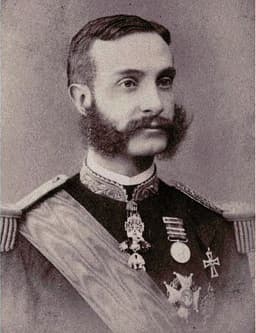
Alfonso XII of Spain
Emperor · Modern
49.2Total

Savang Vatthana
Emperor · Modern
41.7Total
Basic Information
Born
1857
1907
Died
1885
1978
Era
Modern
Modern
Nationality
Spain
Laos
Occupation
Emperor
Emperor
Civilization
Western
Eastern
Score Comparison
Military (10%)
25.9
53.6
Political (20%)
60.0
27.9
Influence (20%)
53.3
47.1
Legacy (20%)
44.2
34.2
Leadership (15%)
68.0
37.4
Strategy (15%)
30.3
62.6
TOTAL
49.2
41.7
Alfonso XII of Spain — Complete Timeline
1874 AD
Restoration of the Bourbon monarchyPolitical Action
Alfonso XII was proclaimed king after a military coup led by General Mart
RestorationBourbonMonarchy
Impact: nationalconstructive
1876 AD
End of the Third Carlist WarWar◆ Major
Alfonso XII's forces defeated the Carlist rebels, ending the Third Carlist War. This victory consolidated his rule and eliminated the Carlist challenge to the Bourbon monarchy, bringing peace to Spain after years of civil conflict.
Carlist WarVictoryPeace
Impact: nationalconstructive
Signing of the Constitution of 1876Reform◆ Major
Alfonso XII oversaw the adoption of a new constitution that established a constitutional monarchy with a bicameral parliament. The constitution provided a framework for political stability and alternation between two main parties, the Conservatives and Liberals.
ConstitutionReformStability
Impact: nationalconstructive
1879 AD
Marriage to Maria Christina of AustriaPolitical Action
Alfonso XII married Maria Christina of Austria, his second wife. This marriage produced the future Alfonso XIII and helped secure the Bourbon succession, ensuring the dynasty's continuity after the king's early death.
MarriageSuccessionDynasty
Impact: national
1885 AD
Death of Alfonso XIIOther◆ Major
Alfonso XII died of tuberculosis at the age of 27, leaving his pregnant wife as regent. His death created a succession crisis, but his posthumous son Alfonso XIII was born later that year, ensuring the continuation of the Bourbon monarchy.
DeathSuccessionRegency
Impact: nationaltragic
Savang Vatthana — Complete Timeline
1959 AD
Accession to the Throne of LaosPolitical Action◆ Major
Savang Vatthana became king of Laos following the death of his father Sisavang Vong. He inherited a kingdom already embroiled in civil war between the royal government, neutralists, and the communist Pathet Lao. His reign was marked by political instability and foreign intervention.
CoronationCivil WarMonarchy
Impact: national
1973 AD
Signing of the Vientiane AgreementPolitical Action◆ Major
Savang Vatthana endorsed the Vientiane Agreement, a ceasefire accord between the royal government and the Pathet Lao. The agreement established a coalition government and temporarily halted fighting in the Laotian Civil War, but failed to resolve the underlying political conflict.
CeasefireCoalitionCivil War
Impact: nationalconstructive
1975 AD
Abdication and Communist TakeoverPolitical Action
Following the Pathet Lao's military victory, Savang Vatthana abdicated the throne on December 2, 1975. The Lao People's Democratic Republic was proclaimed, ending 600 years of Lao monarchy. The king was appointed a 'private citizen' and 'adviser' to the new government.
AbdicationCommunist RevolutionEnd of Monarchy
Impact: nationaltragic
1978 AD
Death in Re-education CampPolitical Action◆ Major
Savang Vatthana, along with his family, was sent to a communist re-education camp in Houaphan Province. He died there in 1978 under unclear circumstances, likely from malnutrition and harsh conditions. His death was not officially acknowledged by the Lao government for decades.
Re-education CampDeathCommunist Repression
Impact: nationaltragic
Expert Analysis
Origins
Alfonso XII was born on November 28, 1857, in Madrid, Spain, as the son of Queen Isabella II and her husband, Francis of Assisi. His early life was marked by political instability: his mother was deposed in 1868, and the family went into exile. He received a military education in Austria and England, which shaped his pragmatic and conciliatory approach. In contrast, Savang Vatthana was born on November 13, 1907, in Luang Prabang, Laos, as the son of King Sisavang Vong. He was educated in French colonial schools and later in France, absorbing Western ideas while maintaining traditional Lao values. His upbringing prepared him for a ceremonial role under French protection, not for the violent upheavals of the Cold War.
Rise to Power
Alfonso XII's rise was engineered by a military coup. On December 29, 1874, General Arsenio Martínez Campos proclaimed Alfonso king in Sagunto, ending the First Spanish Republic. Alfonso returned to Spain in January 1875, and his reign was ratified by the Cortes. He quickly consolidated power by defeating the Carlist rebels, ending the Third Carlist War in 1876. Savang Vatthana became king on October 29, 1959, upon his father's death. He inherited a kingdom already embroiled in civil war between the royal government and the communist Pathet Lao. His rule was weak from the start, as Laos was a pawn in the Vietnam War. The 1973 Vientiane Agreement, which he endorsed, created a coalition government but ultimately failed to prevent a communist takeover.
Leadership & Governance
Alfonso XII governed as a constitutional monarch under the 1876 Constitution, which he helped draft. He balanced power between conservatives and liberals through the turno pacifico system, where two parties alternated in power. He promoted economic recovery and infrastructure projects, such as railway expansion. His leadership score of 68.0 reflects his ability to stabilize Spain after years of turmoil. Savang Vatthana, with a leadership score of 37.4, was largely a figurehead. He attempted neutrality but was unable to control his own military or negotiate with the Pathet Lao. His governance was ineffective; the country descended into civil war, and he was forced to abdicate in 1975.
Triumph & Tragedy
Alfonso XII's greatest success was restoring the Bourbon monarchy and bringing political stability to Spain. He ended the Carlist War and oversaw the constitution of 1876, which lasted until 1923. His tragedy was his early death from tuberculosis at age 27 in 1885, leaving a pregnant widow and a succession crisis. His posthumous son, Alfonso XIII, was born king, but the regency led to political instability. Savang Vatthana's triumph was his role in the Vientiane Agreement, which briefly brought peace. His tragedy was total: he lost his throne, his country became a communist state, and he died in a re-education camp in 1978 under unknown circumstances. His family also perished.
Character & Destiny
Alfonso XII was pragmatic, diplomatic, and determined. He learned from his mother's mistakes and avoided direct confrontation, favoring compromise. His character allowed him to unify factions and modernize Spain's political system. His destiny was cut short, but his legacy endured. Savang Vatthana was traditional, passive, and ill-equipped for the brutal realities of Cold War politics. He believed in diplomacy and neutrality, but his character made him unable to stand up to the Pathet Lao or the U.S. His destiny was tragic: he was a victim of history, swept away by forces he could not control.
Legacy
Alfonso XII's legacy is the restoration of the Bourbon dynasty and the 1876 Constitution, which provided a framework for Spanish politics until the Second Republic. He is remembered as a peacemaker and a modernizer. His total score of 49.2 reflects moderate impact. Savang Vatthana's legacy is that of a failed monarch: the last king of Laos, whose abdication marked the end of 600 years of monarchy. He is largely forgotten, except in Lao diaspora communities. His score of 41.7 is lower due to his lack of political influence and tragic end.
Conclusion
Alfonso XII had a greater impact than Savang Vatthana. His political score of 60.0 versus Savang's 27.9 demonstrates his effectiveness in governance. While both faced challenges, Alfonso successfully stabilized Spain and established a lasting constitutional order. Savang, despite a higher military score (53.6 vs 25.9), was unable to prevent his country's collapse. Alfonso's legacy of peace and constitutional monarchy outweighs Savang's tragic but negligible influence. The data supports Alfonso XII as the more significant historical figure.
Rankings
🥇
Alfonso XII of SpainLeader
Mil: 25.9Pol: 60.0Inf: 53.3
49.2
🥈
Savang Vatthana
Mil: 53.6Pol: 27.9Inf: 47.1
41.7
+7.5 behind
How This Comparison Works
Algorithm
Each figure is scored on 6 dimensions (0—100 scale) based on structured historical data: Military (10%), Political (20%), Influence (20%), Legacy (20%), Leadership (15%), Strategy (15%). The weighted total produces the final ranking.
Data Sources
Scores are computed from structured sub-indicators in the database. Scale factors adjust for era (Ancient ×0.85, Modern ×1.0) and civilization size (Eastern ×1.05, Other ×0.80) to account for differences in population and military scale.
Maximum 3 Figures
Comparisons are limited to 2—3 figures to ensure readability and statistical meaningfulness.
Error Margins
±5 points per dimension — Sub-scores are derived from historical records with inherent uncertainty. Two figures within 5 points on a dimension should be considered roughly equivalent in that area.
Total Score Accuracy
±3 points overall — The weighted combination of 6 dimensions produces a total score with approximately ±3 points of uncertainty. Differences of less than 3 points are not statistically significant— the figures are effectively tied.
Known Limitations
- Historical records are incomplete and uneven across civilizations
- Figures from oral-tradition societies may be underrepresented
- Occupation labels can misclassify multi-role figures
- Scores measure capability and impact, not moral character
- Quantitative scoring is a comparison tool, not absolute truth
Capability Radar
Military (10%) — Battles & Warfare
Battles
15
55
Win Rate
20
54
Expansion
5
58
Political (20%) — Governance & Reform
Reform
60
10
Diplomacy
70
15
Economy
50
10
Influence (20%) — Cultural & Global Reach
Cultural
30
15
Global
30
5
Legacy (20%) — Historical Impact
Historical
40
10
Longevity
35
5
Leadership (15%) — Power & Stability
Tenure
40
19
Stability
65
5
Strategy (15%) — Tactics & Innovation
Strategy
15
60
Tactics
10
64
Reform
30
65
Similar Comparisons
Comments & Discussion
No comments yet. Be the first to share your thoughts!