Loading...
Alp Arslan vs Napoleon Bonaparte
Alp Arslan leads by 3.3 pts · 2 figures compared
…
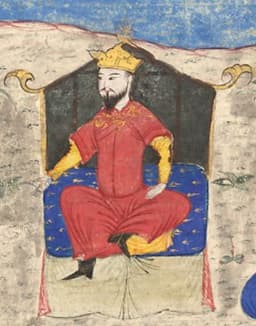
Alp Arslan
Emperor · Medieval
74.2Total

Napoleon Bonaparte
General · Modern
70.9Total
Basic Information
Born
1029
1769
Died
1072
1821
Era
Medieval
Modern
Nationality
Seljuk Empire
France
Occupation
Emperor
General
Civilization
Middle Eastern
Western
Score Comparison
Military (10%)
82.0
94.0
Political (20%)
65.0
72.0
Influence (20%)
82.0
40.0
Legacy (20%)
72.0
80.0
Leadership (15%)
72.0
78.0
Strategy (15%)
70.0
90.0
TOTAL
74.2
70.9
Alp Arslan — Complete Timeline
1070 AD
Conquest of Aleppo and SyriaWar◆ Major
Alp Arslan led campaigns into Syria, capturing Aleppo and extending Seljuk control to the Mediterranean coast. He defeated the Fatimid Caliphate's forces and established Seljuk dominance over the Levant.
ConquestSyriaFatimid
Impact: regional
1071 AD
Battle of ManzikertWar
Alp Arslan defeated the Byzantine Emperor Romanos IV Diogenes at the Battle of Manzikert in eastern Anatolia. The Byzantine army was destroyed and Romanos captured, leading to the Seljuk conquest of Anatolia and the beginning of Turkic settlement in the region.
BattleByzantineAnatolia
Impact: global
1072 AD
AssassinationOther◆ Major
Alp Arslan was assassinated by a captured fortress commander while on campaign in Transoxiana. His death at the height of his power led to a succession struggle and the eventual fragmentation of the Seljuk Empire under his son Malik Shah I.
AssassinationDeathSuccession
Impact: regionaltragic
Napoleon Bonaparte — Complete Timeline
1799 AD
Coup of 18 BrumaireOther◆ Major
Napoleon Bonaparte, with support from his brother Lucien and key political figures, overthrew the Directory in a bloodless coup. He established the Consulate with himself as First Consul, effectively becoming the ruler of France. This event ended the French Revolution's most unstable period.
French RevolutionCoupRise to Power
Impact: regional
1804 AD
Promulgation of the Napoleonic CodeOther◆ Major
Napoleon enacted the Civil Code of the French, known as the Napoleonic Code, a comprehensive set of laws that replaced the fragmented feudal legal systems. The code established legal equality, protected property rights, and secularized law. It became the basis for legal systems in many European and world countries.
Legal ReformNapoleonic CodeCivil Law
Impact: globalconstructive
1805 AD
Battle of AusterlitzWar◆ Major
Napoleon's Grande Arm
Napoleonic WarsBattleDecisive Victory
Impact: global
1812 AD
Invasion of RussiaWar◆ Major
Napoleon led the Grande Arm
Napoleonic WarsInvasionDisaster
Impact: globaldestructive
1815 AD
Battle of WaterlooWar◆ Major
Napoleon's French army was defeated by the combined forces of the Duke of Wellington's Anglo-Allied army and Gebhard Leberecht von Bl
Napoleonic WarsBattleFinal Defeat
Impact: globaldestructive
Expert Analysis
alp-arslan-vs-napoleon-bonaparte
# The Conqueror's Mirror: Napoleon and Alp Arslan
In the summer of 1071, a Seljuk sultan stood before a captive Byzantine emperor, asking what he would have done had their roles been reversed. "I would have killed you," the emperor replied. The sultan smiled and let him live. Seven centuries later, another emperor—this time a Corsican who crowned himself—would face his own moment of mercy and decide differently. Napoleon Bonaparte spared no enemy who could threaten him again, and that difference in temperament, shaped by worlds apart, would define the arc of their empires.
Origins
Alp Arslan, born in 1029, emerged from the steppes of Central Asia into a world of nomadic warriors and crumbling empires. His name meant "Heroic Lion," and he inherited a Seljuk realm that was still forging its identity between the Islamic caliphates and the Byzantine frontier. His father, Chaghri Beg, had led the Oghuz Turks into Persia, and young Alp Arslan learned statecraft in the saddle, commanding troops before he could grow a beard. The world he knew was one of shifting alliances, where a man's word was his bond and a sword his argument.
Napoleon Bonaparte, born in 1769 on the island of Corsica, entered a Europe already in revolution. His family were minor nobles, but the French Revolution had shattered the old order, creating opportunities for ambitious men of talent. Where Alp Arslan inherited a tribal confederation, Napoleon inherited an idea—that merit, not birth, could determine destiny. He studied artillery at military school, devoured the works of Rousseau, and watched the guillotine fall on kings. The world he knew was one of ideologies, where a man could rise from nothing to rule everything.
Rise to Power
Alp Arslan's path was forged in blood and loyalty. He succeeded his uncle Tughril Beg in 1063, but not without challenge. His cousin Kutalmish rebelled, and Alp Arslan crushed him in battle, then executed the rival's sons to secure his throne. He consolidated power not through grand reforms but through personal leadership—riding with his men, sharing their hardships, earning their devotion. By 1070, he had conquered Aleppo and pushed Seljuk control to the Mediterranean coast, proving himself a commander who could inspire thousands to march into the unknown.
Napoleon's rise was a masterclass in political theater. In 1795, he saved the revolutionary government from a royalist uprising with a "whiff of grapeshot"—a brutal artillery barrage that cleared the streets of Paris. He was just twenty-six. Within a year, he led an army into Italy, winning battles that seemed impossible against the Austrians. He didn't just defeat enemies; he outmaneuvered them, turning war into a science of speed and deception. By 1799, he had seized power in a coup, declaring himself First Consul. Five years later, he crowned himself Emperor, taking the crown from the Pope's hands and placing it on his own head—a gesture Alp Arslan would have found both audacious and blasphemous.
Leadership & Governance
Alp Arslan ruled as a sultan, not a reformer. He expanded the Seljuk realm but left little mark on its institutions. His military genius was personal—he led from the front, his strategy relying on the mobility of horse archers and the shock of cavalry charges. At Manzikert in 1071, he faced the Byzantine Emperor Romanos IV Diogenes with a smaller army. He feigned retreat, drew the Byzantines into broken terrain, then turned and destroyed them. It was a classic steppe tactic, executed with perfect timing. But his governance was traditional: he appointed loyal governors, collected tribute, and moved on. He built no codes, founded no schools, changed no laws.
Napoleon was the opposite. He governed as a legislator, a builder of systems. The Napoleonic Code, enacted in 1804, standardized French law across his empire, abolishing feudal privileges and establishing equality before the law. He reformed education, created the Bank of France, and built roads and canals that connected his domain. His military genius was organizational—he divided his armies into corps that could operate independently yet converge on a battlefield, creating a machine of unprecedented efficiency. At Austerlitz in 1805, he lured the Austrians and Russians into a trap, breaking their center and winning a victory so complete that it ended the Third Coalition. But while Alp Arslan's empire relied on personal loyalty, Napoleon's relied on institutional loyalty—and institutions can be rebuilt even after defeat.
Triumph & Tragedy
Alp Arslan's greatest triumph was Manzikert, a victory that opened Anatolia to Turkish settlement and changed the course of history. But his tragedy was his death. In 1072, while campaigning in Transoxiana, he captured a fortress commander named Yusuf al-Khwarazmi. The man was brought before him in chains, and Alp Arslan, known for his mercy, ordered him released. Yusuf drew a hidden dagger and stabbed him. The sultan died four days later, at the height of his power, leaving an empire that would soon fragment.
Napoleon's triumph was Austerlitz, where he destroyed two armies in a single day. But his tragedy was Russia. In 1812, he invaded with over 600,000 men, the largest army Europe had ever seen. He won every battle, reached Moscow, and waited for surrender. The czar did not surrender. Winter came. Napoleon retreated, losing most of his army to cold, hunger, and Russian attacks. He returned to Paris with barely 100,000 men. Two years later, he was exiled to Elba. He escaped, ruled for a hundred days, and was shattered at Waterloo in 1815, ending his career on a rainy field in Belgium.
Character & Destiny
Alp Arslan was a man of the steppe—ruthless in war, generous in victory, fatalistic in peace. He believed his destiny was written by Allah, and he accepted his death with the calm of a man who had lived fully. His mercy toward Romanos was not strategic; it was the gesture of a warrior who respected courage. His assassination was not a failure of intelligence but a failure of cynicism—he trusted a prisoner, and it killed him.
Napoleon was a man of the Enlightenment—calculating, ambitious, restless. He believed destiny could be shaped by will and reason. His mercy was always conditional; he executed the Duke of Enghien, a Bourbon prince, to send a message. His downfall was not trust but overreach. He could not stop, could not consolidate, could not accept that even genius has limits. "Power is my mistress," he once said, and he pursued her to the ends of Europe, until she abandoned him on Saint Helena.
Legacy
Alp Arslan is remembered as the man who opened the door to Anatolia. His victory at Manzikert led to the Seljuk Sultanate of Rum and, eventually, the Ottoman Empire. He is a national hero in Turkey, a symbol of Turkic pride, but his legacy is more cultural than institutional. He left no code, no constitution, no lasting bureaucracy. His empire faded within decades of his death.
Napoleon left an indelible mark on the modern world. The Napoleonic Code influenced legal systems across Europe, Latin America, and parts of Asia. He redrew the map of Europe, abolished the Holy Roman Empire, and spread nationalism as a force that would reshape the continent. He is remembered as both a tyrant and a reformer, a genius and a madman. His legacy is contested but undeniable.
Conclusion
What drives the difference between these two conquerors? Alp Arslan inherited a world of tribes and faith, where victory meant tribute and defeat meant death. He conquered for glory and God, and when he died, his empire died with him. Napoleon inherited a world of nations and ideas, where victory meant reform and defeat meant exile. He conquered for ambition and legacy, and when he fell, his ideas survived. One built a monument of sand; the other, of stone. Both were swept away by time, but Napoleon's stones still stand in the laws we live by, while Alp Arslan's sand has blown into the soil of a nation that remembers his name. The conqueror's mirror reflects not just their faces, but the ages that shaped them.
Rankings
🥇
Alp ArslanLeader
Mil: 82.0Pol: 65.0Inf: 82.0
74.2
🥈
Napoleon Bonaparte
Mil: 94.0Pol: 72.0Inf: 40.0
70.9
+3.3 behind
How This Comparison Works
Algorithm
Each figure is scored on 6 dimensions (0—100 scale) based on structured historical data: Military (10%), Political (20%), Influence (20%), Legacy (20%), Leadership (15%), Strategy (15%). The weighted total produces the final ranking.
Data Sources
Scores are computed from structured sub-indicators in the database. Scale factors adjust for era (Ancient ×0.85, Modern ×1.0) and civilization size (Eastern ×1.05, Other ×0.80) to account for differences in population and military scale.
Maximum 3 Figures
Comparisons are limited to 2—3 figures to ensure readability and statistical meaningfulness.
Error Margins
±5 points per dimension — Sub-scores are derived from historical records with inherent uncertainty. Two figures within 5 points on a dimension should be considered roughly equivalent in that area.
Total Score Accuracy
±3 points overall — The weighted combination of 6 dimensions produces a total score with approximately ±3 points of uncertainty. Differences of less than 3 points are not statistically significant— the figures are effectively tied.
Known Limitations
- Historical records are incomplete and uneven across civilizations
- Figures from oral-tradition societies may be underrepresented
- Occupation labels can misclassify multi-role figures
- Scores measure capability and impact, not moral character
- Quantitative scoring is a comparison tool, not absolute truth
Capability Radar
Military (10%) — Battles & Warfare
Battles
85
95
Win Rate
90
90
Expansion
85
95
Political (20%) — Governance & Reform
Reform
70
95
Diplomacy
80
80
Economy
70
85
Influence (20%) — Cultural & Global Reach
Cultural
65
85
Global
75
90
Legacy (20%) — Historical Impact
Historical
80
95
Longevity
70
90
Leadership (15%) — Power & Stability
Tenure
75
85
Stability
70
70
Strategy (15%) — Tactics & Innovation
Strategy
85
95
Tactics
80
98
Reform
70
92
Similar Comparisons
Comments & Discussion
沙漠雄狮6/17/2026
说白了,拿什么比?阿尔普·阿尔斯兰在曼齐刻尔特活捉了罗马皇帝,还放了他——因为他懂草原法则:放一个软弱的俘虏比杀了他更能瓦解敌人。拿破仑?他要是抓到皇帝,绝对会当场处决。这不是什么“仁慈vs冷酷”的问题,而是文明根基不同。阿尔斯兰是游牧统帅,懂得荣誉即战略;拿破仑是革命产物,把敌人视作绝对威胁。两种体制,两种结局。
The Corsican Gravedigger6/17/2026
Data doesn't lie: Napoleon fought over 60 battles, Alp Arslan maybe a dozen. Napoleon conquered from Madrid to Moscow; Alp Arslan barely reached Anatolia. You want to compare empire-building? Napoleon's France reshaped an entire continent's laws, borders, and ideologies. Alp Arslan's Seljuks? A footnote in Crusader history. The only reason this comparison exists is because people romanticize "ancient" warriors. Give me the guy who revolutionized warfare with artillery and logistics over a horse-
伊斯坦布尔的幽灵6/17/2026
你们都在谈军事,可别忘了地缘政治的重量。阿尔普·阿尔斯兰面对的拜占庭帝国已经腐败百年,曼齐刻尔特只是一个虚弱巨人的最后挣扎。拿破仑对抗的是整个欧洲的联盟——反法同盟、俄奥联军、普鲁士铁骑。他的敌手有威灵顿、库图佐夫、布吕歇尔,而阿尔斯兰的对手罗曼努斯四世连自己的军队都管不住。拿一个虐菜的将军和世界棋局上的战略家比?完全不对等。
The Classics Pedant6/17/2026
This entire comparison is anachronistic nonsense. Alp Arslan was an 11th-century Turkic warlord whose "empire" was a loose tribal confederation held together by personal charisma and raiding economics. Napoleon was an Enlightenment-era state-builder who implemented the Napoleonic Code, reorganized education, and centralized administration. One is a historical figure, the other a world-historical figure. Even their military achievements are incomparable: Alp Arslan's victory at Manzikert was a cl
逆流批判者6/17/2026
别被拿破仑的宏大叙事骗了。他的所谓“军事天才”建立在法国大革命赋予的兵员暴增和民族热情上,换成阿尔斯兰的十万游牧骑兵,拿破仑那套线性战术早被包抄了。更重要的是,阿尔斯兰在曼齐刻尔特后并没有屠杀俘虏,而是建立了一个相对宽容的多民族统治——这在11世纪是罕见的。拿破仑呢?他在埃及屠杀战