Loading...
Alp Arslan vs Rana Sanga
Alp Arslan leads by 16.5 pts · 2 figures compared
…
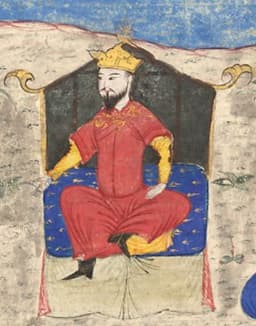
Alp Arslan
Emperor · Medieval
74.2Total
Rana Sanga
Emperor · Medieval
57.7Total
Basic Information
Born
1029
1482
Died
1072
1528
Era
Medieval
Medieval
Nationality
Seljuk Empire
India
Occupation
Emperor
Emperor
Civilization
Middle Eastern
Indian
Score Comparison
Military (10%)
82.0
66.0
Political (20%)
65.0
53.8
Influence (20%)
82.0
59.0
Legacy (20%)
72.0
50.0
Leadership (15%)
72.0
66.0
Strategy (15%)
70.0
58.4
TOTAL
74.2
57.7
Alp Arslan — Complete Timeline
1070 AD
Conquest of Aleppo and SyriaWar◆ Major
Alp Arslan led campaigns into Syria, capturing Aleppo and extending Seljuk control to the Mediterranean coast. He defeated the Fatimid Caliphate's forces and established Seljuk dominance over the Levant.
ConquestSyriaFatimid
Impact: regional
1071 AD
Battle of ManzikertWar
Alp Arslan defeated the Byzantine Emperor Romanos IV Diogenes at the Battle of Manzikert in eastern Anatolia. The Byzantine army was destroyed and Romanos captured, leading to the Seljuk conquest of Anatolia and the beginning of Turkic settlement in the region.
BattleByzantineAnatolia
Impact: global
1072 AD
AssassinationOther◆ Major
Alp Arslan was assassinated by a captured fortress commander while on campaign in Transoxiana. His death at the height of his power led to a succession struggle and the eventual fragmentation of the Seljuk Empire under his son Malik Shah I.
AssassinationDeathSuccession
Impact: regionaltragic
Rana Sanga — Complete Timeline
1518 AD
Battle of KhatoliWar◆ Major
Rana Sanga defeated the Lodi Sultan Ibrahim Lodi at the Battle of Khatoli. The victory expanded Mewar's territory and influence. Rana Sanga captured several Lodi officers and gained control of parts of eastern Rajasthan.
VictoryLodi SultanateTerritorial Expansion
Impact: regionalconstructive
1526 AD
Battle of DholpurWar◆ Major
Rana Sanga defeated Babur's forces at the Battle of Dholpur, capturing the fort. This victory encouraged Sanga to challenge Babur directly. It set the stage for the decisive Battle of Khanwa.
VictoryMughal ConflictPrelude to Khanwa
Impact: regionalconstructive
Formation of Rajput confederation against BaburPolitical Action◆ Major
Rana Sanga united several Rajput kingdoms, including Mewar, Marwar, and Amber, to oppose Babur's invasion of India. The confederation aimed to restore Rajput sovereignty. This alliance was the largest Rajput coalition since the medieval period.
AllianceRajput UnityAnti-Mughal
Impact: regionalconstructive
1527 AD
Battle of KhanwaWar
Rana Sanga led a confederation of Rajput clans against Babur at the Battle of Khanwa. The Rajput forces were defeated by Babur's use of artillery and tactics. This battle cemented Mughal power in North India and ended Rajput hopes of restoring their dominance.
Mughal ConquestRajput ConfederacyDefeat
Impact: globaltragic
Expert Analysis
Origins
Alp Arslan was born in 1029 as Muhammad bin Da'ud, the son of Chaghri Beg, a Seljuk prince. His early life was shaped by the nomadic Turkic traditions of the Oghuz tribes and the Islamic culture of the Seljuk Empire. He received military training from a young age and accompanied his father on campaigns. His grandfather, Seljuk, had founded the dynasty, and his uncle Tughril Beg had established the empire. Alp Arslan's upbringing in the steppe and Persian court gave him a blend of martial prowess and diplomatic acumen.
Rana Sanga was born in 1482 as Maharana Sangram Singh, the eldest son of Rana Raimal of Mewar. He belonged to the Sisodia clan of Rajputs, known for their fierce independence and martial traditions. His early life was marked by internal family conflicts; his father had to suppress rebellions. Sanga received training in warfare and statecraft, and he participated in campaigns against neighboring kingdoms. His formative experiences included witnessing the decline of the Delhi Sultanate and the rise of regional powers.
Rise to Power
Alp Arslan rose to power after the death of his uncle Tughril in 1063. He contested the succession with his cousin Kutalmish, whom he defeated in battle. By 1064, he consolidated control over the Seljuk realm and began expanding. His key turning point came in 1071 when he defeated the Byzantine Emperor Romanos IV Diogenes at the Battle of Manzikert. This victory shattered Byzantine resistance in Anatolia and allowed Seljuk tribes to flood into the region. Alp Arslan's allies included his vizier Nizam al-Mulk, who administered the empire while he campaigned.
Rana Sanga ascended the throne of Mewar in 1509 after his father's death. He quickly asserted independence from the Delhi Sultanate, defeating Sultan Ibrahim Lodi at the Battle of Khatoli in 1517. This victory expanded Mewar's territory and made Sanga the leading Rajput ruler. He formed alliances with other Rajput clans, including Marwar and Amber, and captured strategic forts. His rise culminated in the formation of a grand confederation to oppose Babur's invasion of India. The turning point was the Battle of Khanwa in 1527, where Sanga's coalition faced Babur's Mughal army.
Leadership & Governance
Alp Arslan's leadership style was characterized by centralization and military expansion. He relied heavily on his vizier Nizam al-Mulk, who implemented administrative reforms including the iqta system of land grants. Alp Arslan personally led campaigns but delegated governance to trusted officials. He promoted Sunni Islam and patronized scholars, but he was tolerant of Christians and Jews. His military strategy emphasized mobility and archery, typical of Turkic steppe warfare. At Manzikert, he used feigned retreat to draw the Byzantines into a trap.
Rana Sanga's leadership was rooted in Rajput traditions of honor and clan loyalty. He ruled Mewar with a council of nobles and maintained a feudal system where vassals provided troops. He was a charismatic leader who united disparate Rajput kingdoms through personal diplomacy and marriage alliances. His governance was decentralized, relying on local chieftains. Militarily, he favored heavy cavalry charges and close combat, but he lacked effective artillery. His strategy at Khanwa was to overwhelm Babur with numbers, but he failed to counter Babur's gunpowder weapons.
Triumph & Tragedy
Alp Arslan's greatest triumph was the Battle of Manzikert, which opened Anatolia to Turkish settlement and weakened the Byzantine Empire permanently. He also extended Seljuk control to the Mediterranean coast by conquering Aleppo and Antioch. However, his greatest failure was his assassination in 1072 by a captured fortress commander while on campaign in Transoxiana. His death led to a succession crisis and ultimately the fragmentation of the Seljuk Empire. His military score of 82.0 reflects his battlefield success, but his political score of 65.0 indicates limitations in securing a stable succession.
Rana Sanga's greatest triumph was defeating Ibrahim Lodi at Khatoli and uniting the Rajputs against Babur. He also captured the fort of Dholpur from Babur's forces in 1527. However, his tragic defeat at Khanwa was a disaster. His confederation collapsed, and Babur established Mughal dominance in North India. Sanga was wounded in battle and later died in 1528, possibly poisoned by his own nobles. His legacy of Rajput resistance was overshadowed by Mughal power. His military score of 66.0 and political score of 53.8 reflect his limitations in adapting to new military technologies.
Character & Destiny
Alp Arslan was known for his courage and decisiveness but also for his ruthlessness. He personally executed the Khwarezmian governor who defied him. His character combined steppe pragmatism with Persian courtly culture. His destiny was shaped by his ambition to expand the Seljuk realm, which succeeded in the short term but overextended the empire. Historians note that his death at age 43 cut short his potential; had he lived, he might have consolidated the empire better. His total score of 74.2 ranks him as a highly effective medieval ruler.
Rana Sanga was a proud and determined leader who embodied Rajput ideals of valor and honor. He was blinded in one eye and had over 80 battle wounds, reflecting his personal bravery. However, his character also included a stubborn adherence to traditional warfare, which proved fatal against Babur's modern tactics. His destiny was tied to the decline of Rajput autonomy; despite his efforts, he could not prevent Mughal supremacy. His total score of 57.7 indicates a capable but less impactful ruler compared to Alp Arslan.
Legacy
Alp Arslan's legacy is profound: the Battle of Manzikert is considered a turning point in world history, leading to the Turkification of Anatolia and the eventual rise of the Ottoman Empire. The Seljuk Empire under him established a model of Islamic governance that influenced later dynasties. His grandson Malik Shah expanded the empire further. Alp Arslan's influence score of 82.0 reflects his role in shaping the medieval Islamic world and Byzantine history.
Rana Sanga's legacy is more localized. He is remembered as a symbol of Rajput resistance against Mughal rule. His defeat at Khanwa is seen as the end of Rajput supremacy in North India. However, his efforts to unite the Rajputs inspired later figures like Maharana Pratap. His legacy score of 50.0 is modest, as his impact was limited to regional history.
Conclusion
Alp Arslan had a greater impact on world history than Rana Sanga. His victory at Manzikert altered the course of the Byzantine Empire and facilitated the spread of Turkish peoples into Anatolia, with consequences lasting centuries. In contrast, Rana Sanga's defeat at Khanwa, while significant for Indian history, did not change the broader trajectory of Eurasian history. Alp Arslan's total score of 74.2 versus Sanga's 57.7 reflects this disparity. Alp Arslan's military and influence scores are notably higher (82.0 vs 66.0 and 82.0 vs 59.0). Therefore, Alp Arslan stands as the more consequential figure.
Rankings
🥇
Alp ArslanLeader
Mil: 82.0Pol: 65.0Inf: 82.0
74.2
🥈
Rana Sanga
Mil: 66.0Pol: 53.8Inf: 59.0
57.7
+16.5 behind
How This Comparison Works
Algorithm
Each figure is scored on 6 dimensions (0—100 scale) based on structured historical data: Military (10%), Political (20%), Influence (20%), Legacy (20%), Leadership (15%), Strategy (15%). The weighted total produces the final ranking.
Data Sources
Scores are computed from structured sub-indicators in the database. Scale factors adjust for era (Ancient ×0.85, Modern ×1.0) and civilization size (Eastern ×1.05, Other ×0.80) to account for differences in population and military scale.
Maximum 3 Figures
Comparisons are limited to 2—3 figures to ensure readability and statistical meaningfulness.
Error Margins
±5 points per dimension — Sub-scores are derived from historical records with inherent uncertainty. Two figures within 5 points on a dimension should be considered roughly equivalent in that area.
Total Score Accuracy
±3 points overall — The weighted combination of 6 dimensions produces a total score with approximately ±3 points of uncertainty. Differences of less than 3 points are not statistically significant— the figures are effectively tied.
Known Limitations
- Historical records are incomplete and uneven across civilizations
- Figures from oral-tradition societies may be underrepresented
- Occupation labels can misclassify multi-role figures
- Scores measure capability and impact, not moral character
- Quantitative scoring is a comparison tool, not absolute truth
Capability Radar
Military (10%) — Battles & Warfare
Battles
85
65
Win Rate
90
60
Expansion
85
68
Political (20%) — Governance & Reform
Reform
70
50
Diplomacy
80
65
Economy
70
45
Influence (20%) — Cultural & Global Reach
Cultural
65
55
Global
75
40
Legacy (20%) — Historical Impact
Historical
80
60
Longevity
70
50
Leadership (15%) — Power & Stability
Tenure
75
60
Stability
70
55
Strategy (15%) — Tactics & Innovation
Strategy
85
72
Tactics
80
70
Reform
70
55
Similar Comparisons
Comments & Discussion
No comments yet. Be the first to share your thoughts!