Loading...
This comparison has not been analyzed yet.
One-time AI generation (~1 minute). Scores and timeline are already available below.
Altan Khan vs Stephen Bathory
Altan Khan leads by 3.2 pts · 2 figures compared
…
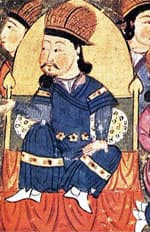
Altan Khan
Emperor · Modern
61.8Total

Stephen Bathory
Emperor · Modern
58.6Total
Basic Information
Born
1507
1533
Died
1582
1586
Era
Modern
Modern
Nationality
Mongolia
Poland
Occupation
Emperor
Emperor
Civilization
Eastern
Western
Score Comparison
Military (10%)
65.0
65.0
Political (20%)
55.0
59.3
Influence (20%)
68.0
60.0
Legacy (20%)
55.0
50.0
Leadership (15%)
72.0
68.0
Strategy (15%)
55.0
55.0
TOTAL
61.8
58.6
Altan Khan — Complete Timeline
1571 AD
Peace Treaty with Ming ChinaPolitical Action◆ Major
Altan Khan negotiated a peace treaty with the Ming dynasty, ending decades of conflict. The treaty established trade relations and recognized Altan Khan's authority, bringing stability to the border region.
Peace TreatyMing DynastyTrade
Impact: regionalconstructive
1578 AD
Establishment of Ties with the Dalai LamaCultural
Altan Khan met with Sonam Gyatso, the third Dalai Lama, and granted him the title 'Dalai Lama'. This meeting formalized the alliance between the Mongols and the Gelug school of Tibetan Buddhism, strengthening Buddhist influence in Mongolia.
Dalai LamaTibetan BuddhismAlliance
Impact: regionalconstructive
1580 AD
Foundation of HohhotCultural◆ Major
Altan Khan founded the city of Hohhot, which became a major center for trade and Buddhism in Inner Mongolia. The city served as his capital and facilitated economic and cultural exchange with the Ming dynasty.
City FoundationHohhotTrade
Impact: regionalconstructive
Stephen Bathory — Complete Timeline
1576 AD
Election as King of PolandPolitical Action◆ Major
Stephen Bathory was elected King of Poland and Grand Duke of Lithuania after the flight of Henry III. His election was supported by the Polish nobility and marked the beginning of his reign.
ElectionKingship
Impact: regionalconstructive
1578 AD
Livonian War CampaignsWar◆ Major
Stephen Bathory led successful military campaigns against Russia during the Livonian War, capturing several key fortresses. His victories forced Tsar Ivan IV to cede territory to Poland-Lithuania.
WarVictoryLivonia
Impact: regional
1582 AD
Treaty of Jam ZapolskiPolitical Action◆ Major
Stephen Bathory negotiated the Treaty of Jam Zapolski with Russia, ending the Livonian War. The treaty granted Poland-Lithuania control over Livonia and Polotsk.
TreatyPeaceTerritorial Gain
Impact: regionalconstructive
1586 AD
DeathOther◆ Major
Stephen Bathory died suddenly at Grodno, possibly from poisoning. His death without a clear heir led to a period of political instability in Poland-Lithuania.
DeathSuccession Crisis
Impact: regionaltragic
This comparison has not been analyzed yet.
One-time AI generation (~1 minute). Scores and timeline are already available below.
Rankings
🥇
Altan KhanLeader
Mil: 65.0Pol: 55.0Inf: 68.0
61.8
🥈
Stephen Bathory
Mil: 65.0Pol: 59.3Inf: 60.0
58.6
+3.2 behind
How This Comparison Works
Algorithm
Each figure is scored on 6 dimensions (0—100 scale) based on structured historical data: Military (10%), Political (20%), Influence (20%), Legacy (20%), Leadership (15%), Strategy (15%). The weighted total produces the final ranking.
Data Sources
Scores are computed from structured sub-indicators in the database. Scale factors adjust for era (Ancient ×0.85, Modern ×1.0) and civilization size (Eastern ×1.05, Other ×0.80) to account for differences in population and military scale.
Maximum 3 Figures
Comparisons are limited to 2—3 figures to ensure readability and statistical meaningfulness.
Error Margins
±5 points per dimension — Sub-scores are derived from historical records with inherent uncertainty. Two figures within 5 points on a dimension should be considered roughly equivalent in that area.
Total Score Accuracy
±3 points overall — The weighted combination of 6 dimensions produces a total score with approximately ±3 points of uncertainty. Differences of less than 3 points are not statistically significant— the figures are effectively tied.
Known Limitations
- Historical records are incomplete and uneven across civilizations
- Figures from oral-tradition societies may be underrepresented
- Occupation labels can misclassify multi-role figures
- Scores measure capability and impact, not moral character
- Quantitative scoring is a comparison tool, not absolute truth
Capability Radar
Military (10%) — Battles & Warfare
Battles
65
65
Win Rate
60
70
Expansion
70
60
Political (20%) — Governance & Reform
Reform
55
70
Diplomacy
80
65
Economy
50
60
Influence (20%) — Cultural & Global Reach
Cultural
70
55
Global
65
45
Legacy (20%) — Historical Impact
Historical
75
60
Longevity
70
50
Leadership (15%) — Power & Stability
Tenure
65
55
Stability
45
50
Strategy (15%) — Tactics & Innovation
Strategy
60
68
Tactics
55
72
Reform
50
75
Similar Comparisons
Comments & Discussion
No comments yet. Be the first to share your thoughts!