Loading...
Frederick the Great vs Stephen Bathory
Frederick the Great leads by 9.5 pts · 2 figures compared
…
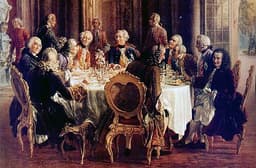
Frederick the Great
Emperor · Modern
68.1Total

Stephen Bathory
Emperor · Modern
58.6Total
Basic Information
Born
1712
1533
Died
1786
1586
Era
Modern
Modern
Nationality
Prussia
Poland
Occupation
Emperor
Emperor
Civilization
Western
Western
Score Comparison
Military (10%)
90.0
65.0
Political (20%)
75.0
59.3
Influence (20%)
55.0
60.0
Legacy (20%)
52.0
50.0
Leadership (15%)
82.0
68.0
Strategy (15%)
88.0
55.0
TOTAL
68.1
58.6
Frederick the Great — Complete Timeline
1723 AD
General Directory EstablishedReform◆ Major
Frederick the Great reorganized the Prussian government by establishing the General Directory, a centralized administrative body. This reform improved tax collection, military logistics, and state efficiency, strengthening Prussia's fiscal and military capacity.
AdministrationReformState Building
Impact: nationalconstructive
1757 AD
Battle of RossbachWar◆ Major
Frederick the Great's Prussian army defeated a larger Franco-Imperial force at Rossbach during the Seven Years' War. The victory showcased Prussian military discipline and Frederick's tactical genius, securing his reputation as a leading commander.
Seven Years' WarBattleMilitary Tactics
Impact: regional
Battle of LeuthenWar◆ Major
Frederick the Great led Prussian forces to a decisive victory over the Austrian army at Leuthen. The battle, fought in Silesia, demonstrated Frederick's use of oblique order tactics and helped Prussia retain control of Silesia during the Seven Years' War.
Seven Years' WarBattleSilesia
Impact: regional
1763 AD
Treaty of Hubertusburg SignedPolitical Action
Frederick the Great signed the Treaty of Hubertusburg with Austria, ending the Seven Years' War. The treaty confirmed Prussian possession of Silesia and established Prussia as a major European power, despite near-defeat earlier in the war.
TreatySeven Years' WarPrussia
Impact: regionalconstructive
1772 AD
First Partition of PolandPolitical Action◆ Major
Frederick the Great orchestrated the First Partition of Poland alongside Russia and Austria. Prussia gained West Prussia, connecting its territories and gaining control of the Vistula River trade, at the expense of Polish sovereignty.
PartitionPolandTerritorial Expansion
Impact: regionaldestructive
Stephen Bathory — Complete Timeline
1576 AD
Election as King of PolandPolitical Action◆ Major
Stephen Bathory was elected King of Poland and Grand Duke of Lithuania after the flight of Henry III. His election was supported by the Polish nobility and marked the beginning of his reign.
ElectionKingship
Impact: regionalconstructive
1578 AD
Livonian War CampaignsWar◆ Major
Stephen Bathory led successful military campaigns against Russia during the Livonian War, capturing several key fortresses. His victories forced Tsar Ivan IV to cede territory to Poland-Lithuania.
WarVictoryLivonia
Impact: regional
1582 AD
Treaty of Jam ZapolskiPolitical Action◆ Major
Stephen Bathory negotiated the Treaty of Jam Zapolski with Russia, ending the Livonian War. The treaty granted Poland-Lithuania control over Livonia and Polotsk.
TreatyPeaceTerritorial Gain
Impact: regionalconstructive
1586 AD
DeathOther◆ Major
Stephen Bathory died suddenly at Grodno, possibly from poisoning. His death without a clear heir led to a period of political instability in Poland-Lithuania.
DeathSuccession Crisis
Impact: regionaltragic
Expert Analysis
Origins
Frederick the Great (1712-1786) was born in Berlin to King Frederick William I and Sophia Dorothea of Hanover. His father, the 'Soldier King,' imposed a harsh military education, but Frederick preferred music and philosophy, leading to a strained relationship. He attempted to flee to England in 1730, was captured, and forced to witness the execution of his friend Katte. This trauma shaped his disciplined yet pragmatic character.
Stephen Bathory (1533-1586) was born in Somlyo, Transylvania, into the noble Bathory family. He studied at the University of Padua and became Prince of Transylvania in 1571. His background as a Hungarian noble gave him experience in regional power struggles, and his election as King of Poland in 1576 marked his entry onto the European stage.
Rise to Power
Frederick ascended the Prussian throne in 1740 at age 28. Immediately, he invaded Silesia, a province of Austria, triggering the War of Austrian Succession (1740-1748). His victory at Mollwitz in 1741 established his military reputation. Through the Treaty of Aix-la-Chapelle (1748), he secured Silesia, doubling Prussia's population. His rise was driven by aggressive expansion and military innovation, including the use of oblique order tactics.
Stephen Bathory was elected King of Poland in 1576 after the flight of Henry III. His election was supported by the Polish nobility, who saw him as a strong leader against internal factions. He consolidated power by subduing the rebellious city of Gdansk in 1577, forcing it to pay homage. His rise was marked by diplomatic maneuvering and military force, but he remained constrained by the Polish-Lithuanian Commonwealth's decentralized political system.
Leadership & Governance
Frederick the Great centralized Prussia's administration through the General Directory, established in 1723 but refined under his rule. He promoted religious tolerance, allowing Catholics and Jews to settle, and reformed the legal system, abolishing torture. He also patronized the arts, inviting Voltaire to his court. However, his governance was authoritarian: he kept the nobility in check but relied on the Junkers for military officers. His leadership style was hands-on, often leading troops personally, as at Leuthen (1757), where he scored a 90.0 in military metrics.
Stephen Bathory governed Poland-Lithuania with a focus on strengthening the monarchy. He reformed the army, creating a standing force of infantry and cavalry, and improved the treasury. He founded the Jesuit Academy in Vilnius, later the University of Vilnius, to counter Protestant influence. However, his power was limited by the Sejm (parliament) and the nobility's privileges. His political score of 59.3 reflects his struggles against internal opposition.
Triumph & Tragedy
Frederick's greatest triumph was surviving the Seven Years' War (1756-1763), where Prussia faced Austria, Russia, France, and Sweden. His victory at Rossbach (1757) and Leuthen (1757) against larger forces are military masterpieces. The Treaty of Hubertusburg (1763) confirmed Prussian possession of Silesia, establishing Prussia as a great power. His tragedy was the near-collapse of Prussia in 1760-1762, saved only by the death of Empress Elizabeth of Russia. Additionally, his legacy includes the militarization of Prussian society, which later contributed to German aggression.
Stephen Bathory's triumph was the Livonian War campaign (1578-1582), where he captured the Russian fortresses of Polotsk, Velikiye Luki, and laid siege to Pskov. The Treaty of Jam Zapolski (1582) gave Poland-Livonia, securing the Baltic coast. His tragedy was his sudden death in 1586, likely from poisoning, which left no heir and plunged Poland into a succession crisis. His reforms were undone by subsequent weak kings.
Character & Destiny
Frederick was a complex figure: a philosopher-king who wrote flute sonatas and corresponded with Enlightenment thinkers, yet a ruthless military commander. His character was shaped by his traumatic youth, leading to a cynical and pragmatic worldview. He believed in the 'reason of state' and justified his aggressive policies as necessary for Prussia's survival. His destiny was to transform a small German state into a European power, but at the cost of perpetual conflict.
Stephen Bathory was known for his energy and decisiveness, but also for his authoritarian tendencies that alienated the Polish nobility. He was a devout Catholic who persecuted Protestants in Transylvania, yet in Poland he promoted religious tolerance. His sudden death prevented him from fully realizing his ambitions, leaving a fragmented legacy.
Legacy
Frederick the Great's legacy is immense. He established Prussia as a military powerhouse and set the stage for German unification. His administrative reforms influenced later European states. His military tactics are studied in war colleges. However, his militarization of society contributed to the rise of Prussianism. His total score of 68.1 reflects his broad impact.
Stephen Bathory's legacy is more modest. He is remembered as a strong king who briefly arrested Poland's decline. His military victories over Russia are celebrated in Polish history, but his internal reforms were short-lived. He scored 58.6 overall, reflecting his limited long-term influence.
Conclusion
Frederick the Great had a greater impact on history than Stephen Bathory. His military innovations (scoring 90.0) and state-building transformed Europe's balance of power. Bathory's achievements were significant but confined to a shorter period and a weaker institutional framework. While Bathory scored 65.0 in military, Frederick's 90.0 and his political and strategic scores (75.0, 88.0) demonstrate his superiority. Frederick's Prussia laid the groundwork for modern Germany, while Bathory's Poland-Lithuania continued its decline. Thus, Frederick the Great is the more consequential figure.
Rankings
🥇
Frederick the GreatLeader
Mil: 90.0Pol: 75.0Inf: 55.0
68.1
🥈
Stephen Bathory
Mil: 65.0Pol: 59.3Inf: 60.0
58.6
+9.5 behind
How This Comparison Works
Algorithm
Each figure is scored on 6 dimensions (0—100 scale) based on structured historical data: Military (10%), Political (20%), Influence (20%), Legacy (20%), Leadership (15%), Strategy (15%). The weighted total produces the final ranking.
Data Sources
Scores are computed from structured sub-indicators in the database. Scale factors adjust for era (Ancient ×0.85, Modern ×1.0) and civilization size (Eastern ×1.05, Other ×0.80) to account for differences in population and military scale.
Maximum 3 Figures
Comparisons are limited to 2—3 figures to ensure readability and statistical meaningfulness.
Error Margins
±5 points per dimension — Sub-scores are derived from historical records with inherent uncertainty. Two figures within 5 points on a dimension should be considered roughly equivalent in that area.
Total Score Accuracy
±3 points overall — The weighted combination of 6 dimensions produces a total score with approximately ±3 points of uncertainty. Differences of less than 3 points are not statistically significant— the figures are effectively tied.
Known Limitations
- Historical records are incomplete and uneven across civilizations
- Figures from oral-tradition societies may be underrepresented
- Occupation labels can misclassify multi-role figures
- Scores measure capability and impact, not moral character
- Quantitative scoring is a comparison tool, not absolute truth
Capability Radar
Military (10%) — Battles & Warfare
Battles
85
65
Win Rate
80
70
Expansion
85
60
Political (20%) — Governance & Reform
Reform
90
70
Diplomacy
80
65
Economy
85
60
Influence (20%) — Cultural & Global Reach
Cultural
80
55
Global
75
45
Legacy (20%) — Historical Impact
Historical
85
60
Longevity
80
50
Leadership (15%) — Power & Stability
Tenure
85
55
Stability
75
50
Strategy (15%) — Tactics & Innovation
Strategy
90
68
Tactics
95
72
Reform
90
75
Similar Comparisons
Comments & Discussion
No comments yet. Be the first to share your thoughts!