Loading...
Altan Khan vs Napoleon Bonaparte
Napoleon Bonaparte leads by 9.1 pts · 2 figures compared
…
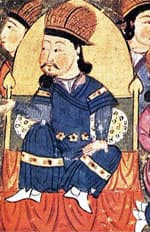
Altan Khan
Emperor · Modern
61.8Total

Napoleon Bonaparte
General · Modern
70.9Total
Basic Information
Born
1507
1769
Died
1582
1821
Era
Modern
Modern
Nationality
Mongolia
France
Occupation
Emperor
General
Civilization
Eastern
Western
Score Comparison
Military (10%)
65.0
94.0
Political (20%)
55.0
72.0
Influence (20%)
68.0
40.0
Legacy (20%)
55.0
80.0
Leadership (15%)
72.0
78.0
Strategy (15%)
55.0
90.0
TOTAL
61.8
70.9
Altan Khan — Complete Timeline
1571 AD
Peace Treaty with Ming ChinaPolitical Action◆ Major
Altan Khan negotiated a peace treaty with the Ming dynasty, ending decades of conflict. The treaty established trade relations and recognized Altan Khan's authority, bringing stability to the border region.
Peace TreatyMing DynastyTrade
Impact: regionalconstructive
1578 AD
Establishment of Ties with the Dalai LamaCultural
Altan Khan met with Sonam Gyatso, the third Dalai Lama, and granted him the title 'Dalai Lama'. This meeting formalized the alliance between the Mongols and the Gelug school of Tibetan Buddhism, strengthening Buddhist influence in Mongolia.
Dalai LamaTibetan BuddhismAlliance
Impact: regionalconstructive
1580 AD
Foundation of HohhotCultural◆ Major
Altan Khan founded the city of Hohhot, which became a major center for trade and Buddhism in Inner Mongolia. The city served as his capital and facilitated economic and cultural exchange with the Ming dynasty.
City FoundationHohhotTrade
Impact: regionalconstructive
Napoleon Bonaparte — Complete Timeline
1799 AD
Coup of 18 BrumaireOther◆ Major
Napoleon Bonaparte, with support from his brother Lucien and key political figures, overthrew the Directory in a bloodless coup. He established the Consulate with himself as First Consul, effectively becoming the ruler of France. This event ended the French Revolution's most unstable period.
French RevolutionCoupRise to Power
Impact: regional
1804 AD
Promulgation of the Napoleonic CodeOther◆ Major
Napoleon enacted the Civil Code of the French, known as the Napoleonic Code, a comprehensive set of laws that replaced the fragmented feudal legal systems. The code established legal equality, protected property rights, and secularized law. It became the basis for legal systems in many European and world countries.
Legal ReformNapoleonic CodeCivil Law
Impact: globalconstructive
1805 AD
Battle of AusterlitzWar◆ Major
Napoleon's Grande Arm
Napoleonic WarsBattleDecisive Victory
Impact: global
1812 AD
Invasion of RussiaWar◆ Major
Napoleon led the Grande Arm
Napoleonic WarsInvasionDisaster
Impact: globaldestructive
1815 AD
Battle of WaterlooWar◆ Major
Napoleon's French army was defeated by the combined forces of the Duke of Wellington's Anglo-Allied army and Gebhard Leberecht von Bl
Napoleonic WarsBattleFinal Defeat
Impact: globaldestructive
Expert Analysis
altan-khan-vs-napoleon-bonaparte
# The Conqueror and the Khan
On a June morning in 1815, Napoleon Bonaparte watched his Imperial Guard march into the muddy fields of Waterloo, their eagles glinting under a gray sky. Across the centuries, in a very different world, Altan Khan rode through the grasslands of Inner Mongolia in 1578, his eyes fixed not on a battlefield but on a meeting that would reshape the spiritual landscape of Asia. One man sought to conquer Europe through fire and steel; the other sought to bind his people to a faith that would outlast any empire. What drove these two leaders—born two and a half centuries apart, on opposite sides of the world—to such different destinies?
Origins
Napoleon Bonaparte was born in 1769 on the island of Corsica, a place of rugged hills and fierce independence, just months after France annexed it. His family was minor nobility, but they were poor, and young Napoleon grew up speaking Italian, not French. The French Revolution of 1789 shattered the old order, creating opportunities that would have been unthinkable under the Bourbon monarchy. For a brilliant, ambitious outsider like Napoleon, the chaos was a ladder. He absorbed the Enlightenment ideals of meritocracy and order, but also the brutal lessons of revolutionary terror.
Altan Khan was born in 1507 into the Mongol royal lineage, a grandson of Dayan Khan who had reunified the Mongol tribes after centuries of fragmentation. The Mongols of the 16th century were a people caught between memory and need. They remembered the glory of Genghis Khan, but their world had shrunk. The Ming dynasty controlled China, and the Mongols were confined to the steppes, reliant on raiding for goods they could no longer trade for. Altan grew up in a culture of warrior honor and Buddhist piety, but also of desperate pragmatism.
The difference in their origins is stark: Napoleon emerged from a revolution that promised to remake the world, while Altan inherited a tradition that sought to preserve a fading way of life. One was shaped by the explosive energy of modernity, the other by the weight of ancient cycles.
Rise to Power
Napoleon’s ascent was meteoric. At age 24, in 1793, he drove British forces from Toulon, earning promotion to brigadier general. In 1796, at only 26, he took command of the French army in Italy and delivered a series of stunning victories against the Austrians. By 1799, he had staged a coup and made himself First Consul of France. His rise was a product of talent, timing, and the vacuum left by revolutionary chaos—a classic story of the self-made man.
Altan Khan’s path was slower and more complex. He became a khan in the 1530s, but his authority was never absolute. The Mongol confederation was a web of competing princes, and Altan had to negotiate, bribe, and fight for every inch of influence. His key turning point came not on a battlefield but at a negotiating table. In 1571, after decades of raiding Ming territory, he signed a peace treaty that opened trade routes and secured grain for his people. It was a political masterstroke, not a military one.
Where Napoleon seized power through sheer force of will, Altan built it through patience and diplomacy. The Frenchman gambled on glory; the Mongol calculated on survival.
Leadership & Governance
Napoleon was a military genius—his strategic score of 93.0 reflects a mind that could orchestrate armies across vast distances, as at Austerlitz in 1805, where he crushed a combined Russian and Austrian force. But his governance was a paradox. He imposed the Napoleonic Code, a legal system that enshrined equality before the law and property rights, yet he crowned himself emperor in 1804 and placed his family on thrones across Europe. He centralized power ruthlessly, suppressing dissent while modernizing France’s bureaucracy and education.
Altan Khan’s leadership was more subtle. His military score of 61.7 is modest, but his political score of 82.6 reveals a ruler who understood that power could be woven from alliances and ideas. In 1578, he met Sonam Gyatso, a Tibetan Buddhist lama, and granted him the title “Dalai Lama”—meaning “Ocean of Wisdom.” This act formalized the bond between Mongol khans and Tibetan Buddhism, a connection that would shape Central Asia for centuries. He also founded the city of Hohhot in 1580, transforming a trading post into a center of commerce and faith.
Napoleon ruled through conquest and law; Altan through religion and trade. One sought to impose order from above, the other to weave it from within.
Triumph & Tragedy
Napoleon’s greatest moment was Austerlitz, where he defeated a larger coalition army with a brilliance that still mesmerizes military historians. His greatest failure was the invasion of Russia in 1812, where he lost over 400,000 men to winter, hunger, and guerrilla attacks. He was exiled to Elba in 1814, returned for a hundred days, and was finally crushed at Waterloo in 1815. He died in 1821 on the remote island of Saint Helena, a prisoner of the British.
Altan Khan’s triumph was the peace of 1571, which ended decades of bloodshed and opened a stable era for his people. His tragedy is less dramatic but more poignant: he died in 1582, just as his Buddhist reforms were taking root, and his successors could not sustain his achievements. The Mongols would eventually fall under Manchu domination, their empire reduced to a memory.
Napoleon’s fall was spectacular and public; Altan’s was quiet and gradual. One was destroyed by his own ambition, the other by the limits of his world.
Character & Destiny
Napoleon was restless, brilliant, and arrogant. He once said, “Power is my mistress,” and he meant it. His personality drove him to constant expansion, unable to consolidate what he had won. He trusted no one fully and micromanaged everything, a trait that served him in battle but failed him in politics.
Altan Khan was pragmatic and patient. He understood that a khan’s power came not from the sword alone but from the loyalty of tribes and the favor of heaven. His embrace of Buddhism was not just spiritual; it was a political tool to unify a fractious people under a common faith. He was a builder, not a destroyer.
Their characters shaped their fates. Napoleon’s ambition created an empire that collapsed under its own weight. Altan’s pragmatism created a legacy that outlasted his dynasty.
Legacy
Napoleon’s legacy is everywhere in modern Europe: the Napoleonic Code influenced legal systems from France to Louisiana, his military reforms shaped modern warfare, and his career inspired both admiration and horror. He is remembered as a titan who remade the world, for better and worse.
Altan Khan’s legacy is quieter but enduring. The Dalai Lama lineage he recognized continues to this day. Hohhot remains a major city in Inner Mongolia. Tibetan Buddhism still shapes Mongolian identity. He is remembered not as a conqueror but as a unifier who gave his people a spiritual home.
Conclusion
Standing at Waterloo, Napoleon saw his world end in mud and blood. Riding across the grasslands, Altan Khan saw his world begin in prayer and trade. One chased glory and found exile; the other sought peace and found eternity. Their stories remind us that power takes many forms—the sword and the sutra, the empire and the monastery—and that the most enduring conquests are often the quietest ones.
Rankings
🥇
Napoleon BonaparteLeader
Mil: 94.0Pol: 72.0Inf: 40.0
70.9
🥈
Altan Khan
Mil: 65.0Pol: 55.0Inf: 68.0
61.8
+9.1 behind
How This Comparison Works
Algorithm
Each figure is scored on 6 dimensions (0—100 scale) based on structured historical data: Military (10%), Political (20%), Influence (20%), Legacy (20%), Leadership (15%), Strategy (15%). The weighted total produces the final ranking.
Data Sources
Scores are computed from structured sub-indicators in the database. Scale factors adjust for era (Ancient ×0.85, Modern ×1.0) and civilization size (Eastern ×1.05, Other ×0.80) to account for differences in population and military scale.
Maximum 3 Figures
Comparisons are limited to 2—3 figures to ensure readability and statistical meaningfulness.
Error Margins
±5 points per dimension — Sub-scores are derived from historical records with inherent uncertainty. Two figures within 5 points on a dimension should be considered roughly equivalent in that area.
Total Score Accuracy
±3 points overall — The weighted combination of 6 dimensions produces a total score with approximately ±3 points of uncertainty. Differences of less than 3 points are not statistically significant— the figures are effectively tied.
Known Limitations
- Historical records are incomplete and uneven across civilizations
- Figures from oral-tradition societies may be underrepresented
- Occupation labels can misclassify multi-role figures
- Scores measure capability and impact, not moral character
- Quantitative scoring is a comparison tool, not absolute truth
Capability Radar
Military (10%) — Battles & Warfare
Battles
65
95
Win Rate
60
90
Expansion
70
95
Political (20%) — Governance & Reform
Reform
55
95
Diplomacy
80
80
Economy
50
85
Influence (20%) — Cultural & Global Reach
Cultural
70
85
Global
65
90
Legacy (20%) — Historical Impact
Historical
75
95
Longevity
70
90
Leadership (15%) — Power & Stability
Tenure
65
85
Stability
45
70
Strategy (15%) — Tactics & Innovation
Strategy
60
95
Tactics
55
98
Reform
50
92
Similar Comparisons
Comments & Discussion
ALPHA-WOLF ENTHUSIAST6/17/2026
Sure, Napoleon had the big names like Austerlitz and Jena, but his ambition collapsed under Russian snow and British steel. Altan Khan? He didn't just fight battles—he strategically embraced Tibetan Buddhism to solidify his legacy, forging a spiritual empire that outlasted any French marshals. Waterloo was a final loss; the Dalai Lama title he secured still echoes. Napoleon conquered for glory; Altan Khan conquered for eternity. That's the difference between a falling star and a lasting sun.
DATA-DRIVEN DISSECTOR6/17/2026
Let’s talk metrics. Napoleon commanded armies over 500,000 strong, revolutionizing warfare with corps organization. Altan Khan's largest recorded force was probably 100,000. Napoleon invaded Russia; Altan Khan raided Beijing. Objectively, Napoleon’s scale crushes Altan’s. But comparing them is apples and war elephants. Altan’s diplomatic shifts—like the 1571 peace treaty with Ming—completely changed Inner Asian trade and politics, a strategic pivot Napoleon never matched. So who was more ‘effect
PLAINS SCHOLAR6/17/2026
别拿欧洲的战争机器跟草原的游牧智慧比。拿破仑输给冬天,阿勒坦汗却用信仰攻城略地。1578年他引入藏传佛教,不是软弱,是最高明的政治手腕:用信仰统一蒙古,比大炮持久多了。草原没有马伦戈平原,但有连绵千里的忠诚。拿破仑想当皇帝,阿勒坦汗却当了活佛的俗家弟子——这才是真正的权力传承。你选一个滑铁卢的失败者还是整个东亚的精神教父?
READY-TO-HISTORY-BUFFER6/17/2026
历史比较总爱吹拿破仑,但阿尔坦汗才是亚洲的隐藏BOSS。他一手重建了蒙古的贸易网络,让部落从自相残杀变成香客朝圣。拿破仑打仗烧钱,阿尔坦汗签和平条约赚钱——明朝开放了互市,草原有了丝绸和茶叶。我宁愿要一个能带来繁荣的统治者,也不要一个让人送死的战争机器。谁更伟大?看谁让人民吃饱,不是看谁占领了多少欧洲首都。
CLASSIC WHIP6/17/2026
拿破仑和阿尔坦汗?这就是梅特涅和忽必烈的儿子。但别搞错了:阿尔坦汗活在忽必烈的阴影下,而拿破仑自己成为了阴影。拿破仑的《民法典》改变了欧洲法律,阿尔坦汗的宗教转变只改变了蒙古祈祷词。阿尔坦汗1550年围困北京,然后呢?退却谈判。拿破仑攻入米兰、开罗、柏林,连金字塔下都开战。一个打的是闪电战,一个打的是精神战。我投拿破仑,因为历史记住的是改变