Loading...
Amyntas of Galatia vs Napoleon Bonaparte
Napoleon Bonaparte leads by 27.8 pts · 2 figures compared
…
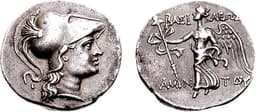
Amyntas of Galatia
Emperor · Ancient
43.1Total

Napoleon Bonaparte
General · Modern
70.9Total
Basic Information
Born
-60
1769
Died
-25
1821
Era
Ancient
Modern
Nationality
Galatia
France
Occupation
Emperor
General
Civilization
Western
Western
Score Comparison
Military (10%)
38.3
94.0
Political (20%)
40.8
72.0
Influence (20%)
45.5
40.0
Legacy (20%)
36.7
80.0
Leadership (15%)
55.3
78.0
Strategy (15%)
43.3
90.0
TOTAL
43.1
70.9
Amyntas of Galatia — Complete Timeline
25 BC
Death in Campaign Against the HomanadesWar◆ Major
Amyntas of Galatia led a military campaign against the Homanades, a rebellious tribe in the Taurus Mountains. He was killed in battle, ending his rule. After his death, Galatia was annexed by Rome as a province.
BattleDeathRoman Annexation
Impact: regionaltragic
Napoleon Bonaparte — Complete Timeline
1799 AD
Coup of 18 BrumaireOther◆ Major
Napoleon Bonaparte, with support from his brother Lucien and key political figures, overthrew the Directory in a bloodless coup. He established the Consulate with himself as First Consul, effectively becoming the ruler of France. This event ended the French Revolution's most unstable period.
French RevolutionCoupRise to Power
Impact: regional
1804 AD
Promulgation of the Napoleonic CodeOther◆ Major
Napoleon enacted the Civil Code of the French, known as the Napoleonic Code, a comprehensive set of laws that replaced the fragmented feudal legal systems. The code established legal equality, protected property rights, and secularized law. It became the basis for legal systems in many European and world countries.
Legal ReformNapoleonic CodeCivil Law
Impact: globalconstructive
1805 AD
Battle of AusterlitzWar◆ Major
Napoleon's Grande Arm
Napoleonic WarsBattleDecisive Victory
Impact: global
1812 AD
Invasion of RussiaWar◆ Major
Napoleon led the Grande Arm
Napoleonic WarsInvasionDisaster
Impact: globaldestructive
1815 AD
Battle of WaterlooWar◆ Major
Napoleon's French army was defeated by the combined forces of the Duke of Wellington's Anglo-Allied army and Gebhard Leberecht von Bl
Napoleonic WarsBattleFinal Defeat
Impact: globaldestructive
Expert Analysis
amyntas-of-galatia-vs-napoleon-bonaparte
# The Conqueror and the Forgotten King
On a spring morning in 1815, Napoleon Bonaparte watched his Grande Armée march through the fields of Waterloo, the fate of Europe balanced on a single day’s battle. Twenty centuries earlier, another ruler—Amyntas of Galatia—rode into the Taurus Mountains with his own army, chasing a rebellious tribe that would cost him his life. Both were leaders of their age, yet one reshaped the Western world while the other vanished into obscurity. What separates a titan from a footnote? The answer lies not merely in talent, but in the currents of history that carried them.
Origins
Napoleon Bonaparte was born in 1769 on the island of Corsica, a land recently annexed by France. His family was minor nobility, struggling and ambitious. The French Revolution, erupting when he was twenty, shattered the old order and opened paths unimaginable under the Bourbon monarchy. Napoleon was a child of upheaval, molded by chaos and opportunity.
Amyntas of Galatia, born around 60 BC, came from a very different world. Galatia was a Celtic kingdom in central Anatolia, a remnant of invading Gauls who had settled there centuries earlier. By Amyntas’s time, the kingdom was a client state of Rome, caught between the ambitions of Roman warlords like Mark Antony and Octavian. Amyntas was not a revolutionary; he was a survivor in a game dominated by Mediterranean superpowers.
Rise to Power
Napoleon’s ascent was meteoric. In 1793, at age twenty-four, he drove the British from Toulon, earning promotion to brigadier general. By 1796, he commanded the Army of Italy, where his lightning campaigns crushed Austrian forces and made him a national hero. His political genius matched his military skill: in 1799, he seized power in a coup, becoming First Consul, and by 1804, Emperor of the French. Each step was a gamble, each victory a foundation for the next.
Amyntas rose through patronage, not conquest. He was appointed king of Galatia by Mark Antony around 36 BC, after Antony had defeated the previous ruler. When Octavian defeated Antony at Actium in 31 BC, Amyntas shrewdly switched allegiance. Octavian, later Augustus, confirmed his rule. Unlike Napoleon, Amyntas did not create his own throne—he received it from stronger hands and kept it by bending with the wind.
Leadership & Governance
As emperor, Napoleon was a whirlwind of reform. He centralized the French state, established the Bank of France, and most enduringly, codified the Napoleonic Code—a legal system that influenced civil law across Europe and the Americas. His military genius was unmatched: at Austerlitz in 1805, he crushed the combined armies of Russia and Austria, a victory so complete it dissolved the Holy Roman Empire. He ruled through charisma, merit, and iron discipline, promoting officers based on talent rather than birth.
Amyntas ruled a small, fragile kingdom. His governance was that of a client king: keep Rome satisfied, collect taxes, and maintain order. The one recorded major event of his reign—a campaign in 25 BC against the Homanades tribe in the Taurus Mountains—ended in disaster. He was killed in the fighting, his kingdom soon annexed by Rome as the province of Galatia. Where Napoleon built an empire, Amyntas barely held his own.
Triumph & Tragedy
Napoleon’s greatest triumph was his early empire: from 1805 to 1812, he dominated Europe, placing his brothers on thrones and redrawing borders at will. His tragedy was hubris. The 1812 invasion of Russia destroyed his Grand Armée, and his refusal to accept a negotiated peace led to his first abdication in 1814. He returned for the Hundred Days in 1815, only to be crushed at Waterloo and exiled to Saint Helena, where he died in 1821 at age fifty-one.
Amyntas’s triumph was survival itself—he navigated the civil wars of Rome and kept his crown. His tragedy was that his legacy was so thin: a single campaign, a single death, and then absorption into Roman provincial administration. He left no code, no empire, no legend.
Character & Destiny
Napoleon was driven by an insatiable hunger for glory. “I am not a man, but a thing,” he once said. “My life is inseparable from my destiny.” His personality—brilliant, restless, egotistical—propelled him to dizzying heights and then to ruin. He could not stop; he could not share power.
Amyntas, by contrast, was a pragmatist. He adapted to Rome’s demands, changed patrons when necessary, and likely saw his role as stewardship, not conquest. But pragmatism, while safe, rarely creates greatness. His caution made him a footnote; Napoleon’s ambition made him a legend.
Legacy
Napoleon’s legacy is immense. The Napoleonic Code survives in dozens of countries. His military campaigns are studied in war colleges. He reshaped nationalism, law, and the map of Europe. His name is synonymous with genius and tyranny, with ambition and downfall.
Amyntas of Galatia is remembered, if at all, as the last king of a forgotten kingdom. His death in the Taurus Mountains ended a dynasty that left no monuments, no literature, no lasting institutions. He scores a total of 52.5 on historical metrics—compared to Napoleon’s 82.4—but numbers alone cannot capture the chasm in impact.
Conclusion
The difference between Napoleon and Amyntas is not simply talent or luck. It is the difference between an age of revolution and an age of consolidation. Napoleon rode the tidal wave of a continent in upheaval; Amyntas navigated the backwaters of a Roman lake. One was a force of nature, the other a caretaker. History remembers the storm, not the keeper of the quiet harbor. Yet both, in their own way, did what their times demanded. Napoleon changed the world; Amyntas kept his world from changing him. Perhaps that is the truest measure of each man’s destiny.
Rankings
🥇
Napoleon BonaparteLeader
Mil: 94.0Pol: 72.0Inf: 40.0
70.9
🥈
Amyntas of Galatia
Mil: 38.3Pol: 40.8Inf: 45.5
43.1
+27.8 behind
How This Comparison Works
Algorithm
Each figure is scored on 6 dimensions (0—100 scale) based on structured historical data: Military (10%), Political (20%), Influence (20%), Legacy (20%), Leadership (15%), Strategy (15%). The weighted total produces the final ranking.
Data Sources
Scores are computed from structured sub-indicators in the database. Scale factors adjust for era (Ancient ×0.85, Modern ×1.0) and civilization size (Eastern ×1.05, Other ×0.80) to account for differences in population and military scale.
Maximum 3 Figures
Comparisons are limited to 2—3 figures to ensure readability and statistical meaningfulness.
Error Margins
±5 points per dimension — Sub-scores are derived from historical records with inherent uncertainty. Two figures within 5 points on a dimension should be considered roughly equivalent in that area.
Total Score Accuracy
±3 points overall — The weighted combination of 6 dimensions produces a total score with approximately ±3 points of uncertainty. Differences of less than 3 points are not statistically significant— the figures are effectively tied.
Known Limitations
- Historical records are incomplete and uneven across civilizations
- Figures from oral-tradition societies may be underrepresented
- Occupation labels can misclassify multi-role figures
- Scores measure capability and impact, not moral character
- Quantitative scoring is a comparison tool, not absolute truth
Capability Radar
Military (10%) — Battles & Warfare
Battles
35
95
Win Rate
30
90
Expansion
25
95
Political (20%) — Governance & Reform
Reform
30
95
Diplomacy
45
80
Economy
35
85
Influence (20%) — Cultural & Global Reach
Cultural
20
85
Global
10
90
Legacy (20%) — Historical Impact
Historical
25
95
Longevity
15
90
Leadership (15%) — Power & Stability
Tenure
40
85
Stability
30
70
Strategy (15%) — Tactics & Innovation
Strategy
30
95
Tactics
30
98
Reform
20
92
Similar Comparisons
Comments & Discussion
Tactical_Pyrrhus6/17/2026
Sure, Napoleon won battles, but Amyntas actually ruled a Celtic kingdom in the middle of Anatolia—talk about cultural fusion. Napoleon’s rise was a product of revolutionary chaos, not pure genius. Amyntas managed to hold power under Rome’s shadow, fighting off tribes like the Homonadeis without the luxury of a Grand Armée. If we’re grading on difficulty, give me the Galatian king any day.
法老之眼6/17/2026
拿破仑就是欧洲的流量明星,靠媒体和宣传把自己吹成神。看看阿敏塔斯,统治加拉太这种三不管地带,还要在罗马大佬间周旋,最后死在平定叛乱的战场上,这才是真硬汉。拿破仑滑铁卢翻车就怪天气太烂,笑死。历史上谁更牛?不是看谁卖周边多,而是谁在夹缝中活得更久。
Data_Crusader6/17/2026
Comparing Napoleon to Amyntas is like pitting a supernova against a candle. Sure, Amyntas held a minor client kingdom for a few years, but Napoleon reshaped legal systems, reorganized Europe, and fought in over 60 battles. Amyntas’s “great” moment was getting ambushed and killed by mountain tribes. Statistically, one guy changed 0.5% of world history; the other changed 50%. Case closed.
青铜剑客6/17/2026
别被拿破仑的帽子戏法骗了,他的成功靠的是法国革命提供的廉价兵源和民族主义冲动。阿敏塔斯是实打实的凯尔特后裔,统治一个讲凯尔特语的安纳托利亚王国,这种跨文化统治能力比拿破仑那套欧陆征服难多了。历史上的失败者往往只是没摊上好剧本,打仗这行,运气比才华重要十倍。
Auspicious_Tyrant6/17/2026
Amyntas was a footnote playing second fiddle to Mark Antony and Octavian, while Napoleon literally wrote his own law codes. The Galatian king’s chief legacy is being a minor ally in Rome’s civil wars. Napoleon, by contrast, inspired nationalism, modern warfare, and the metric system. Amyntas’s death in a minor skirmish sums it up: he was a local operator, not a world-shaker. History’s smoke, not its firestorm.