Loading...
Ana Brnabic vs Napoleon Bonaparte
Napoleon Bonaparte leads by 14.4 pts · 2 figures compared
…
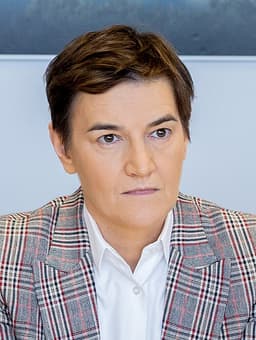
Ana Brnabic
Politician · Modern
56.5Total

Napoleon Bonaparte
General · Modern
70.9Total
Basic Information
Born
1975
1769
Died
—
1821
Era
Modern
Modern
Nationality
Serbia
France
Occupation
Politician
General
Civilization
Western
Western
Score Comparison
Military (10%)
50.0
94.0
Political (20%)
72.0
72.0
Influence (20%)
57.2
40.0
Legacy (20%)
45.0
80.0
Leadership (15%)
72.0
78.0
Strategy (15%)
43.1
90.0
TOTAL
56.5
70.9
Ana Brnabic — Complete Timeline
2017 AD
Appointed Prime Minister of SerbiaPolitical Action◆ Major
Brnabic was appointed as the first female and openly gay Prime Minister of Serbia, succeeding Aleksandar Vucic who became President. Her appointment was seen as a step towards modernization and EU integration.
AppointmentFirst Female PMLGBTQ+ Rights
Impact: nationalconstructive
2020 AD
Re-appointed Prime Minister of SerbiaPolitical Action◆ Major
Brnabic was re-appointed as Prime Minister after the Serbian Progressive Party (SNS) won the parliamentary election. She formed a new government focused on economic recovery, digitalization, and EU accession.
Re-appointmentDigitalizationEU Accession
Impact: national
2022 AD
Re-appointed Prime Minister of Serbia for a third termPolitical Action
Brnabic was re-appointed as Prime Minister for a third term, continuing to lead the government. Her tenure focused on economic reforms, infrastructure projects, and maintaining a multi-vector foreign policy.
Re-appointmentInfrastructureMulti-vector Policy
Impact: national
Napoleon Bonaparte — Complete Timeline
1799 AD
Coup of 18 BrumaireOther◆ Major
Napoleon Bonaparte, with support from his brother Lucien and key political figures, overthrew the Directory in a bloodless coup. He established the Consulate with himself as First Consul, effectively becoming the ruler of France. This event ended the French Revolution's most unstable period.
French RevolutionCoupRise to Power
Impact: regional
1804 AD
Promulgation of the Napoleonic CodeOther◆ Major
Napoleon enacted the Civil Code of the French, known as the Napoleonic Code, a comprehensive set of laws that replaced the fragmented feudal legal systems. The code established legal equality, protected property rights, and secularized law. It became the basis for legal systems in many European and world countries.
Legal ReformNapoleonic CodeCivil Law
Impact: globalconstructive
1805 AD
Battle of AusterlitzWar◆ Major
Napoleon's Grande Arm
Napoleonic WarsBattleDecisive Victory
Impact: global
1812 AD
Invasion of RussiaWar◆ Major
Napoleon led the Grande Arm
Napoleonic WarsInvasionDisaster
Impact: globaldestructive
1815 AD
Battle of WaterlooWar◆ Major
Napoleon's French army was defeated by the combined forces of the Duke of Wellington's Anglo-Allied army and Gebhard Leberecht von Bl
Napoleonic WarsBattleFinal Defeat
Impact: globaldestructive
Expert Analysis
ana-brnabic-vs-napoleon-bonaparte
# The Emperor and the Premier: Two Faces of Power in Modern Europe
On a June evening in 1815, Napoleon Bonaparte stood on a muddy field near Waterloo, watching his Imperial Guard crumble under British fire. Two centuries and two years later, in a sunlit parliament in Belgrade, Ana Brnabić took the oath of office as Serbia’s first female and openly gay prime minister—a moment unimaginable in the world Napoleon had tried to forge. What connects these two figures, separated by time, gender, and the very nature of power? The answer lies not in their similarities but in the chasm between them, a chasm that defines the transformation of European leadership from conquest to consensus.
Origins
Napoleon was born in 1769 on the rugged island of Corsica, a territory only recently annexed by France. His family was minor nobility, poor enough to be hungry but proud enough to dream. The French Revolution, which erupted when he was twenty, shattered the old order and created a vacuum that a young artillery officer could fill. His era was one of cannon smoke and absolute stakes—failure meant the guillotine, success meant a crown.
Ana Brnabić was born in 1975 in Belgrade, then the capital of socialist Yugoslavia. Her father was a civil engineer, her mother a housewife; the family was comfortable but unremarkable. She grew up during the long twilight of communism, studied in the United States and Britain, and returned to a Serbia scarred by the Yugoslav wars of the 1990s. Her era was one of reconstruction, not revolution—where Napoleon’s world demanded military genius, hers demanded managerial competence and political loyalty.
Rise to Power
Napoleon’s ascent was meteoric and bloody. At twenty-four, he recaptured Toulon from British forces with a brilliant artillery placement. At twenty-six, he crushed a royalist uprising in Paris with a “whiff of grapeshot.” By thirty, he had conquered Italy and Egypt, returning to France to seize power in the 1799 coup of 18 Brumaire. Each victory was a gamble; each risk paid off in glory.
Brnabić’s rise was quieter but no less strategic. She worked in international development, consulting for USAID and the European Bank for Reconstruction and Development. In 2016, she was appointed Minister of Public Administration by President Aleksandar Vučić, a role that demanded technocratic efficiency rather than charisma. In 2017, when Vučić stepped down as prime minister to become president, he chose Brnabić as his successor. She was not elected by the people but appointed by a party machine—the opposite of Napoleon’s path, yet equally dependent on a single patron’s will.
Leadership & Governance
Napoleon governed as a military emperor. His Napoleonic Code, instituted in 1804, standardized French law, abolished feudal privileges, and enshrined equality before the law—but also restored slavery and curtailed women’s rights. He built roads, schools, and a centralized bureaucracy, but he spent most of his reign at war. His political wisdom was tactical: he knew how to inspire men but not how to build lasting institutions independent of his will.
Brnabić governs as a technocratic premier. Her achievements are measured in economic growth, EU accession negotiations, and pandemic management. She has focused on digitalization, infrastructure, and attracting foreign investment. Her leadership style is collaborative but deferential—she operates within the shadow of Vučić, who remains the dominant force in Serbian politics. Where Napoleon commanded armies, Brnabić negotiates budgets. Where Napoleon rewrote constitutions, Brnabić implements European regulations.
Triumph & Tragedy
Napoleon’s greatest triumph was Austerlitz in 1805, where he destroyed the combined armies of Austria and Russia. His greatest tragedy was the 1812 invasion of Russia, where he lost half a million men to winter and starvation. His final defeat at Waterloo in 1815 ended an epoch—he died in exile on Saint Helena, a prisoner of the British Empire.
Brnabić’s triumphs are less dramatic but more lasting. She became prime minister in a deeply conservative, patriarchal society—a woman, openly gay, in a Balkan nation where both identities carry stigma. Her re-appointments in 2020 and 2022 signal political stability, not personal glory. Her tragedy is that her legacy is tied to Vučić’s authoritarian drift: critics accuse her of normalizing democratic backsliding, of being a competent manager for an illiberal regime. She may leave office not in exile but in obscurity, her name a footnote to a stronger man’s story.
Character & Destiny
Napoleon was restless, brilliant, and insatiable. “Ambition is never content,” he once said, “even on the summit of the world.” His personality drove him to conquer, but also to overreach—he could not stop, could not share power, could not accept limits. His destiny was shaped by his refusal to compromise.
Brnabić is disciplined, patient, and pragmatic. She has called herself “a servant of the state,” not a visionary. Her personality allows her to endure, to work within constraints, to accept that power in the modern world is networked, not solitary. Her destiny is shaped by her willingness to be useful. Napoleon bent history to his will; Brnabić bends her will to history’s currents.
Legacy
Napoleon’s legacy is monumental. The Napoleonic Code influenced legal systems across Europe and the Americas. His military tactics are still studied. His name evokes both glory and catastrophe—he is a symbol of human ambition’s heights and costs.
Brnabić’s legacy is still being written. As Serbia’s first female and openly gay prime minister, she has shattered glass ceilings. But her tenure has also coincided with declining press freedom and democratic norms. She may be remembered as a pioneer or as a cautionary tale—a competent administrator who enabled autocracy. Her scores, by the metrics of history, are modest compared to Napoleon’s: a military score of 37.5 against his 94.0, a political score of 72.0 against his 75.0. But these numbers miss the point.
Conclusion
Napoleon and Brnabić represent two poles of modern leadership: the conqueror and the manager, the titan and the technocrat. Napoleon’s world was one of absolute power and absolute defeat—a world where a single battle could decide a continent’s fate. Brnabić’s world is one of incremental change, negotiated compromises, and quiet endurance—a world where power is exercised through committees and press conferences, not cavalry charges. Both rose in times of upheaval, both wielded immense authority, both will be judged by what they built. But while Napoleon built an empire of glory and ruin, Brnabić builds a career of service and survival. Their stories remind us that history does not repeat itself—it evolves, and so does the face of power.
Rankings
🥇
Napoleon BonaparteLeader
Mil: 94.0Pol: 72.0Inf: 40.0
70.9
🥈
Ana Brnabic
Mil: 50.0Pol: 72.0Inf: 57.2
56.5
+14.4 behind
How This Comparison Works
Algorithm
Each figure is scored on 6 dimensions (0—100 scale) based on structured historical data: Military (10%), Political (20%), Influence (20%), Legacy (20%), Leadership (15%), Strategy (15%). The weighted total produces the final ranking.
Data Sources
Scores are computed from structured sub-indicators in the database. Scale factors adjust for era (Ancient ×0.85, Modern ×1.0) and civilization size (Eastern ×1.05, Other ×0.80) to account for differences in population and military scale.
Maximum 3 Figures
Comparisons are limited to 2—3 figures to ensure readability and statistical meaningfulness.
Error Margins
±5 points per dimension — Sub-scores are derived from historical records with inherent uncertainty. Two figures within 5 points on a dimension should be considered roughly equivalent in that area.
Total Score Accuracy
±3 points overall — The weighted combination of 6 dimensions produces a total score with approximately ±3 points of uncertainty. Differences of less than 3 points are not statistically significant— the figures are effectively tied.
Known Limitations
- Historical records are incomplete and uneven across civilizations
- Figures from oral-tradition societies may be underrepresented
- Occupation labels can misclassify multi-role figures
- Scores measure capability and impact, not moral character
- Quantitative scoring is a comparison tool, not absolute truth
Capability Radar
Military (10%) — Battles & Warfare
Battles
29
95
Win Rate
29
90
Expansion
36
95
Political (20%) — Governance & Reform
Reform
55
95
Diplomacy
60
80
Economy
55
85
Influence (20%) — Cultural & Global Reach
Cultural
40
85
Global
45
90
Legacy (20%) — Historical Impact
Historical
40
95
Longevity
30
90
Leadership (15%) — Power & Stability
Tenure
60
85
Stability
50
70
Strategy (15%) — Tactics & Innovation
Strategy
39
95
Tactics
40
98
Reform
45
92
Similar Comparisons
Comments & Discussion
VICTORY'S MORTAL6/17/2026
Waterloo wasn't just Napoleon's defeat—it was the death knell for the age of military genius. Napoleon excelled at smashing static enemy formations, but Brnabić navigates a battlefield of parliamentary motions, EU accession chapters, and LGBTQ+ rights in a deeply conservative society. He won Austerlitz in a day; she's spent years trying to normalize same-sex partnerships in Serbia, with mixed results. His battles were dramatic, hers are legislative—and frankly, hers require more sustained nerve.
希腊火传人6/17/2026
拿皇是个失败的浪漫主义者,他以为滑铁卢能改写历史,结果把欧洲拖入保守主义泥潭。而布尔纳比奇呢?她执政的塞尔维亚一边讨好北京,一边幻想加入欧盟,这比翻越阿尔卑斯山还要精分。拿破仑的帝国撑了十年,她的总理位置可能也差不多——但至少他死之前没有同时对中国和欧盟发誓效忠。
DATA OVER DRAMA6/17/2026
The comparison is false equivalence dressed as history. Napoleon commanded armies of hundreds of thousands, fought over sixty battles, and reshaped continental law. Brnabić has been PM for six years in a country of 7 million where the real power sits with Vučić. She's a technocrat who managed public administration reform and a modest GDP bump. Put their "achievements" per capita side by side: Napoleon drew the map of modern Europe; Brnabić streamlined some permits. Let's not inflate managerial c
塞纳河沉思者6/17/2026
拿破仑把《民法典》带到整个欧洲,让农民拥有了土地而不是跪拜领主。而布尔纳比奇呢?她的最大遗产可能是向欧盟证明塞尔维亚可以有个女同总理——然后呢?LGBTQ+权利在塞尔维亚仍然是一纸空文,仇恨游行照旧。她是个象征,不是改革者。拿破仑改变了法律和社会的根基,布尔纳比奇只是擦亮了门面上的玻璃。从根本改变到表面装点,这就是欧洲政治两个世纪来的堕落。