Loading...
Andrei Bogolyubsky vs Napoleon Bonaparte
Napoleon Bonaparte leads by 24.1 pts · 2 figures compared
…
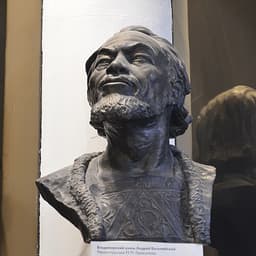
Andrei Bogolyubsky
Emperor · Medieval
46.8Total

Napoleon Bonaparte
General · Modern
70.9Total
Basic Information
Born
1111
1769
Died
1174
1821
Era
Medieval
Modern
Nationality
Vladimir-Suzdal
France
Occupation
Emperor
General
Civilization
Western
Western
Score Comparison
Military (10%)
10.0
94.0
Political (20%)
43.7
72.0
Influence (20%)
54.9
40.0
Legacy (20%)
46.7
80.0
Leadership (15%)
62.2
78.0
Strategy (15%)
45.0
90.0
TOTAL
46.8
70.9
Andrei Bogolyubsky — Complete Timeline
1157 AD
Transfer of the Capital to VladimirPolitical Action
After becoming Grand Prince, Andrei moved his capital from Kiev to Vladimir, a city in the northeast. He made Vladimir the political and religious center of his realm, building the Assumption Cathedral and Golden Gate.
Capital MoveVladimirPolitical Shift
Impact: regionalconstructive
1165 AD
Construction of the Church of the Intercession on the NerlCultural◆ Major
Andrei commissioned the Church of the Intercession on the Nerl River near Vladimir. This white-stone church is a masterpiece of medieval Russian architecture and a symbol of the Vladimir-Suzdal principality's cultural flourishing.
ArchitectureChurchCultural Symbol
Impact: regionalconstructive
1169 AD
Sack of KievWar
Andrei Bogolyubsky led a coalition of Rus princes in sacking Kiev, the traditional capital. His forces looted and burned the city, marking a decline in Kiev's power and the rise of Vladimir-Suzdal as a new center.
Sack of KievDeclineVladimir-Suzdal
Impact: regionaldestructive
1174 AD
Assassination by BoyarsPolitical Action◆ Major
Andrei was assassinated by a group of boyars in his palace at Bogolyubovo. The conspiracy was driven by his autocratic rule and conflicts with the nobility. His death led to a period of civil strife in Vladimir-Suzdal.
AssassinationBoyar RevoltCivil Strife
Impact: nationaltragic
Napoleon Bonaparte — Complete Timeline
1799 AD
Coup of 18 BrumaireOther◆ Major
Napoleon Bonaparte, with support from his brother Lucien and key political figures, overthrew the Directory in a bloodless coup. He established the Consulate with himself as First Consul, effectively becoming the ruler of France. This event ended the French Revolution's most unstable period.
French RevolutionCoupRise to Power
Impact: regional
1804 AD
Promulgation of the Napoleonic CodeOther◆ Major
Napoleon enacted the Civil Code of the French, known as the Napoleonic Code, a comprehensive set of laws that replaced the fragmented feudal legal systems. The code established legal equality, protected property rights, and secularized law. It became the basis for legal systems in many European and world countries.
Legal ReformNapoleonic CodeCivil Law
Impact: globalconstructive
1805 AD
Battle of AusterlitzWar◆ Major
Napoleon's Grande Arm
Napoleonic WarsBattleDecisive Victory
Impact: global
1812 AD
Invasion of RussiaWar◆ Major
Napoleon led the Grande Arm
Napoleonic WarsInvasionDisaster
Impact: globaldestructive
1815 AD
Battle of WaterlooWar◆ Major
Napoleon's French army was defeated by the combined forces of the Duke of Wellington's Anglo-Allied army and Gebhard Leberecht von Bl
Napoleonic WarsBattleFinal Defeat
Impact: globaldestructive
Expert Analysis
andrei-bogolyubsky-vs-napoleon-bonaparte
# The Emperor and the Prince: Two Paths to Power, Two Destinies
On a June morning in 1815, Napoleon Bonaparte watched his Imperial Guard march into the cannon fire of Wellington’s squares at Waterloo. Less than seven centuries earlier, in the dead of a June night in 1174, a group of boyars crept through the darkened corridors of a palace at Bogolyubovo, their daggers drawn for a prince who had tried to rule alone. Both men sought to reshape the world around them. One nearly succeeded; the other left only a stone church and a memory. Why did their stories diverge so radically?
Origins
Napoleon Bonaparte was born in 1769 on the island of Corsica, a place that had only recently become French. His family was minor nobility, provincial and poor. The France of his youth was a powder keg of Enlightenment ideas and crumbling monarchy. He studied at military academies in Brienne and Paris, absorbing the mathematics of artillery and the philosophy of Rousseau. When the Revolution erupted in 1789, he was a twenty-year-old lieutenant, a man without rank or fortune, but with a world about to be turned upside down.
Andrei Bogolyubsky was born in 1111 into the ruling family of the Rurik dynasty, the bloodline that had governed the Rus lands for two centuries. His father, Yuri Dolgoruky, founded Moscow. But Andrei grew up in a world of shifting princely alliances, where power was measured not in cannon but in cavalry, and where the great city of Kiev—the "Mother of Rus Cities"—was the prize every prince coveted. His era was medieval, feudal, and fractured. There was no revolution to ride, only the endless cycle of raid, tribute, and betrayal.
Rise to Power
Napoleon’s ascent was meteoric. In 1793, at age twenty-four, he drove the British out of Toulon with a brilliant artillery plan. By 1796, he commanded the Army of Italy, where his lightning marches and aggressive tactics shattered the Austrian armies. He was a general who led from the front, who slept on the ground with his men, who understood that speed and morale could defeat numbers. In 1799, he seized power in a coup d’état, becoming First Consul. By 1804, he crowned himself Emperor of the French. The path was open because the old order had collapsed.
Andrei’s rise was slower, more patient. He watched his father struggle for control of Kiev, and he learned that the southern capital was a poisoned cup. In 1157, when he became Grand Prince, Andrei made a radical decision: he moved his capital from Kiev to Vladimir, a small city in the northeast. It was a quiet revolution. He would not rule from the ancient center; he would build a new one. He elevated Vladimir, adorned it with white-stone churches, and made it the spiritual heart of the Rus lands. But his power was always contested, always fragile.
Leadership & Governance
Napoleon governed as he commanded: with energy, clarity, and a relentless will to centralize. He reformed French law with the Napoleonic Code, creating a uniform legal system that abolished feudal privileges and enshrined merit over birth. He established the Bank of France, stabilized the currency, and built a network of lycées to educate the next generation. His political wisdom was real: he understood that the Revolution had destroyed the old legitimacy and that he must create a new one. Yet his military genius—with a Strategy score of 93—often overwhelmed his political judgment. He conquered Europe, but he could not pacify it.
Andrei governed as a medieval autocrat, which meant he governed against the grain. He tried to break the power of the boyars—the noble council that had traditionally advised and checked the prince. He surrounded himself with younger men, loyalists from the lesser gentry. He built churches not just for God but for glory: the Church of the Intercession on the Nerl, completed in 1165, is a masterpiece of white-stone architecture, a symbol of Vladimir’s rising status. In 1169, he led a coalition of princes to sack Kiev, looting and burning the old capital. It was a military victory with a political score of 72, but it was also a wound that never healed. He had destroyed the symbol of Rus unity.
Triumph & Tragedy
Napoleon’s greatest triumph was Austerlitz in 1805, where he crushed the combined armies of Russia and Austria. His greatest tragedy was the invasion of Russia in 1812. He marched with 600,000 men into a frozen abyss; fewer than 100,000 returned. The Russian winter was not his enemy—his own hubris was. He could not stop, could not compromise, could not accept limits. In 1814, he was exiled to Elba. He returned in 1815 for the Hundred Days, but Waterloo ended it. His final exile, on Saint Helena, was a long dying.
Andrei’s triumph was the sack of Kiev in 1169. He had humbled the ancient capital and made Vladimir supreme. His tragedy came five years later, in 1174. The boyars he had marginalized conspired against him. They broke into his palace at Bogolyubovo, and in the darkness, they stabbed him to death. He was fifty-three. His autocratic rule had bred no loyalty, only fear. After his death, his realm fractured into civil war.
Character & Destiny
Napoleon was a man of immense will and immense vanity. He believed he was destiny’s instrument. “Impossible is a word to be found only in the dictionary of fools,” he said. He was brilliant, tireless, and utterly incapable of sharing power. His character drove him to conquer, and his character drove him to fall.
Andrei was a man of vision but not of trust. He saw what Vladimir could become, but he could not see that a prince without allies is a prince without protection. He was pious, building churches, but also ruthless, sacking Kiev. His assassination was not a random act; it was the logical end of a rule that had no foundation in consent.
Legacy
Napoleon’s legacy is vast. The Napoleonic Code influences civil law across Europe and beyond. His military campaigns are studied in every war college. His legend—the little corporal who conquered an empire—is immortal. His Legacy score of 78 reflects a figure who reshaped the modern state, for better and worse.
Andrei’s legacy is quieter but deeper in its way. By moving the capital to Vladimir, he shifted the center of Russian power from Kiev to the northeast, laying the groundwork for Moscow’s eventual rise. The Church of the Intercession on the Nerl still stands, a white stone prayer in a green field. He is remembered not as a conqueror but as a founder. His Legacy score of 62 is modest, but his influence on the architecture of Russian history is real.
Conclusion
Two men, seven centuries apart, each trying to build something that would outlast them. Napoleon built an empire of laws and armies; Andrei built a city and a church. One died in exile, the other by the knife. Both understood that power is a fragile thing. But Napoleon had a continent to reshape; Andrei had only a forest and a river. The difference is not just in their scores—82.4 versus 64.9—but in the scale of their ambitions and the nature of their worlds. Napoleon’s tragedy was that he could not stop conquering. Andrei’s tragedy was that he could not stop ruling alone. In the end, both were broken by the forces they tried to command. And both left behind something that outlasted them: a code, a church, a question about what it means to lead.
Rankings
🥇
Napoleon BonaparteLeader
Mil: 94.0Pol: 72.0Inf: 40.0
70.9
🥈
Andrei Bogolyubsky
Mil: 10.0Pol: 43.7Inf: 54.9
46.8
+24.1 behind
How This Comparison Works
Algorithm
Each figure is scored on 6 dimensions (0—100 scale) based on structured historical data: Military (10%), Political (20%), Influence (20%), Legacy (20%), Leadership (15%), Strategy (15%). The weighted total produces the final ranking.
Data Sources
Scores are computed from structured sub-indicators in the database. Scale factors adjust for era (Ancient ×0.85, Modern ×1.0) and civilization size (Eastern ×1.05, Other ×0.80) to account for differences in population and military scale.
Maximum 3 Figures
Comparisons are limited to 2—3 figures to ensure readability and statistical meaningfulness.
Error Margins
±5 points per dimension — Sub-scores are derived from historical records with inherent uncertainty. Two figures within 5 points on a dimension should be considered roughly equivalent in that area.
Total Score Accuracy
±3 points overall — The weighted combination of 6 dimensions produces a total score with approximately ±3 points of uncertainty. Differences of less than 3 points are not statistically significant— the figures are effectively tied.
Known Limitations
- Historical records are incomplete and uneven across civilizations
- Figures from oral-tradition societies may be underrepresented
- Occupation labels can misclassify multi-role figures
- Scores measure capability and impact, not moral character
- Quantitative scoring is a comparison tool, not absolute truth
Capability Radar
Military (10%) — Battles & Warfare
Battles
35
95
Win Rate
40
90
Expansion
45
95
Political (20%) — Governance & Reform
Reform
45
95
Diplomacy
40
80
Economy
35
85
Influence (20%) — Cultural & Global Reach
Cultural
40
85
Global
30
90
Legacy (20%) — Historical Impact
Historical
45
95
Longevity
35
90
Leadership (15%) — Power & Stability
Tenure
50
85
Stability
30
70
Strategy (15%) — Tactics & Innovation
Strategy
35
95
Tactics
30
98
Reform
20
92
Similar Comparisons
Comments & Discussion
CANNONBALL CALCULATOR6/17/2026
Sleepy comparison. Napoleon crushed 300,000 Austrians at Ulm without firing a shot through pure logistics. Andrei got stabbed by his own building contractors. Show me a single battle where Andrei outflanked an entire Habsburg army. One is a military revolution, the other is a medieval tabloid headline. Be serious.
石头教堂守望者6/17/2026
你拿沙皇村的大理石台阶比苏兹达尔的石灰岩?拿破仑用巴黎凯旋门给自己立传,安德烈只建了一座圣母升天教堂——但这座石头教堂在蒙古人烧光一切时还站着。谁更持久?你们这些数字狂只看伤亡,却看不见信仰。安德烈死在匕首下,但他的祈祷石至今有人抚摸。
DATA WRAITH6/17/2026
Explain why the "medieval autocrat vs modern emperor" framing ignores that Napoleon had telegraphs and mass conscription. Andrei ruled a region smaller than Corsica with 12th-century communication speeds. Compare their relative power ceilings, not their body counts. Napoleon's empire died in 11 years. Andrei's political structure lasted generations.
铁血与圣像6/17/2026
军事上拿破仑碾压,但精神层面安德烈更纯粹。拿破仑在莫斯科烧了四天,安德烈在博戈柳博沃建起白墙。你用滑铁卢证明胜利,我用弗拉基米尔的壁画证明永恒。法国皇帝死在圣赫勒拿的流放中,俄国王子死在祭坛前——谁的死更配得上"为信仰而亡"?历史会嘲笑拿破仑的虚荣,却会为安德烈的虔诚默哀。
CORSICAN FANBOY6/17/2026
Revisionist nonsense. Napoleon didn't "nearly succeed"—he conquered Europe. Andrei got murdered by his own druzhina because he couldn't manage basic court politics. One unified a continent, the other couldn't keep his bedroom safe. Stop fetishizing failure. Give me a single Andrei reform that matches the Napoleonic Code. I'll wait.