Loading...
Arnulf of Carinthia vs Napoleon Bonaparte
Napoleon Bonaparte leads by 19.8 pts · 2 figures compared
…
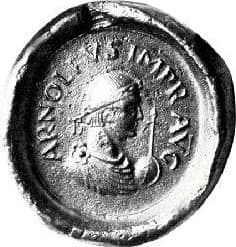
Arnulf of Carinthia
Emperor · Medieval
51.1Total

Napoleon Bonaparte
General · Modern
70.9Total
Basic Information
Born
850
1769
Died
899
1821
Era
Medieval
Modern
Nationality
East Francia
France
Occupation
Emperor
General
Civilization
Western
Western
Score Comparison
Military (10%)
20.0
94.0
Political (20%)
46.6
72.0
Influence (20%)
53.3
40.0
Legacy (20%)
46.7
80.0
Leadership (15%)
74.0
78.0
Strategy (15%)
60.0
90.0
TOTAL
51.1
70.9
Arnulf of Carinthia — Complete Timeline
887 AD
Deposition of Charles the FatPolitical Action
Arnulf played a key role in the deposition of his uncle, Charles the Fat, in 887. As the illegitimate son of Carloman, Arnulf was elected King of East Francia by the nobles, ending the unified Carolingian rule and establishing his own dynasty.
DepositionAccessionEast Francia
Impact: regional
891 AD
Battle of the Dyle (891)War◆ Major
Arnulf of Carinthia led an East Frankish army to victory against Viking raiders at the Battle of the Dyle in present-day Belgium. This victory halted Viking incursions into East Francia and demonstrated Arnulf's military capability, boosting his prestige.
BattleVikingsVictory
Impact: regionalconstructive
892 AD
Campaign against the MagyarsWar◆ Major
Arnulf allied with the Magyars (Hungarians) against the Moravian Empire, inviting them into Central Europe. This decision backfired, as the Magyars later turned on East Francia, launching devastating raids. Arnulf's short-term strategy had long-term negative consequences.
AllianceMagyarsRaids
Impact: regionaldestructive
896 AD
Imperial Coronation (896)Cultural◆ Major
Arnulf was crowned Holy Roman Emperor by Pope Formosus on February 22, 896, in Rome. He had marched into Italy to support the pope against rival factions. His coronation was brief, as he suffered a stroke soon after and returned to East Francia.
CoronationEmperorItaly
Impact: regional
899 AD
Death of Arnulf of CarinthiaOther
Arnulf died on December 8, 899, likely from a stroke. He was succeeded by his young son, Louis the Child, whose weak rule led to further fragmentation and vulnerability to Magyar attacks. Arnulf's reign was marked by military successes but also strategic errors.
DeathSuccessionDecline
Impact: regionaltragic
Napoleon Bonaparte — Complete Timeline
1799 AD
Coup of 18 BrumaireOther◆ Major
Napoleon Bonaparte, with support from his brother Lucien and key political figures, overthrew the Directory in a bloodless coup. He established the Consulate with himself as First Consul, effectively becoming the ruler of France. This event ended the French Revolution's most unstable period.
French RevolutionCoupRise to Power
Impact: regional
1804 AD
Promulgation of the Napoleonic CodeOther◆ Major
Napoleon enacted the Civil Code of the French, known as the Napoleonic Code, a comprehensive set of laws that replaced the fragmented feudal legal systems. The code established legal equality, protected property rights, and secularized law. It became the basis for legal systems in many European and world countries.
Legal ReformNapoleonic CodeCivil Law
Impact: globalconstructive
1805 AD
Battle of AusterlitzWar◆ Major
Napoleon's Grande Arm
Napoleonic WarsBattleDecisive Victory
Impact: global
1812 AD
Invasion of RussiaWar◆ Major
Napoleon led the Grande Arm
Napoleonic WarsInvasionDisaster
Impact: globaldestructive
1815 AD
Battle of WaterlooWar◆ Major
Napoleon's French army was defeated by the combined forces of the Duke of Wellington's Anglo-Allied army and Gebhard Leberecht von Bl
Napoleonic WarsBattleFinal Defeat
Impact: globaldestructive
Expert Analysis
arnulf-of-carinthia-vs-napoleon-bonaparte
# The Emperor and the King: Two Paths to Power in a Fractured Europe
In the winter of 896, a German king knelt before the Pope in Rome, receiving the crown of the Holy Roman Empire. Less than a century later, another man—a Corsican artillery officer—would seize that same crown with his own hands and place it on his own head, signaling to the world that he answered to no one. Arnulf of Carinthia and Napoleon Bonaparte never met, never could have met, yet their stories form a strange mirror across a thousand years. Both men rose from uncertain origins to rule Europe; both faced enemies that threatened to overwhelm their realms; both left behind empires that crumbled almost as soon as they were built. But the differences between them tell us something profound about how history shapes its leaders—and how leaders reshape history in turn.
Origins
Arnulf was born in 850, the illegitimate son of Carloman, King of Bavaria. In the Carolingian world, bastardy was a stain that could never be fully washed away. He grew up in the shadow of his father’s court, learning to fight and to scheme, but always aware that his claim to power was fragile. The Frankish Empire his great-grandfather Charlemagne had built was already splitting apart, and Arnulf’s life was spent trying to hold together what remained.
Napoleon, born in 1769 on the island of Corsica, grew up in a world that had just experienced the Enlightenment and was about to be consumed by revolution. His family was minor nobility, but Corsica had only recently become French, and young Napoleon spoke Italian-accented French that marked him as an outsider. Where Arnulf inherited a crumbling tradition, Napoleon inherited a blank slate. The French Revolution had swept away the old order, and a talented man—any talented man—could rise as high as his ambition and ability could carry him.
Rise to Power
Arnulf’s path to power was a matter of blood and betrayal. In 887, he played a key role in deposing his uncle, Charles the Fat, who had proven incapable of defending the empire from Viking raids. The Carolingian nobles gathered and chose Arnulf as king—not because he was the rightful heir, but because he was the strongest among them. He was elected, not born, to rule. That election, however, came with a price: the other Carolingian kings in West Francia and Italy refused to recognize his authority, and Arnulf spent his reign fighting to make a divided kingdom obey.
Napoleon’s rise was faster, more dramatic, and entirely his own making. He was a young artillery officer when the Revolution broke out, and he seized the opportunities it offered. In 1793, at the Siege of Toulon, he proved his military genius at age twenty-four. By 1796, he was commanding the Army of Italy, winning victories that stunned Europe. In 1799, he overthrew the Directory in a coup d’état and made himself First Consul. By 1804, he was Emperor. Each step was a gamble, and each gamble paid off—until one did not.
Leadership & Governance
Arnulf ruled as a Carolingian king, which meant he was constantly on the move, constantly fighting. His greatest military victory came at the Battle of the Dyle in 891, where he crushed a Viking army that had been ravaging the Low Countries. It was a brilliant defensive battle, but it did not end the Viking threat—nothing could. Arnulf also made a fateful decision in 892 when he allied with the Magyars, the horse-borne warriors from the east, against the Moravian Empire. He invited them into Central Europe as mercenaries, and they never left. Within a generation, the Magyars would be raiding deep into Germany, and Arnulf’s son, Louis the Child, would be unable to stop them.
Napoleon governed on a continental scale. He reformed French law with the Napoleonic Code, creating a legal system that still influences Europe today. He centralized the state, built roads and schools, and promoted men based on merit rather than birth. His military campaigns were masterpieces of speed and deception—Austerlitz in 1805, Jena in 1806, Wagram in 1809. But his governance had a fatal flaw: he could not stop conquering. Each victory brought more territory, more enemies, more resistance. The Spanish Ulcer bled his army dry; the Russian winter destroyed it entirely.
Triumph & Tragedy
Arnulf’s greatest moment came in 896, when Pope Formosus crowned him Holy Roman Emperor in Rome. For a bastard son of a minor Carolingian king, this was an astonishing achievement. He had marched into Italy to support the Pope against rival factions, and the crown was his reward. But the triumph was hollow. Arnulf was already suffering from what contemporaries described as a stroke or paralysis, and he died three years later in 899, leaving his throne to his seven-year-old son. The Carolingian Empire effectively died with him.
Napoleon’s tragedy is better known. He conquered Europe, but he could not hold it. The invasion of Russia in 1812 cost him half a million men. The Battle of Leipzig in 1813—the Battle of Nations—shattered his Grand Army. He was exiled to Elba in 1814, returned in 1815 for the Hundred Days, and met his final defeat at Waterloo on June 18, 1815. He died in exile on Saint Helena in 1821, a prisoner of the British, at age fifty-one.
Character & Destiny
Arnulf was a pragmatist. He did what he had to do to survive and to keep his kingdom together. He allied with pagans against Christians, deposed his own uncle, and accepted a crown from a controversial Pope. He was not a visionary; he was a survivor. His decisions were shaped by the narrow constraints of his time, when the empire was fragmenting, the Church was corrupt, and no single ruler could command the loyalty of all.
Napoleon was a visionary—and a gambler. He believed that a man of talent could shape his own destiny, and he proved it, over and over, until he overreached. His character was a mixture of brilliance and arrogance, charm and ruthlessness. He could inspire men to die for him, but he could also abandon them when they were no longer useful. His destiny was to rise higher than any man of his era, and to fall farther.
Legacy
Arnulf is barely remembered today, even by historians. His scores in military and political leadership are modest—52.2 and 62.1 out of 100, respectively—and his legacy score of 61.8 reflects his obscurity. He was a capable king in a difficult time, but he could not stop the decline of the Carolingian world. The Magyars he invited into Europe would plague Germany for decades; the empire he tried to hold together would fracture into duchies and kingdoms.
Napoleon’s legacy is immense. His military innovations—the corps system, the use of massed artillery, the emphasis on speed and maneuver—shaped warfare for a century. His Napoleonic Code spread across Europe and the Americas. His total influence score of 82.0 and legacy of 78.0 reflect his enduring impact. But his legacy is also ambiguous: he was a liberator who became a tyrant, a democrat who crowned himself emperor, a man who promised freedom and delivered war.
Conclusion
Standing at the end of their stories, one sees two men who faced the same fundamental challenge: how to rule a fractured Europe. Arnulf tried to hold together what remained of Charlemagne’s dream, and failed. Napoleon tried to build something new on the ruins of the old order, and failed too. But their failures were of different kinds. Arnulf’s was the failure of a man trapped by his time, fighting a rear-guard action against forces he could not control. Napoleon’s was the failure of a man who believed he could control everything, until the world proved him wrong. Both remind us that history is not made by individuals alone—but that individuals, for a brief, brilliant moment, can make history bend to their will.
Rankings
🥇
Napoleon BonaparteLeader
Mil: 94.0Pol: 72.0Inf: 40.0
70.9
🥈
Arnulf of Carinthia
Mil: 20.0Pol: 46.6Inf: 53.3
51.1
+19.8 behind
How This Comparison Works
Algorithm
Each figure is scored on 6 dimensions (0—100 scale) based on structured historical data: Military (10%), Political (20%), Influence (20%), Legacy (20%), Leadership (15%), Strategy (15%). The weighted total produces the final ranking.
Data Sources
Scores are computed from structured sub-indicators in the database. Scale factors adjust for era (Ancient ×0.85, Modern ×1.0) and civilization size (Eastern ×1.05, Other ×0.80) to account for differences in population and military scale.
Maximum 3 Figures
Comparisons are limited to 2—3 figures to ensure readability and statistical meaningfulness.
Error Margins
±5 points per dimension — Sub-scores are derived from historical records with inherent uncertainty. Two figures within 5 points on a dimension should be considered roughly equivalent in that area.
Total Score Accuracy
±3 points overall — The weighted combination of 6 dimensions produces a total score with approximately ±3 points of uncertainty. Differences of less than 3 points are not statistically significant— the figures are effectively tied.
Known Limitations
- Historical records are incomplete and uneven across civilizations
- Figures from oral-tradition societies may be underrepresented
- Occupation labels can misclassify multi-role figures
- Scores measure capability and impact, not moral character
- Quantitative scoring is a comparison tool, not absolute truth
Capability Radar
Military (10%) — Battles & Warfare
Battles
45
95
Win Rate
40
90
Expansion
40
95
Political (20%) — Governance & Reform
Reform
35
95
Diplomacy
55
80
Economy
40
85
Influence (20%) — Cultural & Global Reach
Cultural
30
85
Global
30
90
Legacy (20%) — Historical Impact
Historical
45
95
Longevity
35
90
Leadership (15%) — Power & Stability
Tenure
60
85
Stability
45
70
Strategy (15%) — Tactics & Innovation
Strategy
55
95
Tactics
50
98
Reform
30
92
Similar Comparisons
Comments & Discussion
AQUILA_IRONICA6/17/2026
Napoleon’s self-coronation in 1804 was an act of pure political theater that Arnulf would have understood but never dared. Arnulf needed Pope Formosus’s blessing to legitimize his bastardy—without it, the German nobles would never have accepted him. Bonaparte didn’t just ignore the pope; he physically took the crown from him. That’s the difference between a king playing within medieval rules and a tyrant rewriting them. Arnulf earned his legitimacy; Napoleon manufactured his.
RUST_COUNTER6/17/2026
Let’s look at the raw data: Napoleon’s empire lasted 11 years; Arnulf’s “empire” was just the name Holy Roman Emperor with almost no actual power. Arnulf spent his reign fighting Moravians and Vikings without ever fielding more than maybe 15,000 troops. Napoleon commanded half a million at Moscow alone. To compare their military leadership is absurd—one was a local warlord in a fractured kingdom, the other commanded continental armies. Arnulf couldn’t even control Bavaria in 894.
剑柄史学6/17/2026
说俩人一样是“草根逆袭”纯属对历史浪漫化。阿努尔夫再怎么说也是加洛林王室血脉,虽然私生子,但血脉就是通行证;拿破仑是法国大革命从底层提拔起来的军官。阿努尔夫继承的是帝国残骸,拿破仑是白手起家建新帝国。那些比较强调“出身模糊”的说法忽略了一个关键:阿努尔夫从来不是为了权力而战,他是为了保卫家族遗产;拿破仑是为了重塑整个欧洲秩序。这两人动机完全不同。
CROWN_AND_BAYONET6/17/2026
The real mirror here isn’t ambition—it’s how both men’s empires collapsed immediately after they stopped fighting. Arnulf had his triumph at the Battle of Leuven in 891, crushing the Vikings, and within years his kingdom was disintegrating from noble revolts. Napoleon won at Austerlitz in 1805, and ten years later he was dead in exile. Charlemagne’s legacy created a thousand-year institution; these two only got personal reigns. They were both firefighters who built with straw.
碎镜史观6/17/2026
最讽刺的是,拿对阿努尔夫的“昏君”标签套拿破仑,发现完全对不上。阿努尔夫被后世诟病是因为他政绩昙花一现、死后帝国立刻碎成诸侯国;拿破仑的失败被归咎于野心膨胀和穷兵黩武。但仔细想,阿努尔夫那个时代根本不可能建立长期帝国——加洛林世界本就四分五裂;而拿破仑如果见好就收,法兰西皇帝的头衔未必不能传下去。问题的本质不是个人能力,是他们面对的历史结构完全不同。阿努尔夫无能为力,拿破仑