Loading...
Artur Mas vs Napoleon Bonaparte
Napoleon Bonaparte leads by 20.5 pts · 2 figures compared
…
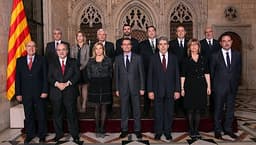
Artur Mas
Politician · Modern
50.4Total

Napoleon Bonaparte
General · Modern
70.9Total
Basic Information
Born
1956
1769
Died
—
1821
Era
Modern
Modern
Nationality
Spain
France
Occupation
Politician
General
Civilization
Western
Western
Score Comparison
Military (10%)
48.3
94.0
Political (20%)
48.0
72.0
Influence (20%)
54.9
40.0
Legacy (20%)
41.7
80.0
Leadership (15%)
67.0
78.0
Strategy (15%)
42.1
90.0
TOTAL
50.4
70.9
Artur Mas — Complete Timeline
2010 AD
Elected President of the Government of CataloniaPolitical Action◆ Major
Mas was elected as the 129th President of the Government of Catalonia, succeeding Jos
Catalan PoliticsElectionGovernance
Impact: regionalconstructive
2012 AD
Shifted to Pro-Independence StancePolitical Action
After a large pro-independence demonstration on September 11, 2012, Mas shifted his political position from autonomy to supporting Catalan independence. He called early elections and campaigned on a platform of self-determination, marking a major change in Catalan politics.
Catalan PoliticsIndependencePolitical Shift
Impact: regionalconstructive
2014 AD
Held the 2014 Catalan Self-Determination ConsultationPolitical Action◆ Major
Mas's government organized a non-binding consultation on Catalan independence on November 9, 2014, despite a Spanish constitutional court suspension. Over 2.3 million people participated, with 80% voting for independence. The event was symbolic but led to legal charges against Mas.
Catalan PoliticsReferendumLegal Conflict
Impact: regionalconstructive
2016 AD
Stepped Down as President to Allow Puigdemont's ElectionPolitical Action◆ Major
Mas stepped down as President of Catalonia to facilitate the election of Carles Puigdemont as his successor, after failing to secure enough support for his own re-election. This move allowed the pro-independence coalition to continue its agenda.
Catalan PoliticsSuccessionCoalition
Impact: regionalconstructive
2017 AD
Banned from Holding Public OfficePolitical Action◆ Major
Mas was convicted of disobedience for organizing the 2014 consultation and banned from holding public office for two years. The ban effectively ended his political career, though he remained influential in the independence movement.
Catalan PoliticsLegal ConflictDisqualification
Impact: regionaltragic
Napoleon Bonaparte — Complete Timeline
1799 AD
Coup of 18 BrumaireOther◆ Major
Napoleon Bonaparte, with support from his brother Lucien and key political figures, overthrew the Directory in a bloodless coup. He established the Consulate with himself as First Consul, effectively becoming the ruler of France. This event ended the French Revolution's most unstable period.
French RevolutionCoupRise to Power
Impact: regional
1804 AD
Promulgation of the Napoleonic CodeOther◆ Major
Napoleon enacted the Civil Code of the French, known as the Napoleonic Code, a comprehensive set of laws that replaced the fragmented feudal legal systems. The code established legal equality, protected property rights, and secularized law. It became the basis for legal systems in many European and world countries.
Legal ReformNapoleonic CodeCivil Law
Impact: globalconstructive
1805 AD
Battle of AusterlitzWar◆ Major
Napoleon's Grande Arm
Napoleonic WarsBattleDecisive Victory
Impact: global
1812 AD
Invasion of RussiaWar◆ Major
Napoleon led the Grande Arm
Napoleonic WarsInvasionDisaster
Impact: globaldestructive
1815 AD
Battle of WaterlooWar◆ Major
Napoleon's French army was defeated by the combined forces of the Duke of Wellington's Anglo-Allied army and Gebhard Leberecht von Bl
Napoleonic WarsBattleFinal Defeat
Impact: globaldestructive
Expert Analysis
artur-mas-vs-napoleon-bonaparte
# The Emperor and the President: Two Paths to Power, Two Destinies
On a cold December morning in 1805, Napoleon Bonaparte stood on the battlefields of Austerlitz, watching his Grand Army shatter the combined forces of Russia and Austria. The sun had broken through the mist just in time, illuminating his greatest triumph. Two centuries later, on a warm September afternoon in 2012, Artur Mas stood in Barcelona, watching a sea of red-and-yellow Estelada flags flood the streets, a million voices demanding independence. Both men stood at the precipice of history. One would reshape a continent. The other would reshape a region—and lose everything in the attempt.
Origins
Napoleon was born in 1769 on the island of Corsica, a year after France had purchased it from Genoa. His family was minor nobility, but their status was precarious. Young Napoleon spoke Italian, not French, and his classmates mocked his accent at military school. That outsider status forged something in him: a hunger to prove himself, a cold determination to rise above those who dismissed him. He devoured military history and Enlightenment philosophy, absorbing the ideas of Rousseau while learning how to load a cannon.
Artur Mas was born in 1956 in Barcelona, into a comfortable Catalan nationalist family. His father was a businessman, his mother a homemaker. He studied economics at the University of Barcelona, then went into business, then politics. Where Napoleon was forged in the fires of revolution, Mas was shaped by the quiet bureaucracy of post-Franco Spain. He joined Convergència Democràtica de Catalunya, a party that sought autonomy through negotiation, not confrontation. The world into which he entered was stable, democratic, and European—a world that did not reward military genius but political patience.
Rise to Power
Napoleon’s ascent was meteoric. He was a 24-year-old artillery officer when he recaptured Toulon from British forces in 1793, earning promotion to brigadier general. By 1796, at 26, he commanded the Army of Italy. He crossed the Alps, defeated the Austrians, and dictated peace terms in Vienna. His Italian campaign was a masterpiece of speed and deception: he moved his armies faster than his enemies could react, striking at their flanks and rear, turning every battle into a trap. In 1799, he staged a coup and became First Consul. By 1804, he crowned himself Emperor.
Mas’s rise was slower, more bureaucratic. He served as a city councilor, then a member of the Catalan parliament, then minister of economy under President Jordi Pujol. In 2010, after years of patient coalition-building, he was elected the 129th President of the Government of Catalonia. His path was not one of conquest but of incremental advancement, of committee meetings and budget negotiations. The turning point came not from a battle but a demonstration: on September 11, 2012, Catalan National Day, an estimated 1.5 million people marched for independence. Mas, who had previously supported autonomy within Spain, saw the tide and shifted his position entirely. It was a calculated risk, but not a military one.
Leadership & Governance
Napoleon governed with a fusion of military discipline and Enlightenment reform. His Napoleonic Code standardized French law, abolished feudalism, and established secular education. He built roads, canals, and a centralized banking system. He understood that power required not just conquest but administration. Yet his governance was also autocratic: he suppressed dissent, controlled the press, and crowned himself emperor. His military genius was undeniable—scores of 94 for military and 93 for strategy—but his political score of 75 reflects a ruler who could not tolerate opposition.
Mas governed in a democracy, which meant his power was always constrained. He pushed for a fiscal pact with Spain, then for a referendum on independence. He had no army, no secret police, no ability to impose his will by force. His leadership score of 76 is respectable but not extraordinary, and his strategy score of 35 reveals a critical weakness: he lacked the capacity to plan beyond the next political crisis. Where Napoleon could adapt his battle plans in hours, Mas could not adapt his political strategy when the Spanish government refused to negotiate.
Triumph & Tragedy
Napoleon’s greatest moment was Austerlitz, where he destroyed a larger army and ended the Third Coalition. His greatest failure was the invasion of Russia in 1812. He marched 600,000 men into the vastness of the Russian winter, and fewer than 100,000 returned. The disaster broke his aura of invincibility. He abdicated in 1814, returned in 1815, and was finally defeated at Waterloo. He died in exile on Saint Helena in 1821, at age 51.
Mas’s greatest moment was the 2014 Catalan self-determination consultation, held on November 9 despite a Spanish constitutional court ban. Over 2.3 million people voted, a powerful demonstration of popular will. His greatest failure was the aftermath: the Spanish government prosecuted him for disobedience, and in 2017 he was convicted and banned from holding public office for two years. He stepped down as president in 2016 to allow Carles Puigdemont to continue the independence push, but the movement fractured. Mas did not die in exile, but he was politically dead.
Character & Destiny
Napoleon was driven by an insatiable ambition. “Impossible is a word to be found only in the dictionary of fools,” he said. He believed he could shape history through sheer will, and for a time, he did. But his arrogance blinded him to limits—the limits of logistics, of winter, of human endurance. He could not stop, could not compromise, could not share power. That same ambition that lifted him to the heights also drove him to destruction.
Mas was driven by a different force: the desire to be on the right side of history. He was not a revolutionary by nature. He was a pragmatist who saw the independence movement as an opportunity. When the street demanded action, he acted. But he lacked the strategic vision to see the consequences. He could not imagine that the Spanish state would use the full force of the law against him. He was a politician who tried to lead a revolution, and revolutions eat their own.
Legacy
Napoleon’s legacy is immense. The Napoleonic Code influenced legal systems across Europe and the Americas. His military tactics are still studied. He reshaped the map of Europe, dismantled the Holy Roman Empire, and inspired nationalism across the continent. His total score of 82.4 reflects a figure who changed the world, for better and worse.
Mas’s legacy is smaller, more ambiguous. His total score of 59.4 reflects a regional leader who catalyzed a movement but could not complete it. He is remembered in Catalonia as the man who dared to challenge Madrid, and in Spain as the man who broke the law. His consultation of 2014 was a rehearsal for the 2017 referendum that would bring Puigdemont, police violence, and a unilateral declaration of independence. Mas opened a door that others walked through, but he could not walk through it himself.
Conclusion
The difference between Napoleon and Mas is not simply one of scale. It is one of nature. Napoleon was a force of nature, a man who bent history to his will until history bent back. Mas was a product of his time, a man who rode a wave he could not control. One commanded armies; the other commanded committees. One conquered Europe; the other could not conquer a single court. Yet both faced the same fundamental question: what happens when ambition meets reality? Napoleon answered with war, and lost. Mas answered with politics, and lost. History remembers the one who fought, even in defeat, more vividly than the one who negotiated, even in victory. But perhaps the quieter lesson is this: the most dangerous moment for any leader is when they believe they can read the future. Napoleon saw only glory. Mas saw only independence. Neither saw the abyss.
Rankings
🥇
Napoleon BonaparteLeader
Mil: 94.0Pol: 72.0Inf: 40.0
70.9
🥈
Artur Mas
Mil: 48.3Pol: 48.0Inf: 54.9
50.4
+20.5 behind
How This Comparison Works
Algorithm
Each figure is scored on 6 dimensions (0—100 scale) based on structured historical data: Military (10%), Political (20%), Influence (20%), Legacy (20%), Leadership (15%), Strategy (15%). The weighted total produces the final ranking.
Data Sources
Scores are computed from structured sub-indicators in the database. Scale factors adjust for era (Ancient ×0.85, Modern ×1.0) and civilization size (Eastern ×1.05, Other ×0.80) to account for differences in population and military scale.
Maximum 3 Figures
Comparisons are limited to 2—3 figures to ensure readability and statistical meaningfulness.
Error Margins
±5 points per dimension — Sub-scores are derived from historical records with inherent uncertainty. Two figures within 5 points on a dimension should be considered roughly equivalent in that area.
Total Score Accuracy
±3 points overall — The weighted combination of 6 dimensions produces a total score with approximately ±3 points of uncertainty. Differences of less than 3 points are not statistically significant— the figures are effectively tied.
Known Limitations
- Historical records are incomplete and uneven across civilizations
- Figures from oral-tradition societies may be underrepresented
- Occupation labels can misclassify multi-role figures
- Scores measure capability and impact, not moral character
- Quantitative scoring is a comparison tool, not absolute truth
Capability Radar
Military (10%) — Battles & Warfare
Battles
29
95
Win Rate
33
90
Expansion
36
95
Political (20%) — Governance & Reform
Reform
35
95
Diplomacy
45
80
Economy
40
85
Influence (20%) — Cultural & Global Reach
Cultural
35
85
Global
25
90
Legacy (20%) — Historical Impact
Historical
30
95
Longevity
20
90
Leadership (15%) — Power & Stability
Tenure
40
85
Stability
30
70
Strategy (15%) — Tactics & Innovation
Strategy
38
95
Tactics
41
98
Reform
42
92
Similar Comparisons
Comments & Discussion
CANNONBALL CYNIC6/17/2026
Look, comparing Austerlitz to a crowded plaza is like comparing a tsunami to a garden hose. Napoleon conquered a continent with blood and iron; Mas had to settle for negotiating with Madrid over a tax dispute. One man marched his army across the Alps; the other couldn’t even get his independence referendum past a constitutional court. Let’s not pretend these are comparable historical figures—Napoleon reshaped Europe, Mas just reshuffled Catalonia’s budget sheets.
长城守卫者6/17/2026
拿破仑是历史的山崩地裂,马斯只是河滩上的小石子。拿破仑用大炮讲道理,马斯用选票写诗。拿破仑在奥斯特里茨赢得了整个欧洲的敬畏,马斯在巴塞罗那只能赢得一堆自拍杆。权力不是游行就能征服的,马斯输在以为广场上的热情能代替地缘政治的冷酷。别忘了,拿破仑的敌人是俄国沙皇,马斯的敌人却是自己的统计数字。
THE GAUGE REBEL6/17/2026
As a data skeptic, I smell revisionism. The summary romanticizes both, but Mas’s “sea of flags” is just a crowd shot—no casualties, no strategic victories, no continent-spanning empire. Napoleon’s Austerlitz had 9,000 French dead, but Mas’s 2012 march was a political selfie. You can’t compare military genius with a failed independence stunt. Numbers don’t lie: Mas’s support never cracked 50% in polls, while Napoleon scared Europe into coalitions. One changed borders; the other just wanted a new
东方史官6/17/2026
拿破仑用枪炮改写文明规则,马斯却困在自治区的行政博弈里。拿破仑让法国从革命废墟中崛起为欧陆霸主;马斯却在2017年目睹独立梦粉碎于宪法第155条。拿破仑在莫斯科大火中撤退,但他在圣赫勒拿岛仍敢改记忆;马斯失去总统位后,只敢在律师函里讨公道。马斯的故事是地方史诗,拿破仑才是世界史教科书。
ROMAN CANDLE RISK6/17/2026
Both men saw themselves as historical lightning rods, but one actually got struck. Napoleon’s ego built empires; Mas’s ego built a checkbook. The Corsican upstart turned France into a military machine that terrorized kings; Mas turned Catalonia into a Brussels lobbyist’s dream. Let’s call it: Mas is Napoleon without the battles, without the glory, and without the exile—just a very expensive lesson in how modern politics thrives on symbolism, not steel.