Loading...
Ashot I of Armenia vs Napoleon Bonaparte
Napoleon Bonaparte leads by 13.0 pts · 2 figures compared
…
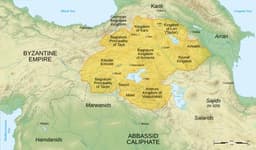
Ashot I of Armenia
Emperor · Medieval
57.9Total

Napoleon Bonaparte
General · Modern
70.9Total
Basic Information
Born
820
1769
Died
890
1821
Era
Medieval
Modern
Nationality
Armenia
France
Occupation
Emperor
General
Civilization
Middle Eastern
Western
Score Comparison
Military (10%)
55.0
94.0
Political (20%)
68.0
72.0
Influence (20%)
57.2
40.0
Legacy (20%)
49.2
80.0
Leadership (15%)
74.0
78.0
Strategy (15%)
45.0
90.0
TOTAL
57.9
70.9
Ashot I of Armenia — Complete Timeline
885 AD
Recognition as King of Armenia by the Abbasid CaliphatePolitical Action◆ Major
The Abbasid Caliphate formally recognized Ashot I as King of Armenia, ending centuries of Arab rule. This recognition, followed by similar recognition from the Byzantine Empire, established the Bagratuni Kingdom of Armenia as a sovereign state.
RecognitionIndependenceBagratuni
Impact: regionalconstructive
Coronation as King of ArmeniaPolitical Action◆ Major
Ashot I was crowned King of Armenia in a ceremony that combined Byzantine and Armenian traditions. This coronation marked the formal restoration of the Armenian monarchy after centuries of foreign domination.
CoronationMonarchyRestoration
Impact: nationalconstructive
886 AD
Alliance with the Byzantine EmpirePolitical Action
Ashot I established a diplomatic alliance with the Byzantine Emperor Basil I. This alliance provided Armenia with Byzantine support against common enemies, particularly the Abbasid Caliphate, and facilitated cultural and economic exchange.
AllianceByzantine EmpireDiplomacy
Impact: regionalconstructive
890 AD
Defeat of the Sajid EmirateWar
Ashot I led a military campaign against the Sajid Emirate, a Muslim dynasty that threatened Armenian territory. His victory secured the eastern borders of his kingdom and demonstrated the military strength of the new Bagratuni state.
BattleSajidDefense
Impact: regionalconstructive
Napoleon Bonaparte — Complete Timeline
1799 AD
Coup of 18 BrumaireOther◆ Major
Napoleon Bonaparte, with support from his brother Lucien and key political figures, overthrew the Directory in a bloodless coup. He established the Consulate with himself as First Consul, effectively becoming the ruler of France. This event ended the French Revolution's most unstable period.
French RevolutionCoupRise to Power
Impact: regional
1804 AD
Promulgation of the Napoleonic CodeOther◆ Major
Napoleon enacted the Civil Code of the French, known as the Napoleonic Code, a comprehensive set of laws that replaced the fragmented feudal legal systems. The code established legal equality, protected property rights, and secularized law. It became the basis for legal systems in many European and world countries.
Legal ReformNapoleonic CodeCivil Law
Impact: globalconstructive
1805 AD
Battle of AusterlitzWar◆ Major
Napoleon's Grande Arm
Napoleonic WarsBattleDecisive Victory
Impact: global
1812 AD
Invasion of RussiaWar◆ Major
Napoleon led the Grande Arm
Napoleonic WarsInvasionDisaster
Impact: globaldestructive
1815 AD
Battle of WaterlooWar◆ Major
Napoleon's French army was defeated by the combined forces of the Duke of Wellington's Anglo-Allied army and Gebhard Leberecht von Bl
Napoleonic WarsBattleFinal Defeat
Impact: globaldestructive
Expert Analysis
ashot-i-of-armenia-vs-napoleon-bonaparte
# The Emperor and the King: Napoleon and Ashot I, Architects of Empire
In the spring of 885, on a windswept plateau in the Caucasus Mountains, a ceremony unfolded that would reshape the destiny of a people. Ashot I, a prince of the Bagratuni dynasty, knelt before a bishop who placed a crown upon his head—a crown recognized by both the Abbasid Caliphate and the Byzantine Empire. Half a continent away and nearly a millennium later, in December 1804, another man stood in Notre-Dame Cathedral in Paris, took the crown from the pope’s hands, and placed it on his own head. Napoleon Bonaparte’s gesture was a declaration of supreme self-confidence; Ashot’s was a delicate balancing act between two great powers. These two figures, separated by time, geography, and culture, both restored sovereignty to their peoples—yet one built an empire that collapsed in a decade, while the other founded a kingdom that endured for centuries. Why did their paths diverge so dramatically?
Origins
Napoleon Bonaparte was born in 1769 on the island of Corsica, a year after France had purchased the island from Genoa. His family belonged to the minor nobility, but their status was precarious in a land of conquest and rebellion. The young Napoleon grew up speaking Italian-accented French, acutely aware of being an outsider. This sense of displacement fueled an ambition that was personal, not national: he sought to conquer not for France but for himself. His education at military schools in Brienne and Paris drilled into him the Enlightenment ideals of meritocracy and rational order, but also the brutal realities of revolutionary warfare.
Ashot I of Armenia, born in 820, came from a lineage far older and more burdened. The Bagratuni family had served as princes under Arab rule for generations, navigating the treacherous currents between the Abbasid Caliphate and the Byzantine Empire. Armenia had been without a king since the fall of the Arsacid dynasty in 428—nearly four centuries of foreign domination. Ashot inherited not just a title but a memory of lost glory. His ambition was collective: to restore Armenia’s place among nations. Where Napoleon was a self-made man in a revolutionary age, Ashot was a traditional ruler in a world of empires.
Rise to Power
Napoleon’s ascent was meteoric, propelled by the chaos of the French Revolution. At age 24, he commanded the artillery at the Siege of Toulon in 1793, a victory that made him a brigadier general. By 1796, he led the Italian campaign, dazzling Europe with lightning marches and decisive battles. His political genius matched his military skill: in 1799, he staged a coup d’état and became First Consul. Within five years, he crowned himself Emperor. His path was one of conquest, ambition, and opportunism.
Ashot’s rise was slower, more patient, and fundamentally political. He did not conquer his way to power; he negotiated it. For decades, he served as *prince of princes* under the Abbasids, proving his loyalty while quietly consolidating Armenian authority. When the Abbasid Caliphate weakened in the late 9th century, Ashot seized the moment—not by war, but by diplomacy. In 885, the Caliph al-Mu’tamid recognized him as King of Armenia, and the Byzantine Emperor Basil I followed suit in 886. Ashot became king not by defeating his enemies but by making himself indispensable to both.
Leadership & Governance
Napoleon governed as a modernizer and centralizer. His Napoleonic Code, enacted in 1804, standardized French law, abolished feudal privileges, and enshrined meritocracy. He built roads, established the Bank of France, and reformed education. Yet his rule was autocratic: he suppressed dissent, controlled the press, and crowned himself emperor. His military genius, with a strategic score of 93, was undeniable—he won over 60 battles, from Austerlitz in 1805 to Jena in 1806. But his governance was inseparable from his ambition. Every reform served his power; every law reinforced his control.
Ashot governed as a restorer and diplomat. His military score of 40 reflects a ruler who fought only when necessary, preferring negotiation to war. His leadership score of 87, however, reveals a different kind of strength: the ability to unite a fractured people. He rebuilt Armenian churches, revived the Armenian alphabet and literature, and established a stable tax system. His alliance with Byzantium in 886 gave Armenia protection without subjugation. Where Napoleon imposed order through force, Ashot cultivated loyalty through tradition and faith. The one victory he did win—the defeat of the Sajid Emirate in 890—was defensive, preserving Armenian territory rather than expanding it.
Triumph & Tragedy
Napoleon’s greatest triumph was Austerlitz in 1805, where he crushed the combined armies of Russia and Austria, cementing his dominance over Europe. His greatest tragedy was the invasion of Russia in 1812—a catastrophic campaign where 600,000 men marched east and fewer than 100,000 returned. The disaster broke his invincible aura, leading to his abdication in 1814, a brief return in 1815, and final defeat at Waterloo. His tragedy was hubris: he could not stop conquering.
Ashot’s triumph was the coronation of 885, which ended four centuries of foreign rule. His tragedy was more subtle: he died in 890, knowing his kingdom was fragile, surrounded by powers that could crush it at any moment. The Bagratuni kingdom would last until 1045, but Ashot’s successors faced constant threats. His tragedy was not a dramatic fall but the weight of survival—a kingdom that could never rest.
Character & Destiny
Napoleon was driven by an insatiable ego. “I am the revolution,” he once said, conflating himself with the very force that had brought him to power. His personality—brilliant, arrogant, restless—shaped his decisions. He trusted no one fully, centralized everything, and believed his will could overcome any obstacle. This made him a conqueror but also a tyrant, and ultimately, an exile on Saint Helena.
Ashot was driven by a sense of duty. He was a diplomat, not a warrior; a builder, not a destroyer. His personality—patient, pragmatic, devout—shaped his decisions. He accepted the limits of Armenian power, seeking not to dominate but to endure. This made him a founder but also a caretaker, and ultimately, a king remembered as “the Great” for restoring what was lost.
Legacy
Napoleon’s legacy is global and contradictory. He spread the ideals of the French Revolution—nationalism, legal equality, secular governance—across Europe, yet he also caused millions of deaths and restored slavery in French colonies. His military tactics are still studied; his code still influences law. But his empire vanished within a decade of his death. He is remembered as a genius and a tyrant, a liberator and a conqueror.
Ashot’s legacy is national and enduring. He restored Armenian sovereignty after centuries, founding a dynasty that ruled for 160 years. His kingdom became a center of Armenian culture, religion, and identity. Today, he is a national hero, celebrated as the father of the medieval Armenian state. But his influence is largely confined to Armenia and its diaspora. He is remembered as a restorer, not a conqueror.
Conclusion
Standing side by side in history’s gallery, Napoleon and Ashot I reveal the two faces of leadership. Napoleon, the comet that blazed across the sky and burned out; Ashot, the steady flame that lit a people’s way through the dark. One sought to remake the world in his image; the other sought to restore his world to its former self. Their differences are not merely of scale but of purpose. Napoleon’s ambition was personal, and his legacy is a lesson in the dangers of unchecked power. Ashot’s ambition was collective, and his legacy is a testament to the quiet power of perseverance. In the end, the emperor who crowned himself is remembered for his fall, while the king who knelt to be crowned is remembered for his rise. Both stories remind us that history measures leaders not by how high they climb, but by what they leave behind.
Rankings
🥇
Napoleon BonaparteLeader
Mil: 94.0Pol: 72.0Inf: 40.0
70.9
🥈
Ashot I of Armenia
Mil: 55.0Pol: 68.0Inf: 57.2
57.9
+13.0 behind
How This Comparison Works
Algorithm
Each figure is scored on 6 dimensions (0—100 scale) based on structured historical data: Military (10%), Political (20%), Influence (20%), Legacy (20%), Leadership (15%), Strategy (15%). The weighted total produces the final ranking.
Data Sources
Scores are computed from structured sub-indicators in the database. Scale factors adjust for era (Ancient ×0.85, Modern ×1.0) and civilization size (Eastern ×1.05, Other ×0.80) to account for differences in population and military scale.
Maximum 3 Figures
Comparisons are limited to 2—3 figures to ensure readability and statistical meaningfulness.
Error Margins
±5 points per dimension — Sub-scores are derived from historical records with inherent uncertainty. Two figures within 5 points on a dimension should be considered roughly equivalent in that area.
Total Score Accuracy
±3 points overall — The weighted combination of 6 dimensions produces a total score with approximately ±3 points of uncertainty. Differences of less than 3 points are not statistically significant— the figures are effectively tied.
Known Limitations
- Historical records are incomplete and uneven across civilizations
- Figures from oral-tradition societies may be underrepresented
- Occupation labels can misclassify multi-role figures
- Scores measure capability and impact, not moral character
- Quantitative scoring is a comparison tool, not absolute truth
Capability Radar
Military (10%) — Battles & Warfare
Battles
35
95
Win Rate
40
90
Expansion
30
95
Political (20%) — Governance & Reform
Reform
50
95
Diplomacy
60
80
Economy
45
85
Influence (20%) — Cultural & Global Reach
Cultural
45
85
Global
30
90
Legacy (20%) — Historical Impact
Historical
50
95
Longevity
45
90
Leadership (15%) — Power & Stability
Tenure
55
85
Stability
50
70
Strategy (15%) — Tactics & Innovation
Strategy
35
95
Tactics
30
98
Reform
25
92
Similar Comparisons
Comments & Discussion
BAGRATUNI_OR_BUST6/17/2026
Let's be real: comparing Ashot I to Napoleon is like comparing a chess grandmaster to a street brawler. Ashot played the long game with the Byzantines and Abbasids, getting both to recognize his crown - a diplomatic miracle. Napoleon? He took his crown from the pope like a petulant teenager, then bled Europe dry for a decade. Ashot's kingdom lasted centuries because he knew survival meant compromise, not conquest.
拿破仑的棋子6/17/2026
说拿破仑像亚述一世?得了吧!拿破仑在奥斯特里茨战役后强行解散神圣罗马帝国,彻底打破了欧洲千年均势。亚述一世再聪明,也只是在两大帝国间玩平衡术,哪敢动这种结构性的变革?拿破仑的野心是炸毁整个旧秩序,亚述不过是在废墟上修修补补。历史后果完全不同,别混为一谈。
STATS_OR_STORIES6/17/2026
The numbers don't lie. Napoleon's empire controlled roughly 70 million subjects at its peak in 1810 - Ashot's Armenia maybe hit a million or two. Yet Napoleon's empire crumbled within 15 years, while Ashot's Bagratid dynasty lasted until 1045. That's not a failure of ambition; it's a failure of structure. Napoleon built a dependency machine that required constant military success. Ashot built a sustainable kingdom that could actually survive a bad harvest or two.
古典学家的叹息6/17/2026
有意思的是,拿破仑在1798年入侵埃及时,还幻想模仿亚历山大大帝在东方建立新文明。结果呢?他在阿克围城战中败给杰扎尔帕夏,只留下一堆考古素描。反观亚述一世,他不需要去东方发现什么——他自己就是东方。拿破仑的浪漫主义帝国梦,在现实中不过是一段插曲;亚述的王国才是扎根千年的活历史。根源不是能力差距,是对文化根基的理解不同。
REVISIONIST_REBEL6/17/2026
Everyone romanticizes Napoleon as the brilliant strategist who built an empire, but let's be honest: he was a product of revolutionary chaos who rode luck and terror. Ashot I rebuilt Armenian statehood from literally nothing after Arab occupation - no guillotine, no mass conscription, no burning of Moscow. The fact that Ashot's dynasty endured for over 150 years while Napoleon's fell in a single generation tells you who understood how to actually govern, not just conquer.