Loading...
Askia Ismail vs Napoleon Bonaparte
Napoleon Bonaparte leads by 23.8 pts · 2 figures compared
…
Askia Ismail
Emperor · Medieval
47.1Total

Napoleon Bonaparte
General · Modern
70.9Total
Basic Information
Born
1500
1769
Died
1539
1821
Era
Medieval
Modern
Nationality
Songhai Empire
France
Occupation
Emperor
General
Civilization
Other
Western
Score Comparison
Military (10%)
46.7
94.0
Political (20%)
39.4
72.0
Influence (20%)
48.6
40.0
Legacy (20%)
40.0
80.0
Leadership (15%)
65.7
78.0
Strategy (15%)
45.0
90.0
TOTAL
47.1
70.9
Askia Ismail — Complete Timeline
1528 AD
Accession as Askia of SonghaiPolitical Action◆ Major
Askia Ismail became ruler of the Songhai Empire following the deposition of his father, Askia Mohammed I. His reign was marked by efforts to restore stability after the internal conflicts that had arisen during his father's later years.
SuccessionSonghai Empire
Impact: national
1539 AD
Deposition of Askia IsmailPolitical Action◆ Major
Askia Ismail was deposed by his brother, Askia Ishaq I, after a reign of approximately 11 years. This event continued the pattern of dynastic instability within the Songhai Empire during the 16th century.
DepositionDynastic Conflict
Impact: nationaldestructive
Napoleon Bonaparte — Complete Timeline
1799 AD
Coup of 18 BrumaireOther◆ Major
Napoleon Bonaparte, with support from his brother Lucien and key political figures, overthrew the Directory in a bloodless coup. He established the Consulate with himself as First Consul, effectively becoming the ruler of France. This event ended the French Revolution's most unstable period.
French RevolutionCoupRise to Power
Impact: regional
1804 AD
Promulgation of the Napoleonic CodeOther◆ Major
Napoleon enacted the Civil Code of the French, known as the Napoleonic Code, a comprehensive set of laws that replaced the fragmented feudal legal systems. The code established legal equality, protected property rights, and secularized law. It became the basis for legal systems in many European and world countries.
Legal ReformNapoleonic CodeCivil Law
Impact: globalconstructive
1805 AD
Battle of AusterlitzWar◆ Major
Napoleon's Grande Arm
Napoleonic WarsBattleDecisive Victory
Impact: global
1812 AD
Invasion of RussiaWar◆ Major
Napoleon led the Grande Arm
Napoleonic WarsInvasionDisaster
Impact: globaldestructive
1815 AD
Battle of WaterlooWar◆ Major
Napoleon's French army was defeated by the combined forces of the Duke of Wellington's Anglo-Allied army and Gebhard Leberecht von Bl
Napoleonic WarsBattleFinal Defeat
Impact: globaldestructive
Expert Analysis
askia-ismail-vs-napoleon-bonaparte
# The Emperor and the Askia: Two Visions of Power in Different Worlds
In the summer of 1528, as the Songhai Empire’s new ruler Askia Ismail took his seat in Gao, a thirteen-year-old boy on the distant island of Corsica was learning to read Latin. Neither could have imagined that their names would one day be spoken in the same breath—one as a titan who reshaped Europe, the other as a footnote in the story of a vanished African empire. Yet their parallel journeys, separated by centuries and continents, reveal how ambition, circumstance, and character can produce wildly different outcomes even when the stakes are identical: the survival of a dynasty and the fate of millions.
Origins
Napoleon Bonaparte was born in 1769 into the minor Corsican nobility, a world of Mediterranean feuds and French colonial rule. His father, Carlo, was a lawyer who navigated the shifting loyalties of island politics, while his mother, Letizia, raised eight children with stern discipline. Corsica had only recently been annexed by France, and young Napoleon grew up speaking Italian-accented French, an outsider in the land he would one day rule. This marginality forged in him a relentless drive to prove himself—a hunger that would never be satisfied.
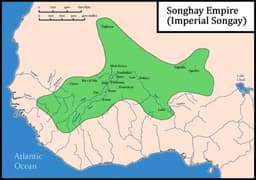
Askia Ismail, by contrast, was born around 1500 into the ruling house of the Songhai Empire, the largest state in West African history. His father, Askia Mohammed I, had transformed Songhai from a riverine kingdom into a sprawling empire stretching from the Sahara to the forests of modern Nigeria. Ismail grew up in a world of Islamic scholarship, trans-Saharan trade, and constant military expansion. The empire his father built was held together by personal loyalty, religious authority, and the threat of cavalry raids. There was no room for outsiders here; Ismail was born at the center, and his challenge was not to conquer but to preserve.
Rise to Power
Napoleon’s ascent was a product of chaos. The French Revolution had shattered the old order, creating opportunities for talented men of modest birth. At twenty-four, he captured Toulon from British forces; at twenty-six, he crushed a royalist uprising in Paris; at twenty-seven, he led a ragged army across the Alps into Italy, winning battles that seemed impossible. In 1799, at age thirty, he seized power in a coup, becoming First Consul of France. His rise was a whirlwind of ambition, luck, and genius—a man who made his own destiny because the old rules had been erased.
Askia Ismail’s path was narrower. In 1528, his father, the great Askia Mohammed, was old and blind. The empire’s succession was contested, and Ismail deposed his father in a palace coup, taking the throne by force. Unlike Napoleon, he inherited a stable structure—but one that was already fraying. The Songhai Empire had been built on the personal authority of one man, and the transition of power was always a crisis. Ismail’s rise was not a revolution but a reshuffling of the same deck.
Leadership & Governance
Napoleon governed with the energy of a whirlwind. He reformed France’s legal system with the Napoleonic Code, standardized education, built roads and canals, and centralized the state. He was a military genius—his 94.0 military score reflects a man who fought over sixty battles and lost only seven. But his political score of 75.0 reveals a flaw: he could conquer but not consolidate. His empire was a pyramid balanced on his own head, and when he fell, it collapsed.
Askia Ismail ruled differently. His political score of 45.0 and military score of 39.0 suggest a cautious, conservative leader. He did not expand the empire; he tried to hold it together. He relied on the existing bureaucracy of Islamic judges and provincial governors, seeking to restore the stability his father had achieved. But his strategy score of 67.8 hints at a tactical mind—he understood that the empire’s strength lay in its trade routes and religious unity, not in endless war. Yet his reign was a holding action, not a transformation.
Triumph & Tragedy
Napoleon’s greatest moment came in 1805 at Austerlitz, where he destroyed the combined armies of Russia and Austria. His worst came in 1812, when the invasion of Russia cost half a million men. The pattern repeated: brilliant victories followed by catastrophic overreach. His final defeat at Waterloo in 1815 was a tragedy of his own making—a man who could not stop.
Askia Ismail’s triumph was simply surviving eleven years as ruler of an empire prone to civil war. His tragedy was that survival was not enough. In 1539, his brother Askia Ishaq I deposed him, and Ismail vanished into the shadows of history. He had no Austerlitz, no Waterloo—only a slow fade into irrelevance.
Character & Destiny
Napoleon was driven by an insatiable ego. “I am not a man, but a thing,” he once said, meaning that he had become a force of nature. His ambition was limitless, and so was his capacity for self-destruction. He could not delegate, could not trust, could not stop. His character was his engine and his prison.
Askia Ismail was a different kind of ruler: cautious, conservative, perhaps even timid. He tried to preserve what his father had built, but preservation is not enough when the world is changing. The Songhai Empire faced the same pressures as all premodern states—succession crises, environmental stress, external threats—but Ismail lacked the vision to transform it. He was a steward, not a revolutionary.
Legacy
Napoleon’s legacy is immense. His legal code influences half the world’s legal systems. His campaigns reshaped European borders and inspired nationalism. He is remembered as a genius, a tyrant, a liberator, a conqueror—a man whose shadow still falls across the modern world. His scores reflect this: Influence 82.0, Legacy 78.0.
Askia Ismail is barely remembered. His total score of 51.6 places him among the minor figures of history. The Songhai Empire itself would collapse within a century, destroyed by Moroccan invaders with guns. Ismail’s name survives only in scholarly footnotes and the oral traditions of the Sahel. He was not a failure, but he was not a success either—he was a placeholder in a story that had no happy ending.
Conclusion
What separates these two men is not talent or ambition, but opportunity and timing. Napoleon lived in an age of revolution, when the old world was dying and a new one could be built from the rubble. Askia Ismail lived in an age of stagnation, when the Songhai Empire was already past its peak. Napoleon could remake the world; Ismail could only try to hold it together. Their stories remind us that history is not a meritocracy—it is a lottery of time and place. The greatest leader cannot win if the game is already lost, and the most flawed genius can change the world if the moment is right. In the end, both men were prisoners of their eras, and their fates were written not by their choices alone, but by the currents of history that carried them forward—or let them drift away.
Rankings
🥇
Napoleon BonaparteLeader
Mil: 94.0Pol: 72.0Inf: 40.0
70.9
🥈
Askia Ismail
Mil: 46.7Pol: 39.4Inf: 48.6
47.1
+23.8 behind
How This Comparison Works
Algorithm
Each figure is scored on 6 dimensions (0—100 scale) based on structured historical data: Military (10%), Political (20%), Influence (20%), Legacy (20%), Leadership (15%), Strategy (15%). The weighted total produces the final ranking.
Data Sources
Scores are computed from structured sub-indicators in the database. Scale factors adjust for era (Ancient ×0.85, Modern ×1.0) and civilization size (Eastern ×1.05, Other ×0.80) to account for differences in population and military scale.
Maximum 3 Figures
Comparisons are limited to 2—3 figures to ensure readability and statistical meaningfulness.
Error Margins
±5 points per dimension — Sub-scores are derived from historical records with inherent uncertainty. Two figures within 5 points on a dimension should be considered roughly equivalent in that area.
Total Score Accuracy
±3 points overall — The weighted combination of 6 dimensions produces a total score with approximately ±3 points of uncertainty. Differences of less than 3 points are not statistically significant— the figures are effectively tied.
Known Limitations
- Historical records are incomplete and uneven across civilizations
- Figures from oral-tradition societies may be underrepresented
- Occupation labels can misclassify multi-role figures
- Scores measure capability and impact, not moral character
- Quantitative scoring is a comparison tool, not absolute truth
Capability Radar
Military (10%) — Battles & Warfare
Battles
35
95
Win Rate
40
90
Expansion
20
95
Political (20%) — Governance & Reform
Reform
40
95
Diplomacy
35
80
Economy
30
85
Influence (20%) — Cultural & Global Reach
Cultural
20
85
Global
10
90
Legacy (20%) — Historical Impact
Historical
25
95
Longevity
15
90
Leadership (15%) — Power & Stability
Tenure
45
85
Stability
40
70
Strategy (15%) — Tactics & Innovation
Strategy
35
95
Tactics
30
98
Reform
25
92
Similar Comparisons
Comments & Discussion
SaharaSamurai6/17/2026
People keep romanticizing these "parallels," but let's call this what it is: Napoleon conquered a continent unified by shared literacy and gunpowder, while Ismail inherited an empire that already controlled Timbuktu's gold and salt routes. Napoleon's Grande Armée had cannons and marshals; Ismail's campaigns were spear-carrying cavalry with no artillery. Comparing their military achievements is like comparing a Ferrari to a war chariot. Different tech trees, different leagues entirely. Napoleon w
Gibbon'sGhost6/17/2026
What this comparison conveniently ignores is that Napoleon's rise was built on the wreckage of a revolution that had already shattered France's feudal order. Ismail ascended as a dynastic heir within a stable empire—no Jacobins, no guillotines, no Continental System. Napoleon had to invent meritocracy, centralize law, and reorganize an entire continent's administration from scratch. Ismail's "reign" was essentially a transition in a pre-existing system. These aren't parallel visions of power; th
尼罗河之狼6/17/2026
少扯什么“不同世界的权力观”,拿破仑的伟大在于他让欧洲第一次见识了什么叫现代国家机器——户籍、法典、军校、省制,一套组合拳直接让法国霸权二十年不倒。伊斯梅尔呢?他继承的桑海帝国连个像样的文字记录体系都没有,军队靠的是奴隶制和部落联盟。你说他“横扫马里”?拜托,马里那时候早就是强弩之末了。把拿破仑放到西非沙漠,他顶多是个带骆驼的部落头人。不是一个量级,别硬凑。
铁血考据党6/17/2026
数据上的硬伤才是最要命的。拿破仑的军队鼎盛时有60万正规军,配备了标准化火炮和骑炮兵协同条令;桑海帝国的所谓“帝国军队”最多也就两三万人,还是季节性征召、武器以矛和弓为主。15世纪马里帝国的衰落就是因为装备碾压不过摩洛哥的火枪队,到了16世纪伊斯梅尔时代,桑海依然没有质变。你把拿破仑的战争规模套到西非?那叫降维打击,不存在什么“平行命运”,只有文明断档期的残酷现实。
乌斯曼之锤6/17/2026
最烦这种“非洲拿破仑”的廉价cosplay。拿破仑是个自学成才的炮兵军官,凭军功和法律知识爬到顶端;伊斯梅尔是靠父亲的血脉和宫廷政变上位,杀兄弟、废功臣,跟欧洲中世纪家族内斗没区别。拿破仑留下了《拿破仑法典》和现代行政区划,伊斯梅尔留下了什么?一座被摩洛哥人烧掉的加奥城?他的帝国在子孙手里二十年内就碎成渣了。别因为政治正确就把一个非洲部落式