Loading...
Baldwin I of Jerusalem vs Napoleon Bonaparte
Napoleon Bonaparte leads by 14.8 pts · 2 figures compared
…
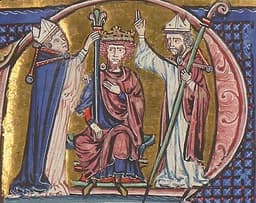
Baldwin I of Jerusalem
Emperor · Medieval
56.1Total

Napoleon Bonaparte
General · Modern
70.9Total
Basic Information
Born
1058
1769
Died
1118
1821
Era
Medieval
Modern
Nationality
Jerusalem
France
Occupation
Emperor
General
Civilization
Western
Western
Score Comparison
Military (10%)
72.5
94.0
Political (20%)
46.6
72.0
Influence (20%)
57.2
40.0
Legacy (20%)
50.0
80.0
Leadership (15%)
62.2
78.0
Strategy (15%)
57.5
90.0
TOTAL
56.1
70.9
Baldwin I of Jerusalem — Complete Timeline
1100 AD
Coronation as First King of JerusalemPolitical Action
Baldwin I was crowned as the first king of Jerusalem on Christmas Day 1100, after the death of his brother Godfrey. He transformed the Crusader state from a lordship into a monarchy, centralizing power and expanding its territory.
CoronationCrusader KingdomJerusalem
Impact: regionalconstructive
1101 AD
Capture of Arsuf and CaesareaWar◆ Major
Baldwin I captured the coastal cities of Arsuf and Caesarea with the help of Genoese and Pisan fleets. These victories secured Crusader control over the Palestinian coast and provided access to Mediterranean trade routes.
ConquestCrusader KingdomCoastal Cities
Impact: regional
1104 AD
Siege of AcreWar◆ Major
Baldwin I besieged and captured the port city of Acre after a four-year blockade, with support from a Genoese fleet. Acre became the most important Crusader port and a major commercial center in the Levant.
SiegeCrusader KingdomAcre
Impact: regional
1105 AD
Defense of the Kingdom against Seljuk AttacksWar◆ Major
Baldwin I defeated a Seljuk Turkish army at the Battle of Ramla in 1105, securing the kingdom's eastern frontier. This victory prevented the Seljuks from recapturing Jerusalem and stabilized Crusader rule.
BattleSeljuksCrusader Kingdom
Impact: regional
1118 AD
Invasion of EgyptWar
Baldwin I led a campaign into Fatimid Egypt, reaching the Nile Delta. He died during the campaign near Al-Arish, possibly from illness. The invasion failed to conquer territory but demonstrated Crusader ambitions beyond the Levant.
InvasionEgyptCrusader Kingdom
Impact: regional
Napoleon Bonaparte — Complete Timeline
1799 AD
Coup of 18 BrumaireOther◆ Major
Napoleon Bonaparte, with support from his brother Lucien and key political figures, overthrew the Directory in a bloodless coup. He established the Consulate with himself as First Consul, effectively becoming the ruler of France. This event ended the French Revolution's most unstable period.
French RevolutionCoupRise to Power
Impact: regional
1804 AD
Promulgation of the Napoleonic CodeOther◆ Major
Napoleon enacted the Civil Code of the French, known as the Napoleonic Code, a comprehensive set of laws that replaced the fragmented feudal legal systems. The code established legal equality, protected property rights, and secularized law. It became the basis for legal systems in many European and world countries.
Legal ReformNapoleonic CodeCivil Law
Impact: globalconstructive
1805 AD
Battle of AusterlitzWar◆ Major
Napoleon's Grande Arm
Napoleonic WarsBattleDecisive Victory
Impact: global
1812 AD
Invasion of RussiaWar◆ Major
Napoleon led the Grande Arm
Napoleonic WarsInvasionDisaster
Impact: globaldestructive
1815 AD
Battle of WaterlooWar◆ Major
Napoleon's French army was defeated by the combined forces of the Duke of Wellington's Anglo-Allied army and Gebhard Leberecht von Bl
Napoleonic WarsBattleFinal Defeat
Impact: globaldestructive
Expert Analysis
baldwin-i-of-jerusalem-vs-napoleon-bonaparte
# The Emperor and the Crusader: Napoleon and Baldwin I Compared
On a sweltering July morning in 1798, a young artillery officer stood before the Pyramids of Giza, his army arrayed behind him. “Soldiers, forty centuries look down upon you,” Napoleon Bonaparte declared, his voice carrying across the desert. A century earlier, another ruler had gazed upon the same monuments: Baldwin of Boulogne, a Frankish knight who had carved a kingdom from the Holy Land. Both men sought to conquer the East, but their fates could not have been more different. Why did one become the master of Europe while the other faded into a footnote of crusading history? The answer lies not merely in their deeds, but in the worlds that shaped them.
Origins
Napoleon Bonaparte was born in 1769 on the island of Corsica, a land recently annexed by France. His family was minor nobility, impoverished and resentful of French rule. Young Napoleon studied at military academies in Brienne and Paris, where his fellow cadets mocked his Corsican accent. He devoured books on military strategy, history, and Enlightenment philosophy, emerging as a prodigy of the revolutionary age. The French Revolution, which erupted when he was twenty, shattered the old order and opened paths that birth alone could never have provided.
Baldin I of Jerusalem, born in 1058 as Baldwin of Boulogne, belonged to the warrior aristocracy of northern France. His family had fought in the Norman conquest of England and the endless feuds of the Frankish nobility. Unlike Napoleon, Baldwin was a second son, destined for the Church. He studied for holy orders but abandoned his tonsure for a sword, joining the First Crusade in 1096. His world was one of feudal loyalty, religious fervor, and brutal simplicity—a stark contrast to the bureaucratic, revolutionary France that produced Napoleon.
Rise to Power
Napoleon’s ascent was meteoric. At the Siege of Toulon in 1793, the twenty-four-year-old captain devised the plan that recaptured the port from the British, earning promotion to brigadier general. In 1796, he took command of the ragged Army of Italy and transformed it into a victorious force, defeating the Austrians in a series of lightning campaigns. By 1799, he had seized power in a coup d’état, becoming First Consul of France. His rise was a product of merit, ambition, and the chaos of revolution—a world where talent could overleap birth.
Baldwin’s path was slower and more contingent. He joined the First Crusade as a minor lord, commanding a small contingent. During the grueling march across Anatolia, he broke away from the main army to carve out his own principality in Edessa. When his brother Godfrey of Bouillon became ruler of Jerusalem in 1099, Baldwin served as his lieutenant. On Godfrey’s death in 1100, Baldwin seized the throne, outmaneuvering the Patriarch of Jerusalem and other rivals. His coronation on Christmas Day 1100 was not the triumph of a revolutionary genius but the patient work of a feudal lord who understood power in a world of fragmented authority.
Leadership & Governance
Napoleon governed with a blend of military brilliance and administrative genius. His Napoleonic Code standardized French law, abolishing feudal privileges and establishing equality before the law. He reformed education, centralized the bureaucracy, and created the Bank of France. As a military commander, his strategy was revolutionary: he used speed, massed artillery, and decisive battle to shatter his enemies. At Austerlitz in 1805, he destroyed a combined Russian-Austrian army, ending the Holy Roman Empire. His leadership was charismatic and ruthless, demanding absolute loyalty while rewarding talent from any background.
Baldwin ruled a kingdom that was a patchwork of crusader lordships, Byzantine allies, and Muslim enemies. He lacked Napoleon’s resources and administrative machinery. Instead, he relied on personal courage and diplomatic skill. In 1101, he captured Arsuf and Caesarea with the help of Genoese and Pisan fleets, securing the coast for Christian pilgrims. In 1104, he besieged Acre for four years, finally taking it with Genoese naval support. At the Battle of Ramla in 1105, he defeated a Seljuk army that threatened his kingdom’s eastern frontier. His governance was personal and opportunistic, a constant negotiation between Frankish barons, Italian merchants, and local Christians.
Triumph & Tragedy
Napoleon’s greatest triumph was his empire: by 1810, he ruled France, Italy, Germany, and Spain, his brothers seated on thrones across Europe. Yet his tragedy was equally vast. The invasion of Russia in 1812 destroyed his Grand Army; the retreat from Moscow killed half a million men. Defeated at Leipzig in 1813, he was exiled to Elba. He returned in 1815 for the Hundred Days, only to meet final defeat at Waterloo. His ambition had no limits, and that boundlessness became his ruin.
Baldwin’s triumphs were smaller but more durable. He expanded the Kingdom of Jerusalem from a precarious foothold into a viable state, capturing the coastal cities that linked the crusaders to Europe. His tragedy came in 1118, when he led an invasion of Egypt, reaching the Nile Delta. There, near the town of Al-Arish, he fell ill and died. His body was brought back to Jerusalem, but his kingdom, while secure, would never again have a ruler of his practical skill. He died not in glorious battle but on a campaign that overreached his strength.
Character & Destiny
Napoleon was a man of immense energy and intellect, but also of colossal ego. He believed himself a man of destiny, a force of history. “Impossible is a word to be found only in the dictionary of fools,” he said. This confidence drove his victories but also his catastrophic overreach. He could not stop, could not consolidate, could not accept limits.
Baldwin was more pragmatic, a survivor in a world where survival was the highest achievement. He had abandoned the Church for the sword, abandoned his wife for a richer heiress, abandoned his brother’s legacy to seize power. He was not a visionary but a realist, a man who understood that in the Holy Land, every victory was temporary and every ally unreliable. His death in Egypt, on a campaign that may have been premature, suggests that even he could be seduced by dreams of conquest.
Legacy
Napoleon’s legacy is immense. The Napoleonic Code influenced legal systems across Europe and the world. His military innovations shaped warfare for a century. His name became synonymous with ambition, genius, and tyranny. He is remembered as a titan of history, a figure who reshaped the modern world.
Baldwin’s legacy is more modest. He is remembered by historians of the Crusades as a capable ruler who stabilized a fragile kingdom. His conquests were absorbed into the larger story of the Latin East, which would fall to Saladin in 1187. He never achieved Napoleon’s fame or influence. Yet his kingdom endured for nearly two centuries, outlasting Napoleon’s empire by decades.
Conclusion
Standing before the Pyramids, Napoleon saw himself as the heir to Alexander and Caesar. Baldwin, riding through the same desert a century earlier, saw only a land to be held, a kingdom to be defended. The difference between them is the difference between the modern and the medieval, the revolutionary and the feudal, the genius and the survivor. Napoleon’s ambition built an empire that collapsed in a decade; Baldwin’s pragmatism built a kingdom that lasted a lifetime. Which is the greater achievement? Perhaps the answer depends on whether one values glory or endurance, brilliance or resilience. Both men conquered, but only one understood that the hardest conquest is not of lands, but of self.
Rankings
🥇
Napoleon BonaparteLeader
Mil: 94.0Pol: 72.0Inf: 40.0
70.9
🥈
Baldwin I of Jerusalem
Mil: 72.5Pol: 46.6Inf: 57.2
56.1
+14.8 behind
How This Comparison Works
Algorithm
Each figure is scored on 6 dimensions (0—100 scale) based on structured historical data: Military (10%), Political (20%), Influence (20%), Legacy (20%), Leadership (15%), Strategy (15%). The weighted total produces the final ranking.
Data Sources
Scores are computed from structured sub-indicators in the database. Scale factors adjust for era (Ancient ×0.85, Modern ×1.0) and civilization size (Eastern ×1.05, Other ×0.80) to account for differences in population and military scale.
Maximum 3 Figures
Comparisons are limited to 2—3 figures to ensure readability and statistical meaningfulness.
Error Margins
±5 points per dimension — Sub-scores are derived from historical records with inherent uncertainty. Two figures within 5 points on a dimension should be considered roughly equivalent in that area.
Total Score Accuracy
±3 points overall — The weighted combination of 6 dimensions produces a total score with approximately ±3 points of uncertainty. Differences of less than 3 points are not statistically significant— the figures are effectively tied.
Known Limitations
- Historical records are incomplete and uneven across civilizations
- Figures from oral-tradition societies may be underrepresented
- Occupation labels can misclassify multi-role figures
- Scores measure capability and impact, not moral character
- Quantitative scoring is a comparison tool, not absolute truth
Capability Radar
Military (10%) — Battles & Warfare
Battles
55
95
Win Rate
60
90
Expansion
65
95
Political (20%) — Governance & Reform
Reform
40
95
Diplomacy
55
80
Economy
35
85
Influence (20%) — Cultural & Global Reach
Cultural
45
85
Global
40
90
Legacy (20%) — Historical Impact
Historical
55
95
Longevity
45
90
Leadership (15%) — Power & Stability
Tenure
50
85
Stability
30
70
Strategy (15%) — Tactics & Innovation
Strategy
60
95
Tactics
55
98
Reform
30
92
Similar Comparisons
Comments & Discussion
legacy_lens6/17/2026
Fun comparison, but calling Baldwin a "footnote" misses the point. He literally *created* a kingdom that lasted nearly a century against impossible odds. Napoleon conquered Europe with mass armies and gunpowder; Baldwin did it with maybe 300 knights and sheer audacity. Different scales, different eras. One is a military genius on a continental stage, the other a desperate survivor who gambled everything and won. Respect the context.
数字帝6/17/2026
这数据对比根本站不住脚。拿破仑打了60多场战役,从意大利到埃及再到莫斯科,指挥过数十万大军;鲍德温一世总共就靠几百到几千骑士在东边打转,最大规模也就万人级别的战斗。把两人放一起比,就像拿哈雷彗星和一把萤火虫比亮度。拿破仑的战争改变了欧洲版图,鲍德温连那点十字军领地都没能守住三代。不是同一量级。
desert_mirage6/17/2026
The Pyramid speech is a great story, but Napoleon's Egyptian campaign was a strategic disaster and he knew it. He abandoned his army to sneak back to France. Meanwhile, Baldwin I actually built a functioning crusader state from scratch, led his men in person through the desert, and captured ports like Arsuf and Caesarea. Napoleon was chasing glory; Baldwin was fighting for survival. Different motivations produce different legacies.
经典迷弟6/17/2026
鲍德温一世才是真正的英雄故事,拿破仑不过是投机取巧的军事暴发户。鲍德温是第一个加冕的耶路撒冷国王,统治期间从无到有建立了十字军政权,靠的是个人魅力和军事才能。拿破仑呢?搞政变上台,当皇帝恢复专制,最后葬送了法兰西。鲍德温虽然出身低,但诚信勇敢,拿破仑一边高喊自由一边奴役欧洲。高下立判。
stats_matter6/17/2026
Let's be specific: Napoleon's record includes the Battle of Austerlitz, where he crushed a combined Russo-Austrian army with fewer troops. Baldwin's best battle was the Battle of Ramla in 1105, where he repelled an Egyptian invasion. Napoleon changed warfare forever with corps systems and mass conscription. Baldwin fought like a medieval knight—brave, but tactically primitive. If we're comparing military impact, Napoleon is simply in another league.