Loading...
This comparison has not been analyzed yet.
One-time AI generation (~1 minute). Scores and timeline are already available below.
Ban Ki-moon vs Sanjaasuren Oyun
Ban Ki-moon leads by 15.9 pts · 2 figures compared
…
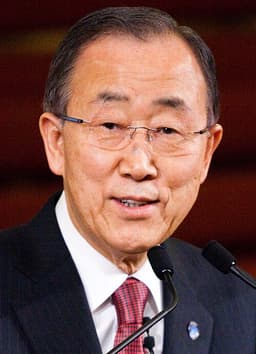
Ban Ki-moon
Politician · Modern
53.2Total

Sanjaasuren Oyun
Politician · Modern
37.3Total
Basic Information
Born
1944
1964
Died
—
—
Era
Modern
Modern
Nationality
Korea
Mongolia
Occupation
Politician
Politician
Civilization
Eastern
Eastern
Score Comparison
Military (10%)
15.2
11.6
Political (20%)
68.0
35.1
Influence (20%)
58.0
48.6
Legacy (20%)
46.7
37.5
Leadership (15%)
72.0
41.5
Strategy (15%)
44.8
31.3
TOTAL
53.2
37.3
Ban Ki-moon — Complete Timeline
2007 AD
Elected Secretary-General of the United NationsPolitical Action◆ Major
Ban Ki-moon became the eighth Secretary-General of the United Nations, succeeding Kofi Annan. His election was seen as a consensus choice, and he focused on climate change, peacekeeping, and UN reform.
UN Secretary-GeneralLeadershipGlobal Governance
Impact: globalconstructive
2011 AD
Launched the Sustainable Energy for All initiativeReform◆ Major
Ban launched the Sustainable Energy for All initiative, aiming to achieve universal energy access, double energy efficiency, and double renewable energy use by 2030. The initiative mobilized governments and private sector partners.
EnergySustainabilityClimate Change
Impact: globalconstructive
Oversaw UN response to the Syrian Civil WarPolitical Action◆ Major
Ban Ki-moon led UN efforts to address the Syrian Civil War, including humanitarian aid and peace negotiations. The UN faced criticism for failing to stop the conflict, which killed hundreds of thousands and displaced millions.
SyriaHumanitarian CrisisUN Failure
Impact: globaltragic
2015 AD
Adopted the Sustainable Development GoalsReform◆ Major
Ban oversaw the adoption of the 2030 Agenda for Sustainable Development, including 17 Sustainable Development Goals to end poverty, protect the planet, and ensure prosperity for all by 2030.
SDGsDevelopmentGlobal Goals
Impact: globalconstructive
Adopted the Paris Agreement on climate changePolitical Action◆ Major
Ban played a key role in the adoption of the Paris Agreement at COP21, a global treaty to limit global warming to well below 2
Climate ChangeParis AgreementCOP21
Impact: globalconstructive
Sanjaasuren Oyun — Complete Timeline
2004 AD
Elected to the State Great Khural (Parliament)Political Action
Oyun was elected to the Mongolian parliament as a member of the Democratic Party. She served as a legislator, focusing on environmental and mining policy.
ParliamentElection
Impact: nationalconstructive
2005 AD
Co-founded the 'Mongolian Women's Political Network'Political Action
Oyun co-founded the Mongolian Women's Political Network, an organization aimed at increasing women's participation in politics. The network provided training and support for female candidates.
Women's RightsPolitical Participation
Impact: nationalprogressive
2007 AD
Appointed Foreign Minister of MongoliaPolitical Action◆ Major
Oyun was appointed Foreign Minister in 2007, becoming the first woman to hold the position. She served until 2008, focusing on Mongolia's foreign policy and international relations.
Foreign MinisterDiplomacyFirst Woman
Impact: nationalconstructive
2008 AD
Resigned as Foreign Minister After 2008 ElectionPolitical Action
Oyun resigned as Foreign Minister following the 2008 parliamentary elections, which were marred by allegations of fraud and violence. Her resignation was part of a broader political reshuffle.
ResignationElection
Impact: national
2012 AD
Served as Minister of Environment and Green DevelopmentPolitical Action◆ Major
Oyun was appointed Minister of Environment and Green Development in 2012, where she advocated for sustainable mining practices and environmental protection. She pushed for stricter regulations on the mining sector.
EnvironmentMiningSustainability
Impact: nationalconstructive
This comparison has not been analyzed yet.
One-time AI generation (~1 minute). Scores and timeline are already available below.
Rankings
🥇
Ban Ki-moonLeader
Mil: 15.2Pol: 68.0Inf: 58.0
53.2
🥈
Sanjaasuren Oyun
Mil: 11.6Pol: 35.1Inf: 48.6
37.3
+15.9 behind
How This Comparison Works
Algorithm
Each figure is scored on 6 dimensions (0—100 scale) based on structured historical data: Military (10%), Political (20%), Influence (20%), Legacy (20%), Leadership (15%), Strategy (15%). The weighted total produces the final ranking.
Data Sources
Scores are computed from structured sub-indicators in the database. Scale factors adjust for era (Ancient ×0.85, Modern ×1.0) and civilization size (Eastern ×1.05, Other ×0.80) to account for differences in population and military scale.
Maximum 3 Figures
Comparisons are limited to 2—3 figures to ensure readability and statistical meaningfulness.
Error Margins
±5 points per dimension — Sub-scores are derived from historical records with inherent uncertainty. Two figures within 5 points on a dimension should be considered roughly equivalent in that area.
Total Score Accuracy
±3 points overall — The weighted combination of 6 dimensions produces a total score with approximately ±3 points of uncertainty. Differences of less than 3 points are not statistically significant— the figures are effectively tied.
Known Limitations
- Historical records are incomplete and uneven across civilizations
- Figures from oral-tradition societies may be underrepresented
- Occupation labels can misclassify multi-role figures
- Scores measure capability and impact, not moral character
- Quantitative scoring is a comparison tool, not absolute truth
Capability Radar
Military (10%) — Battles & Warfare
Battles
16
15
Win Rate
16
20
Expansion
18
18
Political (20%) — Governance & Reform
Reform
40
20
Diplomacy
75
40
Economy
30
15
Influence (20%) — Cultural & Global Reach
Cultural
20
10
Global
60
20
Legacy (20%) — Historical Impact
Historical
40
15
Longevity
30
10
Leadership (15%) — Power & Stability
Tenure
65
15
Stability
60
15
Strategy (15%) — Tactics & Innovation
Strategy
25
23
Tactics
28
26
Reform
31
30
Similar Comparisons
Comments & Discussion
No comments yet. Be the first to share your thoughts!