Loading...
Barquq vs Harald Bluetooth
Harald Bluetooth leads by 1.9 pts · 2 figures compared
…

Barquq
Emperor · Medieval
57.4Total
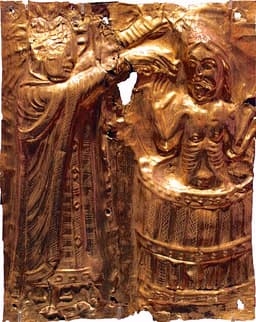
Harald Bluetooth
Emperor · Medieval
59.3Total
Basic Information
Born
1339
911
Died
1399
985
Era
Medieval
Medieval
Nationality
Egypt
Denmark
Occupation
Emperor
Emperor
Civilization
Middle Eastern
Western
Score Comparison
Military (10%)
72.5
40.0
Political (20%)
68.0
72.0
Influence (20%)
58.0
62.0
Legacy (20%)
50.0
56.0
Leadership (15%)
53.2
70.0
Strategy (15%)
50.0
45.0
TOTAL
57.4
59.3
Barquq — Complete Timeline
1382 AD
Accession as Sultan (1382)Political Action◆ Major
Barquq, a Circassian Mamluk, seized the sultanate after deposing the young Sultan Hajji II. He was the first sultan of the Burji dynasty, named after the Circassian Mamluks stationed in the Cairo Citadel. This marked a shift from the Qalawunid dynasty.
SuccessionBurji DynastyMamluk Sultanate
Impact: regional
Consolidation of Power (1382-1389)Political Action◆ Major
Barquq purged rival Mamluk factions, particularly the Z
Power ConsolidationPurgeBurji Dynasty
Impact: regionaldestructive
1389 AD
Deposition and Exile (1389)Political Action◆ Major
Barquq was deposed by a coalition of Mamluk rebels led by Mintash and Yalbugha al-Nasiri. He was imprisoned in the Cairo Citadel and later exiled to al-Karak. This rebellion temporarily restored the Qalawunid puppet Sultan Hajji II.
DepositionExileMamluk Rebellion
Impact: regionaldestructive
1390 AD
Return to Power (1390)Political Action◆ Major
Barquq escaped from al-Karak and raised an army. He defeated the rebel forces and recaptured Cairo. He was restored to the sultanate and executed his rivals. This return solidified his control and ended the Qalawunid restoration.
Return to PowerCivil WarBurji Dynasty
Impact: regionalconstructive
1393 AD
Conflict with Timur (1393-1394)War◆ Major
Barquq faced the threat of Timur's invasion of Syria. He sent an army to defend Aleppo but avoided a direct confrontation. Barquq's diplomatic efforts and military preparations deterred Timur from invading Egypt, preserving Mamluk rule.
Timurid WarsDefenseDiplomacy
Impact: regionalconstructive
1399 AD
Death of Barquq (1399)Other◆ Major
Barquq died in Cairo, likely from natural causes. He was succeeded by his son An-Nasir Faraj. Barquq's reign founded the Burji dynasty, which ruled Egypt until the Ottoman conquest in 1517.
DeathSuccessionBurji Dynasty
Impact: regional
Harald Bluetooth — Complete Timeline
958 AD
Unified DenmarkPolitical Action◆ Major
Harald Bluetooth unified the Danish tribes into a single kingdom, consolidating power over Jutland, Zealand, and surrounding islands. This unification laid the foundation for the medieval Danish state and established the Gorm dynasty's rule.
UnificationDenmarkMedieval Kingdom
Impact: regionalconstructive
965 AD
Introduced Christianity to DenmarkCultural◆ Major
Harald Bluetooth converted to Christianity and mandated the conversion of Denmark. He erected the larger Jelling rune stone, which proclaims that he 'made the Danes Christian'. This event marked Denmark's entry into Christian Europe and aligned it with Latin Christendom.
ChristianizationReligionJelling Stones
Impact: regionalconstructive
Built the Jelling monumentsCultural◆ Major
Harald Bluetooth commissioned the Jelling rune stones and burial mounds in memory of his parents. The larger stone, often called 'Denmark's birth certificate', features a depiction of Christ and a runic inscription celebrating his unification of Denmark and Norway.
Jelling StonesMonumentsCultural Heritage
Impact: regionalconstructive
970 AD
Conquered NorwayWar◆ Major
Harald Bluetooth conquered Norway after defeating Earl Hakon Sigurdsson, bringing Norway under Danish rule. This expansion created a short-lived North Sea empire and demonstrated Danish military power in Scandinavia.
ConquestNorwayDanish Empire
Impact: regional
985 AD
Rebelled against by his son Sweyn ForkbeardPolitical Action◆ Major
Harald Bluetooth faced a rebellion led by his son Sweyn Forkbeard, who opposed his father's rule and Christianization policies. The rebellion forced Harald into exile, where he died shortly after, ending his reign and leading to Sweyn's ascension.
RebellionDynastic ConflictExile
Impact: regionaldestructive
Expert Analysis
Origins
Barquq (born c. 1339) was a Circassian Mamluk purchased as a slave in Egypt. He rose through the military ranks under Sultan al-Ashraf Sha'ban, becoming a powerful emir. His early life was shaped by the Mamluk system, where slaves from the Caucasus were trained as soldiers and administrators. Harald Bluetooth (born c. 935) was the son of King Gorm the Old of Denmark and Thyra. He inherited a kingdom still fragmented among tribal chieftains, with pagan traditions deeply rooted. Harald's early exposure to Viking raids and Christian missionaries influenced his later policies.
Rise to Power
Barquq's rise began in 1382 when he exploited a succession crisis after the death of Sultan al-Ashraf Sha'ban. He deposed the young Sultan Hajji II and proclaimed himself sultan, founding the Burji Mamluk dynasty. His consolidation involved purging rival Zähirī Mamluks (1382-1389), but this led to a rebellion in 1389. Barquq was deposed and exiled to al-Karak. In 1390, he escaped, raised an army, and recaptured Cairo, executing his enemies. Harald Bluetooth's rise was more gradual. He succeeded his father Gorm the Old around 958 and immediately faced challenges from regional chieftains. He unified Denmark through a combination of military campaigns and political marriages, securing control over Jutland, Zealand, and the islands. By 965, he had consolidated enough power to convert to Christianity and mandate the conversion of his subjects.
Leadership & Governance
Barquq's leadership was autocratic and centralized. He staffed the administration with Circassian Mamluks, ensuring their loyalty. He maintained the Mamluk military system but faced constant internal strife. In foreign policy, he confronted Timur's invasion of Syria (1393-1394) by sending an army to Aleppo but avoiding a major battle; instead, he used diplomacy to secure a truce. Harald Bluetooth ruled through a combination of traditional Viking assemblies (things) and Christian ecclesiastical structures. He built the Jelling monuments, including a rune stone proclaiming his unification of Denmark and Christianization. He introduced a centralized coinage system and improved infrastructure, such as the Danevirke fortifications. His governance score of 72.0 reflects his ability to blend old and new systems, while Barquq's political score of 68.0 shows his skill in navigating Mamluk factionalism.
Triumph & Tragedy
Barquq's greatest success was founding the Burji dynasty, which ruled Egypt until 1517. He also successfully defended against Timur, preventing a Mongol invasion of Egypt. However, his reign was marred by constant rebellions; he was deposed once and only returned through military force. His purges created long-term instability. Harald Bluetooth's triumphs include unifying Denmark and introducing Christianity, which integrated Denmark into European Christendom. He also conquered Norway (c. 970), creating a short-lived North Sea empire. His tragedy was the rebellion led by his son Sweyn Forkbeard, which forced him into exile in 986. He died soon after, possibly in battle. Harald's military score of 40.0 is low compared to Barquq's 72.5, but his leadership score of 70.0 exceeds Barquq's 53.2.
Character & Destiny
Barquq was pragmatic and ruthless, willing to purge rivals and break alliances when necessary. His exile and return demonstrate resilience, but his inability to secure a stable succession led to future conflicts. Historians note his skill in playing Mamluk factions against each other. Harald Bluetooth was a visionary who recognized the need for religious and political unity. His conversion to Christianity was likely both sincere and strategic, aligning Denmark with powerful Christian kingdoms. However, his heavy-handed Christianization alienated traditionalists, including his son. Harald's character combined adaptability with stubbornness, ultimately leading to his downfall.
Legacy
Barquq's legacy is the Burji Mamluk dynasty, which lasted over 130 years. He shifted the Mamluk system from a Qalawunid to a Circassian dominance, but his reign did not introduce lasting reforms. The dynasty continued his centralized, faction-ridden politics. Harald Bluetooth's legacy is more profound: he created a unified Danish kingdom that endured, and his Christianization laid the foundation for Denmark's medieval kingdom. The Jelling rune stone is often called 'Denmark's birth certificate.' His name inspired the Bluetooth technology symbol. In terms of influence, Harald scores 62.0 versus Barquq's 58.0, and legacy 56.0 versus 50.0.
Conclusion
While Barquq's military and political maneuvering kept the Mamluk sultanate a major power, his impact was limited to Egypt and Syria, and his dynasty's instability weakened the state. Harald Bluetooth's unification of Denmark and introduction of Christianity had a transformative effect that shaped Scandinavian history for centuries. Harald's total score of 59.3 slightly exceeds Barquq's 57.4, but more importantly, his innovations in governance and religion created lasting institutions. Harald Bluetooth had greater historical impact because his actions fundamentally changed Denmark's trajectory and integrated it into European civilization, whereas Barquq's achievements were primarily about maintaining the status quo within the Mamluk system.
Rankings
🥇
Harald BluetoothLeader
Mil: 40.0Pol: 72.0Inf: 62.0
59.3
🥈
Barquq
Mil: 72.5Pol: 68.0Inf: 58.0
57.4
+1.9 behind
How This Comparison Works
Algorithm
Each figure is scored on 6 dimensions (0—100 scale) based on structured historical data: Military (10%), Political (20%), Influence (20%), Legacy (20%), Leadership (15%), Strategy (15%). The weighted total produces the final ranking.
Data Sources
Scores are computed from structured sub-indicators in the database. Scale factors adjust for era (Ancient ×0.85, Modern ×1.0) and civilization size (Eastern ×1.05, Other ×0.80) to account for differences in population and military scale.
Maximum 3 Figures
Comparisons are limited to 2—3 figures to ensure readability and statistical meaningfulness.
Error Margins
±5 points per dimension — Sub-scores are derived from historical records with inherent uncertainty. Two figures within 5 points on a dimension should be considered roughly equivalent in that area.
Total Score Accuracy
±3 points overall — The weighted combination of 6 dimensions produces a total score with approximately ±3 points of uncertainty. Differences of less than 3 points are not statistically significant— the figures are effectively tied.
Known Limitations
- Historical records are incomplete and uneven across civilizations
- Figures from oral-tradition societies may be underrepresented
- Occupation labels can misclassify multi-role figures
- Scores measure capability and impact, not moral character
- Quantitative scoring is a comparison tool, not absolute truth
Capability Radar
Military (10%) — Battles & Warfare
Battles
60
30
Win Rate
65
35
Expansion
55
45
Political (20%) — Governance & Reform
Reform
65
70
Diplomacy
60
65
Economy
55
50
Influence (20%) — Cultural & Global Reach
Cultural
40
60
Global
40
50
Legacy (20%) — Historical Impact
Historical
55
65
Longevity
50
55
Leadership (15%) — Power & Stability
Tenure
70
60
Stability
50
55
Strategy (15%) — Tactics & Innovation
Strategy
60
40
Tactics
55
25
Reform
50
20
Similar Comparisons
Comments & Discussion
No comments yet. Be the first to share your thoughts!