Loading...
Harald Bluetooth vs Napoleon Bonaparte
Napoleon Bonaparte leads by 11.6 pts · 2 figures compared
…
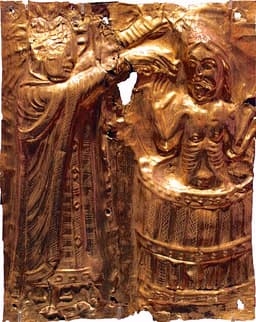
Harald Bluetooth
Emperor · Medieval
59.3Total

Napoleon Bonaparte
General · Modern
70.9Total
Basic Information
Born
911
1769
Died
985
1821
Era
Medieval
Modern
Nationality
Denmark
France
Occupation
Emperor
General
Civilization
Western
Western
Score Comparison
Military (10%)
40.0
94.0
Political (20%)
72.0
72.0
Influence (20%)
62.0
40.0
Legacy (20%)
56.0
80.0
Leadership (15%)
70.0
78.0
Strategy (15%)
45.0
90.0
TOTAL
59.3
70.9
Harald Bluetooth — Complete Timeline
958 AD
Unified DenmarkPolitical Action◆ Major
Harald Bluetooth unified the Danish tribes into a single kingdom, consolidating power over Jutland, Zealand, and surrounding islands. This unification laid the foundation for the medieval Danish state and established the Gorm dynasty's rule.
UnificationDenmarkMedieval Kingdom
Impact: regionalconstructive
965 AD
Introduced Christianity to DenmarkCultural◆ Major
Harald Bluetooth converted to Christianity and mandated the conversion of Denmark. He erected the larger Jelling rune stone, which proclaims that he 'made the Danes Christian'. This event marked Denmark's entry into Christian Europe and aligned it with Latin Christendom.
ChristianizationReligionJelling Stones
Impact: regionalconstructive
Built the Jelling monumentsCultural◆ Major
Harald Bluetooth commissioned the Jelling rune stones and burial mounds in memory of his parents. The larger stone, often called 'Denmark's birth certificate', features a depiction of Christ and a runic inscription celebrating his unification of Denmark and Norway.
Jelling StonesMonumentsCultural Heritage
Impact: regionalconstructive
970 AD
Conquered NorwayWar◆ Major
Harald Bluetooth conquered Norway after defeating Earl Hakon Sigurdsson, bringing Norway under Danish rule. This expansion created a short-lived North Sea empire and demonstrated Danish military power in Scandinavia.
ConquestNorwayDanish Empire
Impact: regional
985 AD
Rebelled against by his son Sweyn ForkbeardPolitical Action◆ Major
Harald Bluetooth faced a rebellion led by his son Sweyn Forkbeard, who opposed his father's rule and Christianization policies. The rebellion forced Harald into exile, where he died shortly after, ending his reign and leading to Sweyn's ascension.
RebellionDynastic ConflictExile
Impact: regionaldestructive
Napoleon Bonaparte — Complete Timeline
1799 AD
Coup of 18 BrumaireOther◆ Major
Napoleon Bonaparte, with support from his brother Lucien and key political figures, overthrew the Directory in a bloodless coup. He established the Consulate with himself as First Consul, effectively becoming the ruler of France. This event ended the French Revolution's most unstable period.
French RevolutionCoupRise to Power
Impact: regional
1804 AD
Promulgation of the Napoleonic CodeOther◆ Major
Napoleon enacted the Civil Code of the French, known as the Napoleonic Code, a comprehensive set of laws that replaced the fragmented feudal legal systems. The code established legal equality, protected property rights, and secularized law. It became the basis for legal systems in many European and world countries.
Legal ReformNapoleonic CodeCivil Law
Impact: globalconstructive
1805 AD
Battle of AusterlitzWar◆ Major
Napoleon's Grande Arm
Napoleonic WarsBattleDecisive Victory
Impact: global
1812 AD
Invasion of RussiaWar◆ Major
Napoleon led the Grande Arm
Napoleonic WarsInvasionDisaster
Impact: globaldestructive
1815 AD
Battle of WaterlooWar◆ Major
Napoleon's French army was defeated by the combined forces of the Duke of Wellington's Anglo-Allied army and Gebhard Leberecht von Bl
Napoleonic WarsBattleFinal Defeat
Impact: globaldestructive
Expert Analysis
harald-bluetooth-vs-napoleon-bonaparte
# The Emperor and the Viking King: Napoleon and Harald Bluetooth
On a June morning in 1815, Napoleon Bonaparte watched his elite Imperial Guard march toward the ridge of Mont-Saint-Jean, their bearskin caps and blue coats a final, defiant gesture against the allied armies of Europe. Nearly a thousand years earlier and a thousand miles north, another ruler stood on a windswept hill in Jutland, ordering a stone carved with runes to declare he "won for himself all of Denmark and Norway and made the Danes Christian." One ended in exile on a remote Atlantic island; the other faded into legend, his name given to a wireless technology that connects the modern world. What separates these two men—both unifiers, both converters, both builders of kingdoms—is not merely the centuries between them, but the very nature of ambition and how it meets its limits.
Origins
Napoleon was born in 1769 on the Mediterranean island of Corsica, a place that had become French only months before his birth. His family belonged to the minor nobility, but they were poor and spoke Italian at home. This outsider status shaped everything: he would always be the foreigner who clawed his way to the top of French society, carrying the chip of a provincial on his shoulder. The Enlightenment was in full bloom when he studied at military academies in Brienne and Paris, and he absorbed its faith in reason, order, and the power of the individual to remake the world.
Harald Bluetooth, born around 911, came from a Denmark that had no written laws, no central government, and no single faith. He was the son of Gorm the Old and Thyra, a royal family that ruled only parts of Jutland. His world was oral, pagan, and violent—a place where power was measured in ships, silver, and the loyalty of chieftains who could turn on a king as easily as they could follow him. There was no Enlightenment to draw upon, only sagas, runes, and the memory of ancestors who had raided the coasts of Europe for generations.
Rise to Power
Napoleon’s ascent was meteoric and built on war. At 24, he drove the British out of Toulon. At 26, he crushed a royalist uprising in Paris with a "whiff of grapeshot." At 27, he led a ragged army across the Alps into Italy and won victory after victory against the Austrians. Each triumph was a stepping stone, and by 1799, at age 30, he seized power in a coup that made him First Consul of France. The French Revolution had devoured its own children—Robespierre, Danton, the king himself—but Napoleon presented himself as the man who could end the chaos and preserve the revolution’s gains.
Harald’s path was slower and more uncertain. He became king of Denmark around 958, after his father Gorm’s death. For years, he consolidated power over the Danish tribes, unifying Jutland, Zealand, and the surrounding islands into a single kingdom by 958. Unlike Napoleon, he did not conquer through brilliant campaigns but through patient negotiation, marriage alliances, and the steady accumulation of prestige. His greatest moment came in 965, when he converted to Christianity and ordered his people to follow. The Jelling rune stone he erected that year—often called "Denmark’s birth certificate"—declares: "Harald, king of the Danes, made the Danes Christian." It was a political act as much as a spiritual one: Christianity brought Denmark into the community of European kingdoms, gave Harald legitimacy with the Holy Roman Empire, and centralized power under a single crown.
Leadership & Governance
Napoleon ruled through sheer force of will and genius. He reorganized France’s legal system with the Napoleonic Code, which standardized laws across the country and became a model for much of Europe. He established the Bank of France, rebuilt the education system, and created a meritocratic bureaucracy where talent could rise regardless of birth. On the battlefield, his speed, logistics, and ability to read terrain were unmatched. He could march an army 30 miles in a day, concentrate his forces at the decisive point, and shatter an enemy with a single devastating blow. His military score of 94 reflects this: he was one of the greatest commanders in history.
Harald governed differently. His political score of 72 is higher than his military score of 31, and this reveals the nature of his power. He was not a conqueror but a consolidator. He built the Jelling monuments—two large burial mounds and two rune stones—as symbols of his dynasty’s legitimacy and his own Christian conversion. He introduced Christianity not by force of arms but by persuasion, example, and the slow erosion of pagan traditions. When he conquered Norway in 970, it was less a military campaign than a political takeover: he defeated Earl Hakon Sigurdsson and then ruled through local chieftains. His leadership score of 80 matches Napoleon’s 80, but it was a leadership of patience and alliance, not of personal magnetism and battlefield charisma.
Triumph & Tragedy
Napoleon’s greatest triumph was Austerlitz in 1805, where he destroyed a combined Russian and Austrian army in a single day. His empire stretched from Spain to Poland, and he placed his brothers on thrones across Europe. But his tragedy was hubris. The invasion of Russia in 1812, with its 600,000 men and its catastrophic retreat in winter, broke his army. He refused to compromise, refused to accept limits, and by 1814 he was forced to abdicate. His return in 1815—the Hundred Days—ended at Waterloo, where his best generals failed him and his old magic could not overcome the combined weight of Europe.
Harald’s triumph was the unification of Denmark and the Christianization of his people. The Jelling rune stone still stands, a monument to his achievement. But his tragedy came from within. His son Sweyn Forkbeard rebelled against him in 985, opposing his rule and his Christianization policies. Harald was driven from his kingdom and died soon after, likely in exile. The irony is bitter: the man who unified Denmark was overthrown by his own son, and the kingdom he built would fragment again after his death.
Character & Destiny
Napoleon was driven by an insatiable hunger for glory. "What is power?" he once asked. "Nothing, unless you have the chance to show it." He believed in his own destiny, in the power of the individual to shape history, and in the idea that a man of talent could rise above any obstacle. This made him magnificent and doomed him. He could not stop, could not share power, could not accept that even genius has limits.
Harald was different. He was a builder, not a destroyer. His ambition was for his kingdom, not for himself. He converted to Christianity not out of personal conviction but because it served his political ends. He unified Denmark not through conquest but through diplomacy and patience. His fate was less dramatic than Napoleon’s—no exile on an Atlantic island, no epic last stand—but it was more human. He was betrayed by his own son, and he died in obscurity.
Legacy
Napoleon left a legacy that reshaped Europe. The Napoleonic Code, the modern bureaucracy, the metric system, the idea of meritocracy—these survived his fall. He is remembered as a military genius and a tyrant, a liberator and a conqueror. His name is synonymous with ambition, and his shadow falls across the entire nineteenth century.
Harald Bluetooth left a smaller legacy, but it endures. The Jelling rune stone is a UNESCO World Heritage site, and his name—Bluetooth—was chosen for a wireless technology that unites devices from different manufacturers, just as Harald united the Danish tribes. It is a fitting tribute: a king who connected his people, remembered in a technology that connects the world.
Conclusion
Napoleon and Harald Bluetooth lived a thousand years apart, but they faced the same fundamental question: how do you build something that lasts? Napoleon tried to build through conquest, through glory, through the sheer force of his personality. He built an empire that collapsed within a decade. Harald built through patience, through symbols, through the slow work of conversion and consolidation. He built a kingdom that, though it fragmented, gave birth to a nation that still exists.
The difference between them is the difference between a comet and a sun. A comet burns bright and fast and disappears; a sun gives steady light, and its warmth lasts for generations. Napoleon was the comet. Harald was the sun. And perhaps, in the end, the sun is the more difficult thing to be.
Rankings
🥇
Napoleon BonaparteLeader
Mil: 94.0Pol: 72.0Inf: 40.0
70.9
🥈
Harald Bluetooth
Mil: 40.0Pol: 72.0Inf: 62.0
59.3
+11.6 behind
How This Comparison Works
Algorithm
Each figure is scored on 6 dimensions (0—100 scale) based on structured historical data: Military (10%), Political (20%), Influence (20%), Legacy (20%), Leadership (15%), Strategy (15%). The weighted total produces the final ranking.
Data Sources
Scores are computed from structured sub-indicators in the database. Scale factors adjust for era (Ancient ×0.85, Modern ×1.0) and civilization size (Eastern ×1.05, Other ×0.80) to account for differences in population and military scale.
Maximum 3 Figures
Comparisons are limited to 2—3 figures to ensure readability and statistical meaningfulness.
Error Margins
±5 points per dimension — Sub-scores are derived from historical records with inherent uncertainty. Two figures within 5 points on a dimension should be considered roughly equivalent in that area.
Total Score Accuracy
±3 points overall — The weighted combination of 6 dimensions produces a total score with approximately ±3 points of uncertainty. Differences of less than 3 points are not statistically significant— the figures are effectively tied.
Known Limitations
- Historical records are incomplete and uneven across civilizations
- Figures from oral-tradition societies may be underrepresented
- Occupation labels can misclassify multi-role figures
- Scores measure capability and impact, not moral character
- Quantitative scoring is a comparison tool, not absolute truth
Capability Radar
Military (10%) — Battles & Warfare
Battles
30
95
Win Rate
35
90
Expansion
45
95
Political (20%) — Governance & Reform
Reform
70
95
Diplomacy
65
80
Economy
50
85
Influence (20%) — Cultural & Global Reach
Cultural
60
85
Global
50
90
Legacy (20%) — Historical Impact
Historical
65
95
Longevity
55
90
Leadership (15%) — Power & Stability
Tenure
60
85
Stability
55
70
Strategy (15%) — Tactics & Innovation
Strategy
40
95
Tactics
25
98
Reform
20
92
Similar Comparisons
Comments & Discussion
No comments yet. Be the first to share your thoughts!