Loading...
Bishop Makarios III vs Naoto Kan
Bishop Makarios III leads by 6.8 pts · 2 figures compared
…
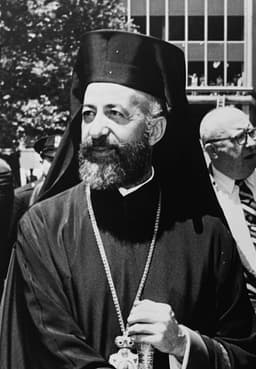
Bishop Makarios III
Politician · Modern
55.7Total

Naoto Kan
Politician · Modern
48.9Total
Basic Information
Born
1913
1946
Died
1977
—
Era
Modern
Modern
Nationality
Cyprus
Japan
Occupation
Politician
Politician
Civilization
Western
Eastern
Score Comparison
Military (10%)
48.2
12.1
Political (20%)
53.8
54.7
Influence (20%)
55.0
55.7
Legacy (20%)
56.0
48.3
Leadership (15%)
72.0
65.7
Strategy (15%)
42.9
36.0
TOTAL
55.7
48.9
Bishop Makarios III — Complete Timeline
1950 AD
Elected Archbishop of CyprusPolitical Action◆ Major
Makarios III was elected Archbishop of Cyprus, becoming the ethnarch of the Greek Cypriot community. His religious authority combined with political leadership made him the central figure in the movement for enosis (union with Greece).
Religious LeadershipEnosisCyprus
Impact: nationalconstructive
1956 AD
Exiled by British authoritiesPolitical Action◆ Major
Makarios was exiled by British colonial authorities to the Seychelles for his alleged support of EOKA, a Greek Cypriot guerrilla group fighting for enosis. His exile lasted one year and galvanized international support for Cypriot independence.
ExileColonialismEOKA
Impact: nationaltragic
1959 AD
Signed London-Zurich AgreementsPolitical Action
Makarios signed the London-Zurich Agreements, which established the independence of Cyprus from British rule. The agreements created a power-sharing constitution between Greek and Turkish Cypriots, but tensions remained.
IndependenceTreatyCyprus
Impact: nationalconstructive
1960 AD
Elected first President of CyprusPolitical Action
Makarios was elected as the first President of the Republic of Cyprus, leading the newly independent state. His presidency aimed to maintain unity between Greek and Turkish Cypriots, but intercommunal violence erupted in 1963.
PresidencyIndependenceCyprus
Impact: nationalconstructive
1970 AD
Survived assassination attemptPolitical Action◆ Major
Makarios survived an assassination attempt when his helicopter was fired upon by Greek Cypriot extremists opposed to his policies. The attack highlighted divisions within the Greek Cypriot community over the direction of the republic.
Assassination AttemptPolitical ViolenceCyprus
Impact: nationaltragic
1974 AD
Overthrown by Greek junta-backed coupPolitical Action
Makarios was overthrown in a coup d'
CoupTurkish InvasionPartition
Impact: globaltragic
Returned to Cyprus as PresidentPolitical Action◆ Major
Makarios returned to Cyprus after the Turkish invasion and resumed his presidency, but he governed only the Greek Cypriot south. He spent his remaining years seeking a negotiated settlement to the Cyprus problem, but died in 1977 without achieving reunification.
ReturnPost-InvasionCyprus Problem
Impact: nationaltragic
Naoto Kan — Complete Timeline
2010 AD
Elected Prime Minister of JapanPolitical Action◆ Major
Kan was elected as Prime Minister of Japan after Yukio Hatoyama resigned. He succeeded Hatoyama as leader of the Democratic Party of Japan and formed a cabinet focused on fiscal reform and reducing the national debt.
JapanPrime MinisterDPJ
Impact: national
2011 AD
Announced phase-out of nuclear powerReform◆ Major
Kan announced a policy to phase out nuclear power in Japan by the 2030s. This decision followed the Fukushima disaster and marked a major shift in Japan's energy policy, though it was later reversed by subsequent governments.
JapanNuclear PowerEnergy Policy
Impact: nationalconstructive
Managed response to Fukushima Daiichi nuclear disasterPolitical Action◆ Major
Kan led Japan's response to the Fukushima nuclear disaster triggered by the T
JapanFukushimaNuclear Disaster
Impact: globaltragic
Resigned as Prime MinisterPolitical Action◆ Major
Kan resigned as Prime Minister after facing criticism over his handling of the Fukushima disaster and declining approval ratings. He was succeeded by Yoshihiko Noda.
JapanResignationFukushima
Impact: nationaltragic
Expert Analysis
Origins
**Makarios III** (born Michael Mouskos, 1913) was raised in a poor peasant family in Panagia, Cyprus. He entered Kykko Monastery at age 13, studied theology at the University of Athens, and later at Boston University. He was ordained a priest in 1946 and quickly rose through the church hierarchy. His religious education instilled a strong sense of Greek Cypriot nationalism and anti-colonial sentiment.
**Naoto Kan** (born 1946) grew up in Ube, Yamaguchi Prefecture, Japan, the son of a salaryman. He studied physics at Tokyo Institute of Technology but became interested in politics during the 1960s student protests. He worked as a patent attorney before entering politics. Kan's background in science and law shaped his analytical approach but left him unprepared for the technical aspects of nuclear disaster management.
Rise to Power
Makarios was elected Archbishop of Cyprus in 1950 at age 37, becoming the ethnarch (national leader) of the Greek Cypriot community. He led the campaign for enosis (union with Greece) and represented Cyprus at the United Nations. In 1955, he supported the EOKA guerrilla campaign against British rule but later negotiated a compromise for independence. He was elected first President of Cyprus in 1960 after signing the London-Zurich Agreements.
Naoto Kan entered the Diet in 1980 as a member of the Japan Socialist Party. He gained national prominence in 1996 as Minister of Health and Welfare, exposing the HIV-tainted blood scandal. He co-founded the Democratic Party of Japan (DPJ) and led it to victory in 2009. Kan became Prime Minister in June 2010 after Yukio Hatoyama's resignation, inheriting a fragile coalition and a struggling economy.
Leadership & Governance
Makarios governed as a charismatic, authoritarian leader who blended religious and political authority. He maintained a delicate balance between Greek and Turkish Cypriots, but his support for enosis alienated Turkish Cypriots. He centralized power, often bypassing parliament. His leadership score of 72.0 reflects his ability to unite Greek Cypriots but also his failure to prevent intercommunal violence.
Kan's leadership style was direct and interventionist. During the Fukushima crisis, he bypassed TEPCO and the Nuclear Safety Commission, personally ordering evacuations and venting of reactors. His strategy score of 36.0 indicates a reactive approach. He alienated bureaucrats and industry, leading to chaotic decision-making. His political score of 54.7 reflects his limited ability to build consensus.
Triumph & Tragedy
Makarios's greatest triumph was achieving Cypriot independence in 1960 and becoming its first president. He survived a 1972 assassination attempt and maintained Greek Cypriot unity. However, his tragedy was the 1974 coup that overthrew him, leading to the Turkish invasion and partition of Cyprus. He returned as president in 1975 but died in office in 1977, leaving a divided island.
Kan's triumph was his decisive response to Fukushima, ordering evacuations that likely saved thousands of lives. He also announced a nuclear phase-out, a major policy shift. His tragedy was the chaotic crisis management, criticized by international experts. His approval ratings plummeted from 60% to 20% within months. He resigned in 2011, and the nuclear phase-out was later reversed by successors.
Character & Destiny
Makarios was shrewd, resilient, and pragmatic. He used his religious authority to legitimize political power but often compromised his nationalist ideals for stability. His character shaped Cyprus's destiny: his balancing act delayed but did not prevent partition. Historians note his scores of 55.0 (influence) and 56.0 (legacy) reflect a leader who shaped his nation's identity but could not control external forces.
Kan was principled but tactless. He insisted on transparency during Fukushima but lacked crisis management skills. His character led to isolation from advisors. His political score of 54.7 and legacy score of 48.3 show a leader who acted bravely but ineffectively. His legacy is tied to a disaster he did not cause but could not master.
Legacy
Makarios is remembered as the founding father of Cyprus, though his vision of a unified island failed. He is venerated by Greek Cypriots, but Turkish Cypriots view him as a symbol of oppression. His scores: military 48.2, political 53.8, influence 55.0, legacy 56.0. The Republic of Cyprus continues to exist, but partition remains.
Kan is remembered for the Fukushima response and nuclear phase-out. His decisions shaped Japan's energy policy for a decade. However, his legacy score of 48.3 reflects the perception of failure. He is a cautionary tale of crisis leadership.
Conclusion
Makarios III had greater impact. His leadership score (72.0 vs 65.7) and total score (55.7 vs 48.9) reflect his role in founding a nation and defining its identity. Kan's influence was temporary and reactive. Makarios shaped Cyprus for decades; Kan's policies were quickly reversed. Thus, Makarios's legacy endures despite tragedy, while Kan's is a footnote in disaster management.
Rankings
🥇
Bishop Makarios IIILeader
Mil: 48.2Pol: 53.8Inf: 55.0
55.7
🥈
Naoto Kan
Mil: 12.1Pol: 54.7Inf: 55.7
48.9
+6.8 behind
How This Comparison Works
Algorithm
Each figure is scored on 6 dimensions (0—100 scale) based on structured historical data: Military (10%), Political (20%), Influence (20%), Legacy (20%), Leadership (15%), Strategy (15%). The weighted total produces the final ranking.
Data Sources
Scores are computed from structured sub-indicators in the database. Scale factors adjust for era (Ancient ×0.85, Modern ×1.0) and civilization size (Eastern ×1.05, Other ×0.80) to account for differences in population and military scale.
Maximum 3 Figures
Comparisons are limited to 2—3 figures to ensure readability and statistical meaningfulness.
Error Margins
±5 points per dimension — Sub-scores are derived from historical records with inherent uncertainty. Two figures within 5 points on a dimension should be considered roughly equivalent in that area.
Total Score Accuracy
±3 points overall — The weighted combination of 6 dimensions produces a total score with approximately ±3 points of uncertainty. Differences of less than 3 points are not statistically significant— the figures are effectively tied.
Known Limitations
- Historical records are incomplete and uneven across civilizations
- Figures from oral-tradition societies may be underrepresented
- Occupation labels can misclassify multi-role figures
- Scores measure capability and impact, not moral character
- Quantitative scoring is a comparison tool, not absolute truth
Capability Radar
Military (10%) — Battles & Warfare
Battles
28
14
Win Rate
34
19
Expansion
37
19
Political (20%) — Governance & Reform
Reform
55
45
Diplomacy
70
35
Economy
50
30
Influence (20%) — Cultural & Global Reach
Cultural
60
20
Global
55
45
Legacy (20%) — Historical Impact
Historical
65
50
Longevity
55
30
Leadership (15%) — Power & Stability
Tenure
65
40
Stability
45
25
Strategy (15%) — Tactics & Innovation
Strategy
36
22
Tactics
44
23
Reform
45
31
Similar Comparisons
Comments & Discussion
No comments yet. Be the first to share your thoughts!