Loading...
Bleda vs Napoleon Bonaparte
Napoleon Bonaparte leads by 32.6 pts · 2 figures compared
…
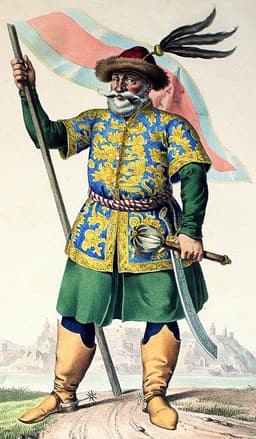
Bleda
Emperor · Ancient
38.3Total

Napoleon Bonaparte
General · Modern
70.9Total
Basic Information
Born
400
1769
Died
445
1821
Era
Ancient
Modern
Nationality
Hunnic Empire
France
Occupation
Emperor
General
Civilization
Western
Western
Score Comparison
Military (10%)
45.0
94.0
Political (20%)
26.4
72.0
Influence (20%)
44.0
40.0
Legacy (20%)
34.2
80.0
Leadership (15%)
41.5
78.0
Strategy (15%)
41.0
90.0
TOTAL
38.3
70.9
Bleda — Complete Timeline
434 AD
Co-rulership with AttilaPolitical Action◆ Major
Upon the death of their uncle Rugila, Bleda and his brother Attila became joint rulers of the Hunnic Empire. This co-rulership marked the beginning of a period of aggressive expansion and diplomatic pressure on the Roman Empire.
HunsSuccessionCo-rulership
Impact: regional
435 AD
Treaty of MargusPolitical Action◆ Major
Bleda and Attila negotiated the Treaty of Margus with the Eastern Roman Empire, securing a tribute of 700 pounds of gold per year and the return of Hun refugees. This treaty demonstrated Hun military leverage and established a pattern of Roman payments.
HunsEastern Roman EmpireTreatyTribute
Impact: regional
441 AD
Campaign against the Eastern Roman EmpireWar◆ Major
Bleda and Attila launched a major campaign against the Eastern Roman Empire, sacking cities along the Danube frontier. This aggression forced the Romans to increase their tribute payments and cede territory, expanding Hun control in the Balkans.
HunsEastern Roman EmpireCampaignSack
Impact: regionaldestructive
445 AD
Assassination by AttilaPolitical Action
Bleda was killed, likely on the orders of his brother Attila, during a hunting expedition. This assassination ended the co-rulership and left Attila as the sole ruler of the Huns, enabling his later campaigns against the Roman Empire.
HunsAssassinationPower Struggle
Impact: regionaldestructive
Napoleon Bonaparte — Complete Timeline
1799 AD
Coup of 18 BrumaireOther◆ Major
Napoleon Bonaparte, with support from his brother Lucien and key political figures, overthrew the Directory in a bloodless coup. He established the Consulate with himself as First Consul, effectively becoming the ruler of France. This event ended the French Revolution's most unstable period.
French RevolutionCoupRise to Power
Impact: regional
1804 AD
Promulgation of the Napoleonic CodeOther◆ Major
Napoleon enacted the Civil Code of the French, known as the Napoleonic Code, a comprehensive set of laws that replaced the fragmented feudal legal systems. The code established legal equality, protected property rights, and secularized law. It became the basis for legal systems in many European and world countries.
Legal ReformNapoleonic CodeCivil Law
Impact: globalconstructive
1805 AD
Battle of AusterlitzWar◆ Major
Napoleon's Grande Arm
Napoleonic WarsBattleDecisive Victory
Impact: global
1812 AD
Invasion of RussiaWar◆ Major
Napoleon led the Grande Arm
Napoleonic WarsInvasionDisaster
Impact: globaldestructive
1815 AD
Battle of WaterlooWar◆ Major
Napoleon's French army was defeated by the combined forces of the Duke of Wellington's Anglo-Allied army and Gebhard Leberecht von Bl
Napoleonic WarsBattleFinal Defeat
Impact: globaldestructive
Expert Analysis
bleda-vs-napoleon-bonaparte
### The Shadow and the Sun
On a summer morning in 1815, Napoleon Bonaparte stood on a muddy ridge near Waterloo, watching his Old Guard march into the muzzles of British cannon. Fourteen hundred years earlier, on the steppes of Central Europe, another ruler met his end not by enemy fire but by a brother’s hand. Bleda, co-king of the Huns, died in a hunting accident—or so the story goes—while Napoleon would die in exile on a remote Atlantic island. One conquered a continent and remade its laws; the other ruled half an empire and vanished into a footnote. What separates a legend from a ghost? The answer lies not in the size of their armies, but in the shape of their ambition.
### Origins
Napoleon Bonaparte was born in 1769 on Corsica, an island of Mediterranean fire and vendetta. His family was minor nobility, but they were poor, and young Napoleon was mocked for his accent and small stature at French military school. Yet France itself was a cauldron of revolution, where a man of talent could rise faster than a nobleman’s son. The world was changing, and Napoleon learned to ride the wave.
Bleda was born around 400 AD, likely on the Hungarian plain, into a world of horse and iron. The Huns were a confederation of nomadic warriors who had terrorized the Roman frontiers for generations. Bleda’s uncle, Rugila, had united the tribes, but when he died in 434, power passed to Bleda and his younger brother Attila. There was no revolution here, no meritocracy—only the brutal logic of the clan. Bleda was born into a system where loyalty was measured in plunder and death was always waiting.
### Rise to Power
Napoleon’s ascent was a masterpiece of opportunity. He was a young artillery officer when the French Revolution threw the old order into chaos. In 1795, he saved the revolutionary government from a royalist mob with a “whiff of grapeshot”—a brutal, efficient use of cannon. By 1796, at 26, he was commanding the Army of Italy, where he won a string of dazzling victories. He did not inherit power; he seized it, piece by piece, campaign by campaign.
Bleda’s rise was simpler and darker. Upon Rugila’s death in 434, he and Attila became joint rulers. The Hunnic Empire was a machine built for war, and Bleda’s first major act was the Treaty of Margus in 435, which secured 700 pounds of gold from the Eastern Roman Empire. It was a diplomatic victory, but it was shared. Bleda never commanded a campaign alone; he was always in his brother’s shadow.
### Leadership & Governance
Napoleon governed like a man building a cathedral. He created the Napoleonic Code, a legal system that swept away feudal privileges and enshrined equality before the law. He reformed education, centralized the state, and appointed officials based on merit. His military genius was legendary—his 94.0 military score reflects campaigns that are still studied today—but he was also a political animal, a man who could charm diplomats and crush rebels with equal skill.
Bleda, by contrast, ruled like a chieftain. His scores—military 41.5, political 40.2, leadership 37.7—suggest a man who was competent but not extraordinary. The Hunnic Empire was a loose federation of tribes, held together by the promise of plunder. Bleda’s governance was the governance of the war camp: tribute, loyalty, and the threat of violence. There were no codes, no reforms, no lasting institutions. When he and Attila launched their campaign against the Eastern Roman Empire in 441, they sacked cities and collected gold, but they built nothing.
### Triumph & Tragedy
Napoleon’s greatest triumph was Austerlitz in 1805, where he crushed the armies of Russia and Austria in a single day. His greatest tragedy was the invasion of Russia in 1812, where he lost half a million men to winter and starvation. He was exiled to Elba, escaped, and returned for one last gamble—Waterloo—where he was defeated by the Duke of Wellington and Prussian forces. His end was a slow fade: six years of captivity on Saint Helena, writing memoirs and dying of stomach cancer at 51.
Bleda’s triumph was the Treaty of Margus, a diplomatic win that brought gold and security. His tragedy was his death in 445, possibly on Attila’s orders, during a hunting expedition. He was 45. There was no grand battle, no epic defeat—just a brother’s betrayal and a quiet erasure. Attila would go on to become the “Scourge of God,” while Bleda became a ghost.
### Character & Destiny
Napoleon was driven by an insatiable hunger for glory. “I love power,” he once said, “but it is as an artist that I love it.” He believed he could shape history with his will, and for a time, he did. But his arrogance and overreach—his refusal to stop—led to his downfall. He was a man of immense discipline and vision, but also of fatal pride.
Bleda remains a cipher. The historical record says almost nothing about his personality. He was likely a capable warrior and a cautious diplomat, but he lacked Attila’s ruthlessness and charisma. In a world that rewarded the strongest, he was not strong enough. His destiny was to be a stepping stone for a greater man.
### Legacy
Napoleon’s legacy is monumental. The Napoleonic Code influenced legal systems across Europe and the Americas. His military tactics are still taught at war colleges. He reshaped nationalism, redrew borders, and inspired both admiration and hatred. His 82.0 influence and 78.0 legacy scores reflect a man who changed the world, even in defeat.
Bleda’s legacy is a footnote. His 47.4 legacy score is telling: he is remembered only because he was Attila’s brother. The Hunnic Empire collapsed after Attila’s death, leaving no lasting institutions. Bleda’s name survives in a few chronicles and a lingering question: what if he had killed Attila first?
### Conclusion
Napoleon and Bleda are separated by fourteen centuries, but the gulf between them is not just time—it is the difference between a man who created his own destiny and a man who was swept along by history. Napoleon’s story is one of will and consequence; Bleda’s is one of circumstance and erasure. In the end, the sun shines on those who dare to seize it, while the shadows are swallowed by the earth.
Rankings
🥇
Napoleon BonaparteLeader
Mil: 94.0Pol: 72.0Inf: 40.0
70.9
🥈
Bleda
Mil: 45.0Pol: 26.4Inf: 44.0
38.3
+32.6 behind
How This Comparison Works
Algorithm
Each figure is scored on 6 dimensions (0—100 scale) based on structured historical data: Military (10%), Political (20%), Influence (20%), Legacy (20%), Leadership (15%), Strategy (15%). The weighted total produces the final ranking.
Data Sources
Scores are computed from structured sub-indicators in the database. Scale factors adjust for era (Ancient ×0.85, Modern ×1.0) and civilization size (Eastern ×1.05, Other ×0.80) to account for differences in population and military scale.
Maximum 3 Figures
Comparisons are limited to 2—3 figures to ensure readability and statistical meaningfulness.
Error Margins
±5 points per dimension — Sub-scores are derived from historical records with inherent uncertainty. Two figures within 5 points on a dimension should be considered roughly equivalent in that area.
Total Score Accuracy
±3 points overall — The weighted combination of 6 dimensions produces a total score with approximately ±3 points of uncertainty. Differences of less than 3 points are not statistically significant— the figures are effectively tied.
Known Limitations
- Historical records are incomplete and uneven across civilizations
- Figures from oral-tradition societies may be underrepresented
- Occupation labels can misclassify multi-role figures
- Scores measure capability and impact, not moral character
- Quantitative scoring is a comparison tool, not absolute truth
Capability Radar
Military (10%) — Battles & Warfare
Battles
20
95
Win Rate
20
90
Expansion
25
95
Political (20%) — Governance & Reform
Reform
10
95
Diplomacy
25
80
Economy
15
85
Influence (20%) — Cultural & Global Reach
Cultural
10
85
Global
10
90
Legacy (20%) — Historical Impact
Historical
15
95
Longevity
10
90
Leadership (15%) — Power & Stability
Tenure
30
85
Stability
20
70
Strategy (15%) — Tactics & Innovation
Strategy
20
95
Tactics
20
98
Reform
10
92
Similar Comparisons
Comments & Discussion
BledaBasher6/17/2026
Anyone who puts Bleda in the same breath as Napoleon is just trolling history. Napoleon rewired Europe’s legal DNA with the Napoleonic Code; Bleda is remembered only because his brother Attila erased him from history. One created institutions that still shape modern law; the other got knifed on a hunting trip by his own kin. That’s not a comparison, it’s a category error.
将军无泪6/17/2026
从军事史看,拿破仑靠的是火炮、纵队战术和对时机的精准把握,而布莱达最大的战术成就可能是骑马冲进树林时没被树枝刮下来。拿滑铁卢的炮弹比狩猎的匕首?这差距比阿尔卑斯山和匈牙利平原的海拔差还大。一个是世界级棋手,另一个连棋盘边的观众都算不上。
NapoleonNerd6/17/2026
Waterloo’s mud cost Napoleon a quarter-hour that changed Europe, but Bleda’s death didn’t alter a single border. The Huns under Attila still rampaged; Rome still crumbled. Napoleon’s defeat at Waterloo shattered his empire in a day, while Bleda’s murder was a family squabble with no strategic consequence. One died making history, the other merely stopped existing.
数据破壁人6/17/2026
讲数据就别感情用事:拿破仑统治了约7,200万欧洲人口,打了超过60场战役,0几年间把版图从巴黎推到莫斯科。布莱达呢?史料里连他到底死了几个军团都没数。一个是大规模系统重构,另一个是游牧部族内部摩擦——把两者放一起是典型的历史伪平等主义,毫无信息密度。
BledaFootnoter6/17/2026
You revisionists love romanticizing the “forgotten” co-king, but let’s get real: Bleda didn’t even get a proper death myth. Napoleon got Saint Helena, memoirs, and a legend that still fascinates historians. Bleda got a one-liner in a chronicle about a “hunting trip.” If your historical footprint is that shallow, don’t expect comparisons to a man who shaped modern Europe.