Loading...
Bohemond I of Antioch vs Napoleon Bonaparte
Napoleon Bonaparte leads by 15.7 pts · 2 figures compared
…
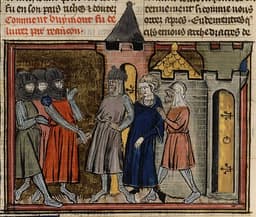
Bohemond I of Antioch
General · Medieval
55.2Total

Napoleon Bonaparte
General · Modern
70.9Total
Basic Information
Born
1054
1769
Died
1111
1821
Era
Medieval
Modern
Nationality
Italy
France
Occupation
General
General
Civilization
Western
Western
Score Comparison
Military (10%)
76.0
94.0
Political (20%)
45.1
72.0
Influence (20%)
53.3
40.0
Legacy (20%)
46.7
80.0
Leadership (15%)
61.1
78.0
Strategy (15%)
66.3
90.0
TOTAL
55.2
70.9
Bohemond I of Antioch — Complete Timeline
1098 AD
Capture of AntiochWar
Bohemond led the capture of Antioch during the First Crusade. He negotiated with a traitor inside the city to open a gate, allowing the crusaders to enter. He then claimed the city for himself, becoming Prince of Antioch.
CrusadeSiegeCrusader States
Impact: regional
1104 AD
Battle of HarranWar◆ Major
Bohemond and Baldwin of Edessa were defeated by a combined Seljuk force at the Battle of Harran. Bohemond was captured and held for ransom, weakening the Principality of Antioch.
Crusader StatesBattleDefeat
Impact: regionaltragic
1107 AD
Campaign against the Byzantine EmpireWar◆ Major
After his release, Bohemond launched a campaign against the Byzantine Empire, besieging Dyrrhachium. He was forced to surrender in 1108 and sign the Treaty of Devol, which made Antioch a vassal of Byzantium.
Byzantine EmpireWarTreaty
Impact: regional
1108 AD
Treaty of DevolPolitical Action◆ Major
Bohemond signed the Treaty of Devol with Byzantine Emperor Alexios I Komnenos. The treaty recognized Bohemond as Prince of Antioch but made him a vassal of the Byzantine Empire, a humiliation that ended his ambitions.
TreatyByzantine EmpireCrusader States
Impact: regional
Napoleon Bonaparte — Complete Timeline
1799 AD
Coup of 18 BrumaireOther◆ Major
Napoleon Bonaparte, with support from his brother Lucien and key political figures, overthrew the Directory in a bloodless coup. He established the Consulate with himself as First Consul, effectively becoming the ruler of France. This event ended the French Revolution's most unstable period.
French RevolutionCoupRise to Power
Impact: regional
1804 AD
Promulgation of the Napoleonic CodeOther◆ Major
Napoleon enacted the Civil Code of the French, known as the Napoleonic Code, a comprehensive set of laws that replaced the fragmented feudal legal systems. The code established legal equality, protected property rights, and secularized law. It became the basis for legal systems in many European and world countries.
Legal ReformNapoleonic CodeCivil Law
Impact: globalconstructive
1805 AD
Battle of AusterlitzWar◆ Major
Napoleon's Grande Arm
Napoleonic WarsBattleDecisive Victory
Impact: global
1812 AD
Invasion of RussiaWar◆ Major
Napoleon led the Grande Arm
Napoleonic WarsInvasionDisaster
Impact: globaldestructive
1815 AD
Battle of WaterlooWar◆ Major
Napoleon's French army was defeated by the combined forces of the Duke of Wellington's Anglo-Allied army and Gebhard Leberecht von Bl
Napoleonic WarsBattleFinal Defeat
Impact: globaldestructive
Expert Analysis
bohemond-i-of-antioch-vs-napoleon-bonaparte
# The Conqueror and the Crusader
In the autumn of 1107, a Norman prince stood before the walls of Dyrrhachium, the great Adriatic fortress of the Byzantine Empire. Nearly seven centuries later, in the spring of 1815, a Corsican general marched through the gates of Grenoble, reclaiming a throne that had been stripped from him. Both men had conquered kingdoms, rewritten laws, and bent armies to their will. Yet one would die in exile on a remote Atlantic island, the other in a monastic retreat in southern Italy. Their names were Napoleon Bonaparte and Bohemond I of Antioch, and their stories reveal how two men of similar ambition could travel such different arcs across history—one a titan whose shadow still falls over Europe, the other a footnote, remembered only by specialists and crusade enthusiasts.
Origins
Napoleon Bonaparte was born in 1769 on Corsica, a Mediterranean island that had passed from Italian to French control just a year before his birth. His family belonged to the minor nobility, but they were neither wealthy nor powerful. The world into which he entered was one of revolution and upheaval—the old order of Europe was cracking, and a boy who read Plutarch’s *Lives* and studied artillery could dream of reshaping it. His education at French military academies gave him the tools of war, but his Corsican roots gave him a sense of being an outsider, a man who had to prove himself again and again.
Bohemond I of Antioch, born in 1054 in southern Italy, came from a different mold. He was the eldest son of Robert Guiscard, the Norman warlord who had carved out a duchy in Apulia through sheer ferocity. The Normans were adventurers, mercenaries who had seized lands from Lombards, Byzantines, and Muslims alike. Bohemond grew up in a world where power was taken, not inherited—his father had disinherited him in favor of a younger brother, Roger Borsa, leaving Bohemond with nothing but his name and his sword. Where Napoleon was forged in the fire of revolution, Bohemond was shaped by the brutal calculus of Norman ambition: if you wanted a kingdom, you had to conquer it.
Rise to Power
Napoleon’s ascent was meteoric, a product of the chaos unleashed by the French Revolution. In 1793, at the age of 24, he distinguished himself at the Siege of Toulon, where his artillery tactics drove out British forces. By 1796, he was commanding the Army of Italy, and within a year, he had crushed the Austrians and carved out a reputation as a military genius. His path was not just about battles—it was about timing. The Revolution had created a vacuum, and Napoleon filled it with his own ambition, staging a coup in 1799 to become First Consul, then crowning himself Emperor in 1804.
Bohemond’s rise was slower, harder, and more contingent on the great religious movement of his age: the First Crusade. In 1096, when Pope Urban II called for Christians to liberate Jerusalem, Bohemond saw his opportunity. He had spent years fighting the Byzantines alongside his father, but the Crusade offered a holy pretext for conquest. He joined the expedition not as a pilgrim but as a prince in search of a throne. His moment came in 1098 at Antioch, a city that had resisted the crusaders for eight months. Bohemond negotiated with a traitor inside the walls—a man named Firouz, an Armenian guard—who opened a gate. The city fell, and Bohemond declared himself its prince. It was a turning point, a seizure of power that was both brutal and brilliant, but it was a local triumph, not a continental one.
Leadership & Governance
Napoleon’s leadership was transformative. As emperor, he reorganized France’s legal system with the Napoleonic Code, a body of civil law that standardized justice, protected property rights, and secularized the state. He established the Bank of France, reformed education, and built roads and canals. On the battlefield, his strategy was revolutionary—he used speed, concentration of force, and decisive engagements to shatter his enemies. His 1805 victory at Austerlitz is still studied as a masterpiece of military art. Yet his political wisdom was flawed: he alienated the Catholic Church, antagonized the British, and overreached by invading Russia in 1812. His governance was a blend of genius and hubris.
Bohemond’s rule was narrower. As Prince of Antioch, he governed a small, fragile state wedged between the Byzantine Empire and Muslim powers. He issued charters, minted coins, and defended his principality, but his political vision was limited to survival. His military strategy was competent but not revolutionary—he relied on Norman heavy cavalry and siegecraft, but his defeat at the Battle of Harran in 1104, where he and Baldwin of Edessa were crushed by a Seljuk force, showed his limitations. He was captured and spent years in captivity, a humiliation that Napoleon never suffered until his final days.
Triumph & Tragedy
Napoleon’s greatest moment was his coronation in 1804, when he took the crown from the Pope’s hands and placed it on his own head—a gesture of supreme self-confidence. His empire stretched from Spain to Poland, and his armies seemed invincible. But his tragedy was equally grand: the invasion of Russia in 1812, where 600,000 men marched east and fewer than 100,000 returned. The retreat was a nightmare of snow, starvation, and Cossack attacks. His final defeat at Waterloo in 1815, against the Duke of Wellington and Gebhard Leberecht von Blücher, sealed his fate. He died in 1821 on Saint Helena, a prisoner of the British, his empire reduced to memory.
Bohemond’s triumph was the capture of Antioch in 1098—a victory that gave him a kingdom. But his tragedy unfolded in the Treaty of Devol in 1108, where, after his failed campaign against the Byzantine Empire, he was forced to recognize Byzantine suzerainty over Antioch. He had besieged Dyrrhachium in 1107, hoping to reclaim his father’s ambitions, but Alexios I Komnenos outmaneuvered him diplomatically and militarily. Bohemond signed the treaty, swore fealty to the emperor, and died in 1111, his principality reduced to a vassal state. Where Napoleon’s fall was epic, Bohemond’s was anticlimactic—a surrender, not a battle.
Character & Destiny
Napoleon was driven by an insatiable hunger for glory. He once said, “Glory is fleeting, but obscurity is forever.” His personality was a paradox: a brilliant administrator who could not stop waging war, a reformer who craved absolute power. His decisions were shaped by a conviction that he was destiny’s instrument—a belief that led him to conquer Europe but also to destroy his own empire. He was ruthless, charismatic, and ultimately isolated.
Bohemond was a pragmatist, a Norman who understood that power was a game of survival. He was described by the Byzantine princess Anna Komnene as “a man of immense ambition, a born schemer.” His character was forged in the crucible of Norman politics—he could negotiate with traitors, fight in the mud, and bow to emperors when necessary. But he lacked Napoleon’s vision. He did not seek to transform the world; he sought to carve out a piece of it for himself. His destiny was to be a prince of a small, contested state, not the master of a continent.
Legacy
Napoleon’s legacy is monumental. The Napoleonic Code influenced legal systems across Europe and the Americas. His military tactics are still taught in war colleges. He reshaped nationalism, redrew borders, and inspired both admiration and hatred. He is remembered as a genius and a tyrant, a figure who embodies the contradictions of modernity.
Bohemond’s legacy is faint. He is a name in crusade histories, a footnote in the story of the Norman expansion. The Principality of Antioch lasted less than two centuries, and his descendants faded into obscurity. He is remembered not as a world-changer but as a symbol of the Crusades’ complexity—a man of faith and ambition, violence and diplomacy.
Conclusion
What separates these two men is scale. Napoleon lived in an age of revolution, when a single man could harness the energy of millions and reshape a continent. Bohemond lived in an age of faith and feudalism, when power was local and ambition was bounded by the limits of a horse’s ride. Both were conquerors, but one conquered a world, the other a city. Both were prisoners—one of an island, the other of a treaty. And both remind us that history is not a ladder of progress but a landscape of chance, where the same ambition can lead to the throne of Europe or the dust of a forgotten principality.
Rankings
🥇
Napoleon BonaparteLeader
Mil: 94.0Pol: 72.0Inf: 40.0
70.9
🥈
Bohemond I of Antioch
Mil: 76.0Pol: 45.1Inf: 53.3
55.2
+15.7 behind
How This Comparison Works
Algorithm
Each figure is scored on 6 dimensions (0—100 scale) based on structured historical data: Military (10%), Political (20%), Influence (20%), Legacy (20%), Leadership (15%), Strategy (15%). The weighted total produces the final ranking.
Data Sources
Scores are computed from structured sub-indicators in the database. Scale factors adjust for era (Ancient ×0.85, Modern ×1.0) and civilization size (Eastern ×1.05, Other ×0.80) to account for differences in population and military scale.
Maximum 3 Figures
Comparisons are limited to 2—3 figures to ensure readability and statistical meaningfulness.
Error Margins
±5 points per dimension — Sub-scores are derived from historical records with inherent uncertainty. Two figures within 5 points on a dimension should be considered roughly equivalent in that area.
Total Score Accuracy
±3 points overall — The weighted combination of 6 dimensions produces a total score with approximately ±3 points of uncertainty. Differences of less than 3 points are not statistically significant— the figures are effectively tied.
Known Limitations
- Historical records are incomplete and uneven across civilizations
- Figures from oral-tradition societies may be underrepresented
- Occupation labels can misclassify multi-role figures
- Scores measure capability and impact, not moral character
- Quantitative scoring is a comparison tool, not absolute truth
Capability Radar
Military (10%) — Battles & Warfare
Battles
75
95
Win Rate
70
90
Expansion
65
95
Political (20%) — Governance & Reform
Reform
40
95
Diplomacy
65
80
Economy
35
85
Influence (20%) — Cultural & Global Reach
Cultural
45
85
Global
45
90
Legacy (20%) — Historical Impact
Historical
60
95
Longevity
50
90
Leadership (15%) — Power & Stability
Tenure
55
85
Stability
30
70
Strategy (15%) — Tactics & Innovation
Strategy
75
95
Tactics
80
98
Reform
30
92
Similar Comparisons
Comments & Discussion
HopliteGhost6/17/2026
Bohemond was a first-rate siege commander and a monster of personal charisma, but comparing him to Napoleon is like comparing a coastal skirmish to a continental war. The Norman prince never commanded more than 35,000 men at any point; Napoleon routinely maneuvered armies of 200,000 across Europe. Bohemond’s “empire” was a sliver of the Levant. Napoleon reshaped entire legal codes, economies, and national boundaries. One was a regional warlord riding a crusading wave; the other was a systemic re
数据猎人6/17/2026
把博希蒙德和拿破仑放一起比,根本是数字层面的闹剧。博希蒙德在安条克围城战时最多指挥过约1.5万人,而拿破仑在1812年入侵俄国时率领了超过60万大军。就算考虑时代人口差异,拿破仑的军事动员能力是博希蒙德的四倍以上。而且博希蒙德那场所谓的“史诗胜利”——攻占安条克——很大程度上是靠叛徒内应,不是什么战略天才。你们这些十字军粉能不能先算算人数再开口?
RhetorArchitect6/17/2026
What interests me is their propaganda. Napoleon mastered the modern bulletin—he could make a tactical retreat sound like a strategic triumph. Bohemond, however, invented crusader mythmaking: he literally claimed Saint George appeared in the sky to rally his troops at Antioch. Both men understood that wars are won as much in the telling as in the fighting. But Napoleon’s narrative was rationalist and future-facing; Bohemond’s was medieval and miraculous. That difference explains why one is taught
帝政叛徒6/17/2026
拿博希蒙德和拿破仑比,本身就是对历史语境的背叛。一个是封建骑士头子,靠教皇的号令和宗教狂热拉队伍;另一个是资产阶级革命的产物,凭个人才能和法律制度建立帝国。博希蒙德甚至被拜占庭皇帝用外交手段耍得团团转,他的所谓“王国”不到三十年就崩溃了。拿破仑的《法典》至今仍在法国和欧洲很多地方有效。一个是临时工,一个是系统架构师。别拿流星当恒星。
ChansonDeGeste6/17/2026
你们都在谈政治军事,但真正让这两人分道扬镳的是时代的精神气质。博希蒙德在世时,他的事迹被编成长诗在意大利的广场上传唱,《安条克之歌》把他写成上帝挑选的战士。拿破仑呢?他身边是记者、画家、作曲家和学者——贝多芬为他谱曲,歌德被他接见。一个是吟游诗人的英雄,一个是启蒙时代的天才。他们的不同,是中世纪信仰与现代理性