Loading...
This comparison has not been analyzed yet.
One-time AI generation (~1 minute). Scores and timeline are already available below.
Bonar Law vs Earl of Durham
Earl of Durham leads by 10.9 pts · 2 figures compared
…
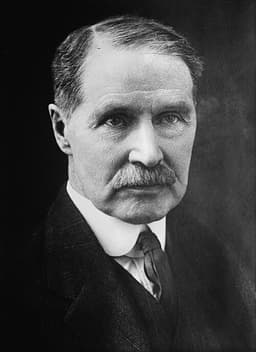
Bonar Law
Politician · Modern
44.8Total

Earl of Durham
Politician · Modern
55.7Total
Basic Information
Born
1858
1792
Died
1923
1840
Era
Modern
Modern
Nationality
United Kingdom
United Kingdom
Occupation
Politician
Politician
Civilization
Western
Western
Score Comparison
Military (10%)
46.9
47.4
Political (20%)
43.7
72.0
Influence (20%)
47.9
61.0
Legacy (20%)
38.3
52.0
Leadership (15%)
51.9
51.9
Strategy (15%)
42.0
40.9
TOTAL
44.8
55.7
Bonar Law — Complete Timeline
1911 AD
Served as Leader of the Conservative PartyPolitical Action◆ Major
Bonar Law was elected leader of the Conservative Party, succeeding Arthur Balfour. He led the party through the pre-war period, opposing Irish Home Rule and supporting tariff reform. His leadership helped unify the party.
Conservative PartyLeadershipHome Rule
Impact: nationalconstructive
1912 AD
Opposed Irish Home RulePolitical Action◆ Major
Bonar Law led Conservative opposition to the Third Home Rule Bill, which would have granted Ireland self-government. He supported the Ulster Unionists and warned of civil war, contributing to the political crisis in Ireland.
IrelandHome RuleUnionism
Impact: regionaldestructive
1922 AD
Became Prime Minister of the United KingdomPolitical Action◆ Major
Bonar Law became Prime Minister after the Conservative Party withdrew from the coalition government. He served for 211 days, the shortest term of any 20th-century UK PM. His government focused on trade and post-war reconstruction.
Prime MinisterConservative PartyShortest term
Impact: national
1923 AD
Resigned as Prime Minister due to ill healthPolitical Action◆ Major
Bonar Law resigned as Prime Minister in May 1923 after being diagnosed with terminal throat cancer. He was succeeded by Stanley Baldwin. His resignation marked the end of his brief premiership.
ResignationHealthPrime Minister
Impact: nationaltragic
Earl of Durham — Complete Timeline
1838 AD
Appointed Governor General of CanadaPolitical Action◆ Major
Lord Durham was appointed Governor General and High Commissioner to British North America following the Rebellions of 1837-1838. His mission was to investigate the causes of unrest and recommend reforms.
Canadian HistoryBritish North AmericaRebellions of 1837
Impact: regional
Resigned as Governor GeneralPolitical Action
Durham resigned after the British government disallowed his ordinance exiling rebel prisoners to Bermuda without trial. His resignation cut short his direct involvement but allowed him to focus on writing his influential report.
ResignationBritish North AmericaRebellions
Impact: regional
1839 AD
Published the Report on the Affairs of British North AmericaPolitical Action
Durham's Report recommended responsible government and the union of Upper and Lower Canada. It proposed assimilating French Canadians through legislative union, a controversial suggestion that shaped Canadian constitutional development.
Durham ReportResponsible GovernmentCanadian Confederation
Impact: regionalconstructive
This comparison has not been analyzed yet.
One-time AI generation (~1 minute). Scores and timeline are already available below.
Rankings
🥇
Earl of DurhamLeader
Mil: 47.4Pol: 72.0Inf: 61.0
55.7
🥈
Bonar Law
Mil: 46.9Pol: 43.7Inf: 47.9
44.8
+10.9 behind
How This Comparison Works
Algorithm
Each figure is scored on 6 dimensions (0—100 scale) based on structured historical data: Military (10%), Political (20%), Influence (20%), Legacy (20%), Leadership (15%), Strategy (15%). The weighted total produces the final ranking.
Data Sources
Scores are computed from structured sub-indicators in the database. Scale factors adjust for era (Ancient ×0.85, Modern ×1.0) and civilization size (Eastern ×1.05, Other ×0.80) to account for differences in population and military scale.
Maximum 3 Figures
Comparisons are limited to 2—3 figures to ensure readability and statistical meaningfulness.
Error Margins
±5 points per dimension — Sub-scores are derived from historical records with inherent uncertainty. Two figures within 5 points on a dimension should be considered roughly equivalent in that area.
Total Score Accuracy
±3 points overall — The weighted combination of 6 dimensions produces a total score with approximately ±3 points of uncertainty. Differences of less than 3 points are not statistically significant— the figures are effectively tied.
Known Limitations
- Historical records are incomplete and uneven across civilizations
- Figures from oral-tradition societies may be underrepresented
- Occupation labels can misclassify multi-role figures
- Scores measure capability and impact, not moral character
- Quantitative scoring is a comparison tool, not absolute truth
Capability Radar
Military (10%) — Battles & Warfare
Battles
30
31
Win Rate
34
34
Expansion
38
35
Political (20%) — Governance & Reform
Reform
30
85
Diplomacy
40
60
Economy
35
40
Influence (20%) — Cultural & Global Reach
Cultural
10
40
Global
15
55
Legacy (20%) — Historical Impact
Historical
20
70
Longevity
10
65
Leadership (15%) — Power & Stability
Tenure
20
15
Stability
25
30
Strategy (15%) — Tactics & Innovation
Strategy
40
35
Tactics
38
40
Reform
43
43
Similar Comparisons
Comments & Discussion
No comments yet. Be the first to share your thoughts!