Loading...
Bonar Law vs Francisco de Quevedo
Francisco de Quevedo leads by 5.7 pts · 2 figures compared
…
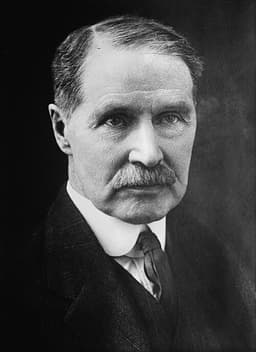
Bonar Law
Politician · Modern
44.8Total

Francisco de Quevedo
Politician · Modern
50.5Total
Basic Information
Born
1858
1580
Died
1923
1645
Era
Modern
Modern
Nationality
United Kingdom
Spain
Occupation
Politician
Politician
Civilization
Western
Western
Score Comparison
Military (10%)
46.9
50.0
Political (20%)
43.7
27.9
Influence (20%)
47.9
72.0
Legacy (20%)
38.3
52.0
Leadership (15%)
51.9
41.5
Strategy (15%)
42.0
41.2
TOTAL
44.8
50.5
Bonar Law — Complete Timeline
1911 AD
Served as Leader of the Conservative PartyPolitical Action◆ Major
Bonar Law was elected leader of the Conservative Party, succeeding Arthur Balfour. He led the party through the pre-war period, opposing Irish Home Rule and supporting tariff reform. His leadership helped unify the party.
Conservative PartyLeadershipHome Rule
Impact: nationalconstructive
1912 AD
Opposed Irish Home RulePolitical Action◆ Major
Bonar Law led Conservative opposition to the Third Home Rule Bill, which would have granted Ireland self-government. He supported the Ulster Unionists and warned of civil war, contributing to the political crisis in Ireland.
IrelandHome RuleUnionism
Impact: regionaldestructive
1922 AD
Became Prime Minister of the United KingdomPolitical Action◆ Major
Bonar Law became Prime Minister after the Conservative Party withdrew from the coalition government. He served for 211 days, the shortest term of any 20th-century UK PM. His government focused on trade and post-war reconstruction.
Prime MinisterConservative PartyShortest term
Impact: national
1923 AD
Resigned as Prime Minister due to ill healthPolitical Action◆ Major
Bonar Law resigned as Prime Minister in May 1923 after being diagnosed with terminal throat cancer. He was succeeded by Stanley Baldwin. His resignation marked the end of his brief premiership.
ResignationHealthPrime Minister
Impact: nationaltragic
Francisco de Quevedo — Complete Timeline
1626 AD
Publication of 'El Buscón'Cultural◆ Major
Francisco de Quevedo published his picaresque novel 'Historia de la vida del Busc
LiteraturePicaresqueSatire
Impact: globalconstructive
1627 AD
Publication of 'Sueños y discursos'Cultural◆ Major
Quevedo published 'Sue
LiteratureSatireCensorship
Impact: nationalconstructive
1632 AD
Appointment as secretary to the kingPolitical Action
Quevedo was appointed secretary to King Philip IV, a position that gave him influence at court. However, his political career was marked by conflicts and rivalries, particularly with the powerful Count-Duke of Olivares.
AppointmentCourtPolitics
Impact: national
1639 AD
Imprisonment in the convent of San MarcosPolitical Action◆ Major
Quevedo was arrested and imprisoned in the convent of San Marcos in Le
ImprisonmentCensorshipOlivares
Impact: nationaldestructive
Expert Analysis
Origins
Bonar Law was born on September 16, 1858, in Rexton, New Brunswick, Canada, to Presbyterian minister James Law and Elizabeth Kidston. After his mother's death, he was raised by wealthy relatives in Scotland. He left school at 14 to work in banking, later entering the iron trade. Despite lacking a university education, Law became a successful businessman and Conservative MP in 1900. His Canadian birth made him the only UK Prime Minister born outside the British Isles.
Francisco de Quevedo was born on September 14, 1580, in Madrid, Spain, into a noble family. His father was secretary to Princess Maria of Spain, and his mother was a lady-in-waiting. Quevedo studied at the University of Alcalá de Henares and later at the University of Valladolid, mastering classical languages and philosophy. He was a polyglot, fluent in Latin, Greek, Hebrew, Arabic, French, Italian, and Spanish. His early exposure to courtly life and intellectual circles shaped his satirical and critical worldview.
Rise to Power
Bonar Law entered Parliament in 1900 as a Conservative MP for Glasgow Blackfriars. He rose quickly, becoming Parliamentary Secretary to the Board of Trade in 1902 and then a prominent tariff reform advocate. In 1911, he was elected Leader of the Conservative Party, succeeding Arthur Balfour. Law's opposition to Irish Home Rule galvanized the Unionist base. During World War I, he served as Chancellor of the Exchequer and later as Lord Privy Seal. In 1922, he played a key role in the Conservative withdrawal from the coalition government, leading to his appointment as Prime Minister on October 23, 1922. His rise was marked by pragmatism and party loyalty.
Francisco de Quevedo gained prominence through his literary works, particularly his picaresque novel 'El Buscón' (published 1626) and his satirical 'Sueños y discursos' (1627). He became secretary to the Duke of Osuna, a powerful nobleman, and served as his agent in Naples. Through Osuna, Quevedo entered the court of Philip IV, eventually becoming secretary to the king in 1632. His political career, however, was turbulent; he was imprisoned in 1639 for satirizing the Count-Duke of Olivares, spending nearly four years in the convent of San Marcos. His rise was driven by literary talent and noble patronage, but undermined by his sharp tongue.
Leadership & Governance
Bonar Law's leadership style was cautious, conciliatory, and focused on party unity. As Prime Minister, he prioritized fiscal responsibility, negotiating the settlement of war debts with the United States. His government passed the Irish Free State Constitution Act, establishing the Irish Free State. Law's governance approach was conservative and pragmatic; he avoided bold reforms. His political score of 43.7 reflects limited legislative impact. His leadership score of 51.9 indicates competence but not exceptionalism. He managed a divided Conservative Party but lacked a transformative vision.
Francisco de Quevedo's governance was indirect, as a courtier and royal secretary. He wielded influence through his writings and personal connections, but his political power was circumscribed. His satirical works criticized corruption and hypocrisy, but alienated powerful figures like Olivares. His leadership score of 41.5 reflects his failure to achieve lasting political office. His strategy score of 41.2 indicates poor political maneuvering. Unlike Law, Quevedo's governance was not about administration but about intellectual and moral critique.
Triumph & Tragedy
Bonar Law's greatest triumph was becoming Prime Minister and stabilizing the Conservative Party after the 1922 Carlton Club meeting, where he led the decision to end the coalition. He also successfully negotiated the Irish settlement. His tragedy was his brief tenure—only 211 days—cut short by terminal throat cancer. He resigned on May 22, 1923, and died later that year. His legacy as the 'unknown Prime Minister' stems from this brevity. His influence score of 47.9 and legacy score of 38.3 reflect limited lasting impact.
Francisco de Quevedo's triumph lies in his literary output: 'El Buscón' is a masterpiece of Spanish picaresque, and his poetry and satires are celebrated for their wit and depth. His influence score of 72.0 highlights his enduring impact on Spanish literature. His tragedy was his imprisonment and political marginalization. His conflicts with Olivares led to his downfall, and he died in 1645 shortly after release, impoverished and disillusioned. His political score of 27.9 reflects his failed ambitions.
Character & Destiny
Bonar Law was reserved, industrious, and deeply loyal to his party. His Canadian background and business acumen gave him a pragmatic outlook. He was known for his integrity and lack of personal ambition, which paradoxically limited his drive. His character shaped his destiny: his cautiousness made him a caretaker PM, and his ill health cut short his term. Historians often describe him as competent but unremarkable.
Quevedo was brilliant, caustic, and combative. His sharp satire and intellectual arrogance made him enemies. His character led to self-destruction: his writings provoked powerful figures, resulting in imprisonment. His destiny was to be a literary giant but a political failure. His total score of 50.5 is higher than Law's 44.8, but his impact is concentrated in culture, not governance.
Legacy
Bonar Law's legacy is as the shortest-serving UK Prime Minister of the 20th century. His political impact is minimal; no major institutions or laws bear his name. He is remembered primarily for the 1922 Carlton Club meeting and his role in ending the coalition. His military score of 46.9, political 43.7, and influence 47.9 all hover near average, reflecting his limited footprint.
Quevedo's legacy is immense in Spanish literature. He is considered one of the greatest poets and satirists of the Spanish Golden Age, alongside Luis de Góngora (his rival). His works continue to be studied and admired. His influence score of 72.0 is the highest in this comparison. However, his political legacy is negligible.
Conclusion
While Bonar Law scored 44.8 total and Quevedo 50.5, the comparison is not straightforward. Quevedo's higher total is driven by his influence score (72.0), reflecting his literary impact. Law's political and leadership scores are higher (43.7 vs 27.9; 51.9 vs 41.5), but his overall impact was fleeting. In terms of enduring influence, Quevedo clearly surpasses Law. His works have shaped Spanish culture for centuries, while Law's premiership is a historical footnote. Therefore, Francisco de Quevedo had greater impact, as his literary legacy continues to resonate, whereas Bonar Law's political career, though significant in its moment, left little lasting mark.
Rankings
🥇
Francisco de QuevedoLeader
Mil: 50.0Pol: 27.9Inf: 72.0
50.5
🥈
Bonar Law
Mil: 46.9Pol: 43.7Inf: 47.9
44.8
+5.7 behind
How This Comparison Works
Algorithm
Each figure is scored on 6 dimensions (0—100 scale) based on structured historical data: Military (10%), Political (20%), Influence (20%), Legacy (20%), Leadership (15%), Strategy (15%). The weighted total produces the final ranking.
Data Sources
Scores are computed from structured sub-indicators in the database. Scale factors adjust for era (Ancient ×0.85, Modern ×1.0) and civilization size (Eastern ×1.05, Other ×0.80) to account for differences in population and military scale.
Maximum 3 Figures
Comparisons are limited to 2—3 figures to ensure readability and statistical meaningfulness.
Error Margins
±5 points per dimension — Sub-scores are derived from historical records with inherent uncertainty. Two figures within 5 points on a dimension should be considered roughly equivalent in that area.
Total Score Accuracy
±3 points overall — The weighted combination of 6 dimensions produces a total score with approximately ±3 points of uncertainty. Differences of less than 3 points are not statistically significant— the figures are effectively tied.
Known Limitations
- Historical records are incomplete and uneven across civilizations
- Figures from oral-tradition societies may be underrepresented
- Occupation labels can misclassify multi-role figures
- Scores measure capability and impact, not moral character
- Quantitative scoring is a comparison tool, not absolute truth
Capability Radar
Military (10%) — Battles & Warfare
Battles
30
28
Win Rate
34
31
Expansion
38
35
Political (20%) — Governance & Reform
Reform
30
15
Diplomacy
40
25
Economy
35
10
Influence (20%) — Cultural & Global Reach
Cultural
10
70
Global
15
55
Legacy (20%) — Historical Impact
Historical
20
65
Longevity
10
60
Leadership (15%) — Power & Stability
Tenure
20
20
Stability
25
10
Strategy (15%) — Tactics & Innovation
Strategy
40
36
Tactics
38
41
Reform
43
41
Similar Comparisons
Comments & Discussion
No comments yet. Be the first to share your thoughts!