Loading...
This comparison has not been analyzed yet.
One-time AI generation (~1 minute). Scores and timeline are already available below.
Borommakot vs Mohammed V of Morocco
Borommakot leads by 2.8 pts · 2 figures compared
…
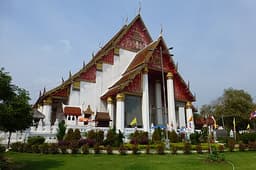
Borommakot
Emperor · Modern
57.2Total

Mohammed V of Morocco
Emperor · Modern
54.4Total
Basic Information
Born
1680
1909
Died
1758
1961
Era
Modern
Modern
Nationality
Thailand
Morocco
Occupation
Emperor
Emperor
Civilization
Eastern
Middle Eastern
Score Comparison
Military (10%)
55.0
10.6
Political (20%)
59.3
72.0
Influence (20%)
59.0
58.3
Legacy (20%)
47.5
56.0
Leadership (15%)
78.0
72.0
Strategy (15%)
45.0
31.4
TOTAL
57.2
54.4
Borommakot — Complete Timeline
1733 AD
Accession to the thronePolitical Action◆ Major
Borommakot became king of Ayutthaya after a civil war with his brother, Prince Aphai. His reign is considered the last golden age of the Ayutthaya Kingdom.
SuccessionCivil War
Impact: national
1740 AD
Construction of Wat PhutthaisawanCultural
Borommakot built Wat Phutthaisawan, a large Buddhist temple complex in Ayutthaya. The temple housed a famous Buddha image and became a major pilgrimage site.
Temple BuildingBuddhism
Impact: nationalconstructive
1745 AD
Restoration of Wat MahathatCultural
Borommakot ordered the restoration of Wat Mahathat, one of Ayutthaya's oldest temples. The restoration included rebuilding the main prang and adding new monastic quarters.
Temple RestorationBuddhism
Impact: nationalconstructive
1750 AD
Sending of Buddhist mission to Sri LankaCultural◆ Major
Borommakot dispatched a Siamese Buddhist mission to Sri Lanka to re-establish the higher ordination lineage. The mission successfully revived the Siam Nikaya order in Sri Lanka, which continues to this day.
BuddhismDiplomacySri Lanka
Impact: globalconstructive
1755 AD
Construction of Wat Na Phra MenCultural
Borommakot built Wat Na Phra Men, a temple located opposite the royal palace. The temple was used for royal ceremonies and housed a large bronze Buddha image.
Temple BuildingBuddhism
constructive
Mohammed V of Morocco — Complete Timeline
1953 AD
Exiled by French Authorities to MadagascarPolitical Action
Mohammed V was deposed and exiled by French authorities to Madagascar, along with his family, for his nationalist stance and support for Moroccan independence. This act sparked widespread protests and strengthened the independence movement.
Moroccan IndependenceFrench ColonialismExile
Impact: nationaltragic
1955 AD
Return from Exile and Restoration as SultanPolitical Action
Mohammed V returned to Morocco from exile in Madagascar after negotiations with France. He was restored as Sultan, marking a major victory for the nationalist movement. His return was celebrated by massive crowds.
Moroccan IndependenceNationalismReturn
Impact: nationalconstructive
1956 AD
Proclamation of Moroccan IndependencePolitical Action
Mohammed V successfully negotiated the end of the French protectorate over Morocco. He proclaimed the country's independence and became its first king, uniting the nation under his leadership.
Moroccan IndependenceDecolonizationMonarchy
Impact: nationalconstructive
1962 AD
Promulgation of the First Moroccan ConstitutionReform◆ Major
Mohammed V oversaw the drafting and promulgation of Morocco's first constitution. It established a constitutional monarchy with a parliament, though the king retained significant powers. This was a key step in modernizing the state.
ConstitutionPolitical ReformMonarchy
Impact: nationalconstructive
This comparison has not been analyzed yet.
One-time AI generation (~1 minute). Scores and timeline are already available below.
Rankings
🥇
BorommakotLeader
Mil: 55.0Pol: 59.3Inf: 59.0
57.2
🥈
Mohammed V of Morocco
Mil: 10.6Pol: 72.0Inf: 58.3
54.4
+2.8 behind
How This Comparison Works
Algorithm
Each figure is scored on 6 dimensions (0—100 scale) based on structured historical data: Military (10%), Political (20%), Influence (20%), Legacy (20%), Leadership (15%), Strategy (15%). The weighted total produces the final ranking.
Data Sources
Scores are computed from structured sub-indicators in the database. Scale factors adjust for era (Ancient ×0.85, Modern ×1.0) and civilization size (Eastern ×1.05, Other ×0.80) to account for differences in population and military scale.
Maximum 3 Figures
Comparisons are limited to 2—3 figures to ensure readability and statistical meaningfulness.
Error Margins
±5 points per dimension — Sub-scores are derived from historical records with inherent uncertainty. Two figures within 5 points on a dimension should be considered roughly equivalent in that area.
Total Score Accuracy
±3 points overall — The weighted combination of 6 dimensions produces a total score with approximately ±3 points of uncertainty. Differences of less than 3 points are not statistically significant— the figures are effectively tied.
Known Limitations
- Historical records are incomplete and uneven across civilizations
- Figures from oral-tradition societies may be underrepresented
- Occupation labels can misclassify multi-role figures
- Scores measure capability and impact, not moral character
- Quantitative scoring is a comparison tool, not absolute truth
Capability Radar
Military (10%) — Battles & Warfare
Battles
30
5
Win Rate
40
7
Expansion
20
13
Political (20%) — Governance & Reform
Reform
65
60
Diplomacy
60
75
Economy
70
40
Influence (20%) — Cultural & Global Reach
Cultural
65
60
Global
30
50
Legacy (20%) — Historical Impact
Historical
55
65
Longevity
40
55
Leadership (15%) — Power & Stability
Tenure
70
65
Stability
75
55
Strategy (15%) — Tactics & Innovation
Strategy
30
15
Tactics
35
19
Reform
20
22
Similar Comparisons
Comments & Discussion
No comments yet. Be the first to share your thoughts!