Loading...
Boun Oum vs Napoleon Bonaparte
Napoleon Bonaparte leads by 23.6 pts · 2 figures compared
…
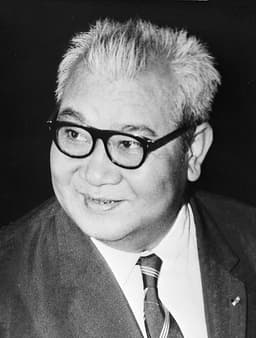
Boun Oum
Politician · Modern
47.3Total

Napoleon Bonaparte
General · Modern
70.9Total
Basic Information
Born
1912
1769
Died
1980
1821
Era
Modern
Modern
Nationality
Laos
France
Occupation
Politician
General
Civilization
Eastern
Western
Score Comparison
Military (10%)
36.6
94.0
Political (20%)
40.8
72.0
Influence (20%)
49.4
40.0
Legacy (20%)
40.0
80.0
Leadership (15%)
65.7
78.0
Strategy (15%)
52.8
90.0
TOTAL
47.3
70.9
Boun Oum — Complete Timeline
1960 AD
Role in the Battle of VientianeWar◆ Major
Boun Oum allied with General Phoumi Nosavan to retake Vientiane from neutralist forces led by Kong Le. The battle resulted in heavy casualties and destruction in the capital, and Boun Oum's forces emerged victorious, installing a right-wing government.
BattleCivil WarVientiane
Impact: nationaldestructive
Formation of the Right-Wing Government in ChampasakPolitical Action◆ Major
Boun Oum, as prince of Champasak, formed a right-wing government in southern Laos with support from the United States and Thailand. His government opposed the neutralist coalition of Souvanna Phouma and the communist Pathet Lao, deepening the Laotian Civil War.
Civil WarRight-WingUS Support
Impact: nationaldestructive
1975 AD
Exile to ThailandPolitical Action◆ Major
Following the communist takeover of Laos, Boun Oum fled to Thailand, where he lived in exile. He continued to oppose the Pathet Lao government but never returned to Laos. His exile marked the end of the traditional Lao aristocracy's political influence.
ExileCommunist TakeoverAristocracy
Impact: nationaltragic
Napoleon Bonaparte — Complete Timeline
1799 AD
Coup of 18 BrumaireOther◆ Major
Napoleon Bonaparte, with support from his brother Lucien and key political figures, overthrew the Directory in a bloodless coup. He established the Consulate with himself as First Consul, effectively becoming the ruler of France. This event ended the French Revolution's most unstable period.
French RevolutionCoupRise to Power
Impact: regional
1804 AD
Promulgation of the Napoleonic CodeOther◆ Major
Napoleon enacted the Civil Code of the French, known as the Napoleonic Code, a comprehensive set of laws that replaced the fragmented feudal legal systems. The code established legal equality, protected property rights, and secularized law. It became the basis for legal systems in many European and world countries.
Legal ReformNapoleonic CodeCivil Law
Impact: globalconstructive
1805 AD
Battle of AusterlitzWar◆ Major
Napoleon's Grande Arm
Napoleonic WarsBattleDecisive Victory
Impact: global
1812 AD
Invasion of RussiaWar◆ Major
Napoleon led the Grande Arm
Napoleonic WarsInvasionDisaster
Impact: globaldestructive
1815 AD
Battle of WaterlooWar◆ Major
Napoleon's French army was defeated by the combined forces of the Duke of Wellington's Anglo-Allied army and Gebhard Leberecht von Bl
Napoleonic WarsBattleFinal Defeat
Impact: globaldestructive
Expert Analysis
boun-oum-vs-napoleon-bonaparte
# The Emperor and the Prince: Two Paths Through Modernity
In the winter of 1815, Napoleon Bonaparte stood on the deck of the *Bellerophon*, watching the coast of France disappear into the Atlantic mist. He was forty-five years old, a man who had crowned himself emperor of Europe and who would die seven years later on a volcanic island in the South Atlantic. A century and a half later, in the humid heat of southern Laos, Prince Boun Oum of Champasak boarded a plane for Thailand, leaving behind a kingdom that had fallen to communists. He was sixty-three, a prince who had twice been prime minister and who would die in exile, his name barely known beyond the Mekong River valley. What connects these two men—and what separates them—is not merely geography or scale, but the very nature of how power operates in different eras and different worlds.
Origins
Napoleon was born in 1769 on Corsica, a Mediterranean island that had become French only the year before. His family was minor nobility, poor enough that he wore threadbare coats to military school, where his classmates mocked his accent. The French Revolution, which erupted when he was twenty, shattered the old order and created a vacuum into which talent could climb. He was a child of the Enlightenment and the cannon: his education at Brienne and the École Militaire taught him mathematics, artillery, and the conviction that merit mattered more than birth.
Boun Oum was born in 1912 into the royal house of Champasak, one of the three kingdoms that had been unified into French Laos. His family had ruled for centuries, their legitimacy woven into Buddhist cosmology and local spirit worship. Unlike Napoleon, who had to fight for every step upward, Boun Oum inherited his claim to power. But inheritance in colonial Indochina was a poisoned gift: the French held the real authority, and the prince's world was one of courtly maneuvering within the narrow spaces left by empire.
Rise to Power
Napoleon's ascent was meteoric because the Revolution had destroyed every barrier. At twenty-four, he drove the British out of Toulon and became a brigadier general. At twenty-six, he saved the Directory from a royalist mob with a "whiff of grapeshot." At thirty, he conquered Italy and Egypt, turning military victories into political capital. His coup of 18 Brumaire in 1799 made him First Consul; by 1804, he was emperor. Each step was a gamble, each victory a building block. He understood that in revolutionary France, legitimacy came from success.
Boun Oum's path was slower and more constrained. He became prime minister for the first time in 1949, when Laos was still a French protectorate. His power came from his title, his network of aristocratic allies, and the patronage of foreign powers. The Cold War had arrived in Southeast Asia, and Washington saw the prince as a bulwark against communism. His second premiership, from 1960 to 1962, was born from crisis: a neutralist coup in Vientiane, a civil war, and the intervention of American and Soviet-backed forces. Where Napoleon created his own opportunities, Boun Oum was carried by currents he could not fully control.
Leadership and Governance
Napoleon ruled through a fusion of military genius and administrative reform. His campaigns—Austerlitz in 1805, Jena in 1806, Wagram in 1809—were masterpieces of speed, deception, and concentrated force. But he also gave France the Napoleonic Code, a legal framework that enshrined equality before the law, property rights, and secular administration. He built schools, roads, and a centralized state that outlasted his empire. His leadership was personal, charismatic, and exhausting: he drove himself and his men to the breaking point.
Boun Oum governed in a different key. As a right-wing leader in a fractured country, his role was less to create than to hold together. He allied with General Phoumi Nosavan to retake Vientiane in 1960, a battle that brought temporary order but deepened the civil war. His political score of 77.2 reflects a man who understood the art of coalition, patronage, and foreign manipulation—but who could not build the kind of durable institutions that Napoleon created. His military score of 27.4 tells the story: he was not a general but a prince who hired generals.
Triumph and Tragedy
Napoleon's greatest moment was Austerlitz, where he destroyed a larger Russo-Austrian army in a single day, ending the Third Coalition and cementing his mastery of Europe. His tragedy was the invasion of Russia in 1812, a campaign that cost half a million lives and shattered his Grand Army. He never recovered. Exiled to Elba, he returned for the Hundred Days, only to meet final defeat at Waterloo in 1815. His ambition was his greatness and his ruin.
Boun Oum's triumph was more modest: he kept southern Laos under right-wing control during the chaos of the early 1960s, delaying the communist victory by more than a decade. His tragedy was the fall of Laos in 1975, when the Pathet Lao took power and he fled into exile. He had spent his life defending a traditional order that could not survive the age of ideologies. Napoleon died on Saint Helena, a prisoner; Boun Oum died in 1980 in Thailand, a refugee.
Character and Destiny
Napoleon was driven by an insatiable hunger for glory. "Impossible is a word to be found only in the dictionary of fools," he said. He believed that he could bend history to his will, and for a time, he was right. But his arrogance, his refusal to compromise, and his conviction that he could conquer Russia as he had conquered Italy led to his fall. His personality was the engine of his destiny.
Boun Oum was more cautious, more aware of limits. He was a prince in an age that had little use for princes. His leadership score of 84.1 suggests real skill in managing men and factions, but his strategy score of 54.6 reveals a man who reacted to events rather than shaping them. He was not a revolutionary but a guardian, and guardians rarely survive revolutions.
Legacy
Napoleon's legacy is immense. The Napoleonic Code influenced legal systems across Europe and the world. His military campaigns are still studied in war colleges. He reshaped the map of Europe and accelerated the spread of nationalism. He is remembered as both a tyrant and a reformer, a figure of myth and history.
Boun Oum's legacy is local and fading. He is a footnote in the history of the Laotian Civil War, a prince who fought for a lost cause. His total score of 64.1 reflects a life of significance within a small stage. He did not change the world; he tried to preserve a piece of it.
Conclusion
The difference between Napoleon and Boun Oum is not simply one of scale or talent. It is the difference between an age of revolution and an age of decline, between a man who made his own world and a man who inherited a world that was already ending. Napoleon's story is about the power of individual will; Boun Oum's is about the weight of history. One conquered Europe; the other lost a kingdom. Both, in the end, were defeated by forces larger than themselves. But Napoleon's defeat became legend, while Boun Oum's became silence. That, perhaps, is the cruelest measure of historical significance.
Rankings
🥇
Napoleon BonaparteLeader
Mil: 94.0Pol: 72.0Inf: 40.0
70.9
🥈
Boun Oum
Mil: 36.6Pol: 40.8Inf: 49.4
47.3
+23.6 behind
How This Comparison Works
Algorithm
Each figure is scored on 6 dimensions (0—100 scale) based on structured historical data: Military (10%), Political (20%), Influence (20%), Legacy (20%), Leadership (15%), Strategy (15%). The weighted total produces the final ranking.
Data Sources
Scores are computed from structured sub-indicators in the database. Scale factors adjust for era (Ancient ×0.85, Modern ×1.0) and civilization size (Eastern ×1.05, Other ×0.80) to account for differences in population and military scale.
Maximum 3 Figures
Comparisons are limited to 2—3 figures to ensure readability and statistical meaningfulness.
Error Margins
±5 points per dimension — Sub-scores are derived from historical records with inherent uncertainty. Two figures within 5 points on a dimension should be considered roughly equivalent in that area.
Total Score Accuracy
±3 points overall — The weighted combination of 6 dimensions produces a total score with approximately ±3 points of uncertainty. Differences of less than 3 points are not statistically significant— the figures are effectively tied.
Known Limitations
- Historical records are incomplete and uneven across civilizations
- Figures from oral-tradition societies may be underrepresented
- Occupation labels can misclassify multi-role figures
- Scores measure capability and impact, not moral character
- Quantitative scoring is a comparison tool, not absolute truth
Capability Radar
Military (10%) — Battles & Warfare
Battles
5
95
Win Rate
5
90
Expansion
5
95
Political (20%) — Governance & Reform
Reform
30
95
Diplomacy
40
80
Economy
25
85
Influence (20%) — Cultural & Global Reach
Cultural
20
85
Global
15
90
Legacy (20%) — Historical Impact
Historical
25
95
Longevity
15
90
Leadership (15%) — Power & Stability
Tenure
45
85
Stability
20
70
Strategy (15%) — Tactics & Innovation
Strategy
5
95
Tactics
5
98
Reform
5
92
Similar Comparisons
Comments & Discussion
火线老兵6/17/2026
拿皇从基层炮手干到欧洲霸主,靠的是硬实力和革命机遇;而占巴塞亲王不过是法国殖民体系的棋子,其权力完全依赖法国人赏赐。拿破仑在瓦格拉姆战役中伤亡三万摧毁第五次反法同盟,Boun Oum却在老挝内战中连游击队都摆不平。两个世界,两种能力的鸿沟。
SkepticalHistorian6/17/2026
Let’s not over-romanticize: Napoleon’s “empire” lasted barely a decade, and his greatest legacy is a bankrupt France and a million casualties. Boun Oum, by contrast, presided over a region that produced the Ho Chi Minh Trail—a logistical nightmare that humiliated superpowers. Who actually disrupted more history? The Prince’s failure to contain Pathet Lao helped ignite Vietnam, while Napoleon just gave Europe a headache.
旧制度遗民6/17/2026
看到有人拿大革命的明星和世袭的土王比较,真是历史的玩笑。拿破仑代表的是现代极权暴力的丑陋诞生,他那套中央集权后来被各国学了去;Boun Oum至少守护了一种传统的、地方性的权力模式。前者用《拿破仑法典》捆绑整个欧洲,后者连自家老挝的少数民族都管不住。我宁可要一个无能的旧君主,也不要一个高效的暴君。
CipherInk6/17/2026
Data wise, compare their impact: Napoleon directly caused ~6.5 million military deaths over 15 years; Boun Oum’s entire reign saw fewer combat casualties in Laos but his ouster triggered a civil war that dropped 2 million tons of bombs. The Prince’s exit was a catalyst for a catastrophe orders of magnitude larger, per capita. Napoleon’s butcher bill is famous; Boun Oum’s aftermath is invisible—but deadlier in the long run.
PolisProf6/17/2026
As a military historian, Napoleon is the quintessential product of the Revolutionary era—his Corsican outsider status gave him the hunger to master artillery in an age of chaos. Boun Oum inherited a throne; Napoleon stormed one. One was forged by the crucible of the 18th-century battlefield, the other by colonial intrigue. No contest: the Emperor reshaped the map of the West; the Prince lost a kingdom the size of a footnote.