Loading...
This comparison has not been analyzed yet.
One-time AI generation (~1 minute). Scores and timeline are already available below.
Burnaburiash II vs Chandragupta I
Chandragupta I leads by 13.8 pts · 2 figures compared
…
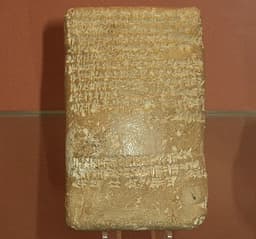
Burnaburiash II
Emperor · Ancient
43.1Total

Chandragupta I
Emperor · Ancient
56.9Total
Basic Information
Born
-1359
319
Died
-1333
335
Era
Ancient
Ancient
Nationality
Kassite Dynasty
India
Occupation
Emperor
Emperor
Civilization
Middle Eastern
Indian
Score Comparison
Military (10%)
25.9
55.0
Political (20%)
40.8
61.3
Influence (20%)
47.1
57.2
Legacy (20%)
38.3
50.0
Leadership (15%)
62.2
74.0
Strategy (15%)
36.8
43.3
TOTAL
43.1
56.9
Burnaburiash II — Complete Timeline
1350 BC
Correspondence with AkhenatenPolitical Action◆ Major
Burnaburiash II exchanged diplomatic letters with the Egyptian pharaoh Akhenaten, as recorded in the Amarna letters. The correspondence dealt with marriage alliances, trade, and mutual recognition, reflecting the diplomatic network of the Late Bronze Age.
DiplomacyAmarna LettersEgypt
Impact: regional
1345 BC
Conflict with Assyria over Border TerritoriesWar
Burnaburiash II engaged in a conflict with Assyria over border territories, as mentioned in the Amarna letters. The dispute highlighted the shifting power dynamics in Mesopotamia, though the outcome was inconclusive and did not lead to major territorial changes.
ConflictAssyriaBorder
Impact: regional
Chandragupta I — Complete Timeline
308 AD
Married Princess KumaradeviPolitical Action◆ Major
Chandragupta I married Kumaradevi, a princess of the Licchavi clan. This alliance brought the wealthy Licchavi territories under Gupta control, strengthening his political and military position.
Marriage AllianceLicchaviGupta
Impact: regionalconstructive
319 AD
Founded the Gupta EmpirePolitical Action
Chandragupta I established the Gupta Empire by consolidating territories in the Ganges basin. He assumed the title Maharajadhiraja, marking the beginning of a dynasty that would dominate northern India for centuries.
Gupta EmpireFoundingIndia
Impact: regionalconstructive
320 AD
Issued Gupta Era CoinageCultural
Chandragupta I issued gold coins bearing his image and the title Maharajadhiraja. These coins standardized currency in his realm and promoted Gupta sovereignty, becoming a model for later rulers.
CoinageEconomyGupta
Impact: regionalconstructive
This comparison has not been analyzed yet.
One-time AI generation (~1 minute). Scores and timeline are already available below.
Rankings
🥇
Chandragupta ILeader
Mil: 55.0Pol: 61.3Inf: 57.2
56.9
🥈
Burnaburiash II
Mil: 25.9Pol: 40.8Inf: 47.1
43.1
+13.8 behind
How This Comparison Works
Algorithm
Each figure is scored on 6 dimensions (0—100 scale) based on structured historical data: Military (10%), Political (20%), Influence (20%), Legacy (20%), Leadership (15%), Strategy (15%). The weighted total produces the final ranking.
Data Sources
Scores are computed from structured sub-indicators in the database. Scale factors adjust for era (Ancient ×0.85, Modern ×1.0) and civilization size (Eastern ×1.05, Other ×0.80) to account for differences in population and military scale.
Maximum 3 Figures
Comparisons are limited to 2—3 figures to ensure readability and statistical meaningfulness.
Error Margins
±5 points per dimension — Sub-scores are derived from historical records with inherent uncertainty. Two figures within 5 points on a dimension should be considered roughly equivalent in that area.
Total Score Accuracy
±3 points overall — The weighted combination of 6 dimensions produces a total score with approximately ±3 points of uncertainty. Differences of less than 3 points are not statistically significant— the figures are effectively tied.
Known Limitations
- Historical records are incomplete and uneven across civilizations
- Figures from oral-tradition societies may be underrepresented
- Occupation labels can misclassify multi-role figures
- Scores measure capability and impact, not moral character
- Quantitative scoring is a comparison tool, not absolute truth
Capability Radar
Military (10%) — Battles & Warfare
Battles
10
40
Win Rate
10
45
Expansion
10
50
Political (20%) — Governance & Reform
Reform
30
45
Diplomacy
50
50
Economy
30
50
Influence (20%) — Cultural & Global Reach
Cultural
20
55
Global
20
50
Legacy (20%) — Historical Impact
Historical
30
60
Longevity
20
65
Leadership (15%) — Power & Stability
Tenure
40
55
Stability
40
55
Strategy (15%) — Tactics & Innovation
Strategy
10
40
Tactics
10
35
Reform
10
30
Similar Comparisons
Comments & Discussion
No comments yet. Be the first to share your thoughts!