Loading...
Camille Chamoun vs Said Musa
Camille Chamoun leads by 1.9 pts · 2 figures compared
…
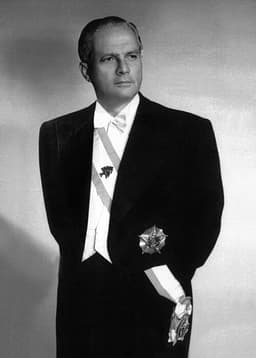
Camille Chamoun
Politician · Modern
51.4Total
Said Musa
Politician · Modern
49.5Total
Basic Information
Born
1900
1944
Died
1987
—
Era
Modern
Modern
Nationality
Lebanon
Belize
Occupation
Politician
Politician
Civilization
Middle Eastern
Other
Score Comparison
Military (10%)
39.4
17.7
Political (20%)
61.3
68.0
Influence (20%)
53.3
49.4
Legacy (20%)
45.0
39.2
Leadership (15%)
65.0
74.0
Strategy (15%)
39.6
43.1
TOTAL
51.4
49.5
Camille Chamoun — Complete Timeline
1952 AD
Elected President of LebanonPolitical Action◆ Major
Camille Chamoun was elected President of Lebanon on September 23, 1952, succeeding Bechara El Khoury. His election marked a shift in Lebanese politics, and he served a six-year term until 1958.
PresidencyElectionLebanon
Impact: national
1958 AD
1958 Lebanon crisis and U.S. interventionWar◆ Major
President Chamoun faced a major political crisis when Muslim factions rebelled against his pro-Western policies and alleged attempts to amend the constitution for a second term. The U.S. intervened by landing Marines in Beirut to stabilize the government.
Civil WarU.S. InterventionPolitical Crisis
Impact: regionaldestructive
Refused to resign during the 1958 crisisPolitical Action
Chamoun refused to resign despite widespread opposition and the formation of a rebel government in Tripoli. He remained in power until the end of his term in September 1958, when he handed over to Fuad Chehab.
ResistancePolitical StalemateTransition
Impact: national
Founded the National Liberal PartyPolitical Action
After leaving the presidency, Chamoun founded the National Liberal Party (NLP) in 1958. The party became a major political force representing Maronite Christian interests and played a role in the Lebanese Civil War.
Political PartyMaronitePost-presidency
Impact: national
1975 AD
Role in the Lebanese Civil WarWar◆ Major
Chamoun's National Liberal Party and its militia, the Tigers, fought in the Lebanese Civil War as part of the Christian Lebanese Front. He opposed the Taif Agreement and remained a polarizing figure until his death in 1987.
Civil WarMilitiaChristian Faction
Impact: nationaldestructive
Said Musa — Complete Timeline
1998 AD
Elected Prime Minister of BelizePolitical Action◆ Major
Said Musa led the People's United Party to victory in the 1998 general election, becoming prime minister. He was the first Belizean prime minister of Palestinian descent.
ElectionBelizePUP
Impact: nationalconstructive
1999 AD
Implemented Economic ReformsReform◆ Major
Musa's government introduced economic reforms including privatization of state enterprises and tax incentives for foreign investment. These policies aimed to stimulate growth but increased national debt.
Economic ReformPrivatizationBelize
Impact: national
2003 AD
Re-elected in 2003Political Action◆ Major
Musa won a second term in the 2003 general election, continuing his focus on infrastructure and social programs. His government faced criticism over rising crime and corruption.
ElectionBelizePUP
Impact: nationalconstructive
2005 AD
Faced Corruption AllegationsPolitical Action◆ Major
Musa's government was embroiled in corruption scandals, including allegations of misuse of public funds. Protests erupted in 2005, demanding accountability and reforms.
CorruptionScandalBelize
Impact: nationaldestructive
2008 AD
Lost 2008 General ElectionPolitical Action◆ Major
Musa's PUP was defeated by the United Democratic Party in the 2008 general election, ending his ten-year tenure. He stepped down as party leader after the loss.
ElectionBelizeDefeat
Impact: national
Expert Analysis
Origins
Camille Chamoun was born on April 3, 1900, in Deir el Qamar, Lebanon, into a prominent Maronite Christian family. His father was a lawyer and politician. Chamoun studied at the Saint Joseph University in Beirut and later earned a law degree from the French Mandate authorities. He entered politics early, becoming a deputy in 1934.
Said Musa was born on March 19, 1944, in San Ignacio, Belize, into a family of Palestinian Christian immigrants. His father was a shopkeeper. Musa studied at the University of the West Indies and later at the University of London, earning a law degree. He became involved in politics as a member of the People's United Party (PUP) in the 1970s.
Rise to Power
Chamoun's rise began with his election to the Lebanese parliament in 1934. He served as minister of finance and interior in various governments. In 1952, he led a constitutional crisis that forced President Bechara El Khoury to resign, and Chamoun was elected president on September 23, 1952, with 74 votes out of 77 in parliament.
Musa rose through the ranks of the PUP, serving as minister of education and later as attorney general. In 1998, he led the PUP to a landslide victory, winning 26 of 29 seats in the House of Representatives. He became prime minister on August 28, 1998, the first Belizean prime minister of Palestinian descent.
Leadership & Governance
Chamoun's presidency was marked by pro-Western policies, aligning Lebanon with the United States and the Baghdad Pact. He faced opposition from Muslim factions who supported Arab nationalism. In 1958, a rebellion erupted, and Chamoun requested U.S. intervention, resulting in the landing of U.S. Marines. He refused to resign despite calls for his ouster. His leadership style was confrontational, scoring 65.0 in leadership but only 39.6 in strategy.
Musa's governance focused on economic reforms, privatization, and attracting foreign investment. He implemented tax incentives and infrastructure projects. However, his government faced corruption allegations, leading to protests in 2005. He was re-elected in 2003 but lost in 2008. His political score is 68.0, higher than Chamoun's 61.3, but his legacy score is lower at 39.2 vs. 45.0.
Triumph & Tragedy
Chamoun's greatest success was maintaining Lebanon's independence and pro-Western orientation during the 1958 crisis, with U.S. support. His failure was his inability to bridge sectarian divides, which contributed to the Lebanese Civil War later. His role in the civil war as leader of the National Liberal Party's militia, the Tigers, further deepened divisions.
Musa's triumphs include economic growth and infrastructure development. Belize's GDP grew by an average of 4% during his tenure. However, his legacy is tarnished by corruption scandals and rising public debt. The 2005 protests highlighted widespread dissatisfaction.
Character & Destiny
Chamoun was known for his determination and stubbornness. He refused to compromise during the 1958 crisis, leading to U.S. intervention. His character shaped his fate as a polarizing figure. Historians note that his policies alienated Muslim communities, setting the stage for future conflict.
Musa was seen as a pragmatic leader but was criticized for being out of touch. His decision to stay in power despite corruption allegations eroded public trust. He scored 74.0 in leadership but only 43.1 in strategy, indicating a lack of long-term planning.
Legacy
Chamoun's legacy is mixed. He is remembered as a staunch pro-Western leader who preserved Lebanon's sovereignty but also as a sectarian figure. His National Liberal Party continued after his death in 1987. His influence score is 53.3.
Musa's legacy is similarly mixed. He is credited with modernizing Belize's economy but also with fostering corruption. His political influence remains within the PUP. He scored 39.2 in legacy, lower than Chamoun's 45.0.
Conclusion
Camille Chamoun had a greater impact on his country and region, with a total score of 51.4 compared to Musa's 49.5. Despite his flaws, Chamoun's actions during the 1958 crisis had lasting implications for Lebanon and the Middle East, involving U.S. intervention. Musa's impact was more limited to Belize's domestic affairs. Therefore, Chamoun's influence is more significant historically.
Rankings
🥇
Camille ChamounLeader
Mil: 39.4Pol: 61.3Inf: 53.3
51.4
🥈
Said Musa
Mil: 17.7Pol: 68.0Inf: 49.4
49.5
+1.9 behind
How This Comparison Works
Algorithm
Each figure is scored on 6 dimensions (0—100 scale) based on structured historical data: Military (10%), Political (20%), Influence (20%), Legacy (20%), Leadership (15%), Strategy (15%). The weighted total produces the final ranking.
Data Sources
Scores are computed from structured sub-indicators in the database. Scale factors adjust for era (Ancient ×0.85, Modern ×1.0) and civilization size (Eastern ×1.05, Other ×0.80) to account for differences in population and military scale.
Maximum 3 Figures
Comparisons are limited to 2—3 figures to ensure readability and statistical meaningfulness.
Error Margins
±5 points per dimension — Sub-scores are derived from historical records with inherent uncertainty. Two figures within 5 points on a dimension should be considered roughly equivalent in that area.
Total Score Accuracy
±3 points overall — The weighted combination of 6 dimensions produces a total score with approximately ±3 points of uncertainty. Differences of less than 3 points are not statistically significant— the figures are effectively tied.
Known Limitations
- Historical records are incomplete and uneven across civilizations
- Figures from oral-tradition societies may be underrepresented
- Occupation labels can misclassify multi-role figures
- Scores measure capability and impact, not moral character
- Quantitative scoring is a comparison tool, not absolute truth
Capability Radar
Military (10%) — Battles & Warfare
Battles
23
25
Win Rate
25
25
Expansion
25
29
Political (20%) — Governance & Reform
Reform
40
45
Diplomacy
55
50
Economy
35
45
Influence (20%) — Cultural & Global Reach
Cultural
30
20
Global
30
15
Legacy (20%) — Historical Impact
Historical
40
20
Longevity
30
15
Leadership (15%) — Power & Stability
Tenure
60
40
Stability
20
50
Strategy (15%) — Tactics & Innovation
Strategy
31
30
Tactics
35
35
Reform
38
36
Similar Comparisons
Comments & Discussion
No comments yet. Be the first to share your thoughts!