Loading...
Canaan Banana vs Napoleon Bonaparte
Napoleon Bonaparte leads by 32.5 pts · 2 figures compared
…
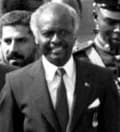
Canaan Banana
Politician · Modern
38.4Total

Napoleon Bonaparte
General · Modern
70.9Total
Basic Information
Born
1936
1769
Died
—
1821
Era
Modern
Modern
Nationality
Zimbabwe
France
Occupation
Politician
General
Civilization
Other
Western
Score Comparison
Military (10%)
48.1
94.0
Political (20%)
30.7
72.0
Influence (20%)
45.5
40.0
Legacy (20%)
35.0
80.0
Leadership (15%)
31.2
78.0
Strategy (15%)
42.2
90.0
TOTAL
38.4
70.9
Canaan Banana — Complete Timeline
1980 AD
Elected President of ZimbabwePolitical Action◆ Major
Canaan Banana was elected as the first President of independent Zimbabwe, a largely ceremonial role. He served as head of state while Robert Mugabe was Prime Minister.
PresidencyIndependence
Impact: national
1999 AD
Convicted of Sodomy and Sexual AssaultOther◆ Major
Banana was convicted on 11 counts of sodomy and sexual assault, committed against his male bodyguards and employees. He was sentenced to 10 years in prison, though he served only 18 months.
ConvictionSexual AssaultScandal
Impact: nationaldestructive
Napoleon Bonaparte — Complete Timeline
1799 AD
Coup of 18 BrumaireOther◆ Major
Napoleon Bonaparte, with support from his brother Lucien and key political figures, overthrew the Directory in a bloodless coup. He established the Consulate with himself as First Consul, effectively becoming the ruler of France. This event ended the French Revolution's most unstable period.
French RevolutionCoupRise to Power
Impact: regional
1804 AD
Promulgation of the Napoleonic CodeOther◆ Major
Napoleon enacted the Civil Code of the French, known as the Napoleonic Code, a comprehensive set of laws that replaced the fragmented feudal legal systems. The code established legal equality, protected property rights, and secularized law. It became the basis for legal systems in many European and world countries.
Legal ReformNapoleonic CodeCivil Law
Impact: globalconstructive
1805 AD
Battle of AusterlitzWar◆ Major
Napoleon's Grande Arm
Napoleonic WarsBattleDecisive Victory
Impact: global
1812 AD
Invasion of RussiaWar◆ Major
Napoleon led the Grande Arm
Napoleonic WarsInvasionDisaster
Impact: globaldestructive
1815 AD
Battle of WaterlooWar◆ Major
Napoleon's French army was defeated by the combined forces of the Duke of Wellington's Anglo-Allied army and Gebhard Leberecht von Bl
Napoleonic WarsBattleFinal Defeat
Impact: globaldestructive
Expert Analysis
canaan-banana-vs-napoleon-bonaparte
The Emperor and the Pastor: Two Lives That Defined Power’s Extremes
On a June morning in 1815, Napoleon Bonaparte watched his Imperial Guard advance for the last time across the muddy fields of Waterloo. The sun had dried the ground after a night of rain, but it could not dry the blood that would soon soak it. Half a world away and a century and a half later, Canaan Banana stood before a cheering crowd in Salisbury—soon to be Harare—as the first President of independent Zimbabwe. One man commanded the greatest army Europe had ever seen; the other led a nation from a ceremonial chair. Both rose from obscurity to the pinnacle of power. Both fell into disgrace. Yet the chasm between them is not merely one of scale—it is one of substance, of character, and of the very meaning of leadership.
Origins
Napoleon was born in 1769 on the island of Corsica, a recent French acquisition. His family was minor nobility, poor but proud. He spoke Italian before French, and his accent would mark him as an outsider for life. Yet France’s revolutionary turmoil gave him what birth could not: opportunity. The old aristocracy fled or lost their heads; the army needed officers, and a young artilleryman with a gift for mathematics and a hunger for glory found his path.
Canaan Banana was born in 1936 in what was then Southern Rhodesia, a British colony ruled by a white minority. His father was a farmer, his mother a homemaker. He became a Methodist minister, a path of moral authority rather than military might. Where Napoleon learned to command cannons, Banana learned to command congregations. The difference in their origins is not just geography—it is the difference between a world that rewarded conquest and a world that demanded patience.
Rise to Power
Napoleon’s ascent was a lightning bolt. In 1793, at age 24, he drove the British out of Toulon with a daring artillery plan. By 1796, he commanded the Army of Italy, winning battle after battle against the Austrians. He was not yet thirty when he seized power in the 1799 coup of 18 Brumaire. His rise was violent, swift, and entirely self-made.
Canaan Banana’s rise was slower, quieter, and negotiated. He was not a guerrilla commander like Robert Mugabe; he was a pastor who preached against colonial rule. When Zimbabwe gained independence in 1980, the new nation needed a figurehead—someone uncontroversial, a symbol of unity. Banana was elected President in 1980, but the real power lay with Prime Minister Mugabe. His political score of 42.7 reflects a man who reached the top not by seizing the throne, but by being placed upon it.
Leadership & Governance
Napoleon governed as he conquered: with relentless energy and absolute control. His Napoleonic Code standardized French law, abolished feudal privileges, and established merit-based advancement. He built roads, founded schools, and stabilized the currency. But he also suppressed dissent, censored the press, and crowned himself Emperor in 1804. His military score of 94.0 and strategy of 93.0 speak of a genius who could win battles but could not win peace.
Canaan Banana’s presidency was ceremonial by design. He opened parliament, hosted dignitaries, and signed bills. His leadership score of 39.2 suggests a man who did not lead so much as occupy a role. Yet in that role, he provided moral cover for a government that soon became authoritarian. When Mugabe turned his North Korean-trained brigade against the Ndebele people in the 1980s, Banana did not stop it. His governance was not tyranny—it was abdication.
Triumph & Tragedy
Napoleon’s greatest moment was perhaps Austerlitz in 1805, where he crushed the Russian and Austrian armies in a masterpiece of deception and timing. His tragedy was the invasion of Russia in 1812, where he lost half a million men to winter, disease, and guerrilla attacks. Exiled to Elba, he returned for a Hundred Days, only to meet final defeat at Waterloo in 1815. He died in 1821 on Saint Helena, a British prisoner.
Canaan Banana’s triumph was symbolic: standing on the podium in 1980 as Zimbabwe’s first black head of state, a moment of hope after decades of war. His tragedy was personal and sordid. In 1999, he was convicted on 11 counts of sodomy and sexual assault against his male bodyguards and employees. The man who had once represented national unity was sentenced to prison, his moral authority shattered. He died in 2003, largely forgotten.
Character & Destiny
Napoleon’s character was a furnace of ambition. “Power is my mistress,” he once said. He believed he could impose order on chaos through sheer will. That will built an empire and destroyed it. His personality—restless, brilliant, arrogant—drove him to overreach. He could not stop because he could not imagine limits.
Canaan Banana’s character is harder to read. He was a minister who preached righteousness but lived duplicity. His conviction suggests a man who abused trust in the most intimate way. Where Napoleon’s flaw was hubris, Banana’s was hypocrisy. One destroyed nations; the other destroyed his own soul.
Legacy
Napoleon’s legacy is written in the laws of Europe. The Napoleonic Code influenced civil law across the continent and beyond. He reshaped borders, toppled old regimes, and unleashed nationalism that would define the next century. His legacy score of 78.0 reflects a man who changed the world, for better and worse.
Canaan Banana’s legacy is a footnote. His influence score of 59.8 is generous; most Zimbabweans remember him only as the president before Mugabe, or as a cautionary tale about power and secrecy. He left no laws, no institutions, no enduring symbol. His name became a cruel joke.
Conclusion
What separates Napoleon from Canaan Banana is not intelligence or opportunity—it is the scale of the stage and the weight of the role. Napoleon was a force of history, a man who bent events to his will until events broke him. Banana was a placeholder, a man who filled a seat but never filled the moment. One created a code that outlasted his empire; the other created only shame. In their different falls, both reveal a truth about power: it does not make a man great. It only reveals what he already is.
Rankings
🥇
Napoleon BonaparteLeader
Mil: 94.0Pol: 72.0Inf: 40.0
70.9
🥈
Canaan Banana
Mil: 48.1Pol: 30.7Inf: 45.5
38.4
+32.5 behind
How This Comparison Works
Algorithm
Each figure is scored on 6 dimensions (0—100 scale) based on structured historical data: Military (10%), Political (20%), Influence (20%), Legacy (20%), Leadership (15%), Strategy (15%). The weighted total produces the final ranking.
Data Sources
Scores are computed from structured sub-indicators in the database. Scale factors adjust for era (Ancient ×0.85, Modern ×1.0) and civilization size (Eastern ×1.05, Other ×0.80) to account for differences in population and military scale.
Maximum 3 Figures
Comparisons are limited to 2—3 figures to ensure readability and statistical meaningfulness.
Error Margins
±5 points per dimension — Sub-scores are derived from historical records with inherent uncertainty. Two figures within 5 points on a dimension should be considered roughly equivalent in that area.
Total Score Accuracy
±3 points overall — The weighted combination of 6 dimensions produces a total score with approximately ±3 points of uncertainty. Differences of less than 3 points are not statistically significant— the figures are effectively tied.
Known Limitations
- Historical records are incomplete and uneven across civilizations
- Figures from oral-tradition societies may be underrepresented
- Occupation labels can misclassify multi-role figures
- Scores measure capability and impact, not moral character
- Quantitative scoring is a comparison tool, not absolute truth
Capability Radar
Military (10%) — Battles & Warfare
Battles
24
95
Win Rate
23
90
Expansion
28
95
Political (20%) — Governance & Reform
Reform
5
95
Diplomacy
10
80
Economy
5
85
Influence (20%) — Cultural & Global Reach
Cultural
5
85
Global
5
90
Legacy (20%) — Historical Impact
Historical
5
95
Longevity
5
90
Leadership (15%) — Power & Stability
Tenure
10
85
Stability
5
70
Strategy (15%) — Tactics & Innovation
Strategy
31
95
Tactics
33
98
Reform
37
92
Similar Comparisons
Comments & Discussion
Bastard of Destiny6/17/2026
Comparing a Methodist pastor to Napoleon is like comparing a firecracker to a supernova. Banana was a ceremonial figurehead whose greatest legacy is a constitutional dispute and his name being a punchline. Napoleon rewrote Europe’s map, legal codes, and military doctrine. One commanded armies that fought from Egypt to Moscow; the other presided over a government that couldn't keep its own credit rating. Scale isn't everything, but when the difference is between conquering nations and getting arr
汉尼拔的叹息6/17/2026
拿破仑和香蕉?这是把狮子和仓鼠放在一个笼子里比较。香蕉不过是国际政治的木偶,象征性总统,1936年生人,独立后靠姆加贝提线才能动。拿破仑呢?从炮兵少尉一路杀到皇帝,连战六次反法同盟还能让欧洲震颤。香蕉的历史地位连给拿破仑擦靴子都不配——不如想想滑铁卢那天,要是法军有更好的元帅,世界会怎样。
Skeptic6/17/2026
I smell revisionist garbage. Banana's "accomplishments" include being forced out by Mugabe in a coup and later convicted of sodomy. That's not "falling from power" - that's being too weak to hold it. Napoleon was exiled twice by hostile coalitions, not his own lieutenants. The comparison ignores they both had embarrassing sexual scandals, but Napoleon's affairs produced dynastic heirs, not criminal charges. Different weight classes entirely. This analysis cherry-picks "both fell from grace" to p
历史课代表6/17/2026
两位都是时代巨浪里的小人物翻身,这没错。但拿破仑的革命遗产——法典、教育体系、行政改革——至今仍在欧洲运转。香蕉呢?他1987年被迫辞职后,津巴布韦就走向经济崩溃和恶性通胀,现在连面包都要外汇。如果领袖是建筑灵魂的人,那拿破仑建了一座能住几百年的宫殿,香蕉盖的却是茅草屋,一吹就倒。
Machiavelli's Ghost6/17/2026
Both understood power, but only one knew how to wield it. Napoleon cultivated a meritocracy that turned peasants into marshals. Banana presided over a one-party state where his own vice president couped him. Napoleon's military genius is undeniable: 60 battles lost only 7. Banana's entire political career was dependent on Mugabe's support. The comparison reveals a fundamental truth: political power that isn't backed by steel is just pageantry. Napoleon ruled by will; Banana by permission.