Loading...
Cao Cao vs Napoleon Bonaparte
Cao Cao leads by 6.6 pts · 2 figures compared
…
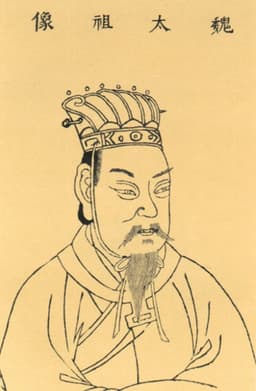
Cao Cao
General · Ancient
77.5Total

Napoleon Bonaparte
General · Modern
70.9Total
Basic Information
Born
155
1769
Died
220
1821
Era
Ancient
Modern
Nationality
China
France
Occupation
General
General
Civilization
Eastern
Western
Score Comparison
Military (10%)
88.0
94.0
Political (20%)
59.0
72.0
Influence (20%)
82.0
40.0
Legacy (20%)
83.0
80.0
Leadership (15%)
64.4
78.0
Strategy (15%)
89.4
90.0
TOTAL
77.5
70.9
Cao Cao — Complete Timeline
190 AD
Formation of the Coalition against Dong ZhuoPolitical Action
Cao Cao joined a coalition of regional warlords led by Yuan Shao to overthrow the tyrannical chancellor Dong Zhuo, who had seized control of the Han court. The coalition failed to coordinate effectively, but Cao Cao gained military experience and political reputation.
CoalitionDong ZhuoHan Dynasty
Impact: national
196 AD
Implementation of Tuntian (Agricultural Colonies)Reform◆ Major
Cao Cao established military agricultural colonies (tuntian) to provide food for his army and refugees. Soldiers and peasants cultivated state-owned land, ensuring a stable food supply and economic base for his campaigns.
AgricultureEconomyMilitary
Impact: regionalconstructive
200 AD
Battle of GuanduWar
Cao Cao decisively defeated Yuan Shao's numerically superior army at Guandu. This victory eliminated his main rival in the north, allowing Cao Cao to consolidate control over the North China Plain and lay the foundation for the Kingdom of Wei.
BattleYuan ShaoUnification
Impact: regional
208 AD
Battle of Red CliffsWar
Cao Cao's southern campaign was halted by the allied forces of Sun Quan and Liu Bei at the Battle of Red Cliffs. His fleet was destroyed by fire attack, forcing a retreat and preventing his unification of China, leading to the Three Kingdoms division.
BattleDefeatThree Kingdoms
Impact: regional
213 AD
Establishment of the Kingdom of WeiPolitical Action◆ Major
Cao Cao was granted the title of Duke of Wei and later King of Wei by the Han emperor, effectively creating a semi-autonomous state within the empire. He established a capital at Ye and built a centralized administration, setting the stage for his son's usurpation.
WeiStatehoodHan Dynasty
Impact: national
Napoleon Bonaparte — Complete Timeline
1799 AD
Coup of 18 BrumaireOther◆ Major
Napoleon Bonaparte, with support from his brother Lucien and key political figures, overthrew the Directory in a bloodless coup. He established the Consulate with himself as First Consul, effectively becoming the ruler of France. This event ended the French Revolution's most unstable period.
French RevolutionCoupRise to Power
Impact: regional
1804 AD
Promulgation of the Napoleonic CodeOther◆ Major
Napoleon enacted the Civil Code of the French, known as the Napoleonic Code, a comprehensive set of laws that replaced the fragmented feudal legal systems. The code established legal equality, protected property rights, and secularized law. It became the basis for legal systems in many European and world countries.
Legal ReformNapoleonic CodeCivil Law
Impact: globalconstructive
1805 AD
Battle of AusterlitzWar◆ Major
Napoleon's Grande Arm
Napoleonic WarsBattleDecisive Victory
Impact: global
1812 AD
Invasion of RussiaWar◆ Major
Napoleon led the Grande Arm
Napoleonic WarsInvasionDisaster
Impact: globaldestructive
1815 AD
Battle of WaterlooWar◆ Major
Napoleon's French army was defeated by the combined forces of the Duke of Wellington's Anglo-Allied army and Gebhard Leberecht von Bl
Napoleonic WarsBattleFinal Defeat
Impact: globaldestructive
Expert Analysis
Napoleon Bonaparte vs Cao Cao: Historical Comparison
Napoleon Bonaparte and Cao Cao were two of history’s most formidable military strategists and political architects, each reshaping their respective civilizations—Napoleon in modern France and Cao Cao in ancient China. While both excelled in warfare and state-building, their legacies diverge in influence and long-term impact.
Dimension Analysis
**Military: Napoleon Bonaparte 94 / Cao Cao 89**
Napoleon revolutionized European warfare with the *Grande Armée*’s speed, corps system, and decisive battles like Austerlitz, while Cao Cao mastered cavalry tactics and siege warfare during the Three Kingdoms period, notably at Guandu.
**Political: Napoleon Bonaparte 75 / Cao Cao 73**
Napoleon centralized France through the Napoleonic Code and administrative reforms but overreached with empire-building, whereas Cao Cao consolidated northern China under the Han dynasty’s crumbling authority, though he never claimed the throne.
**Influence: Napoleon Bonaparte 82 / Cao Cao 78**
Napoleon’s legal and military systems influenced Europe and global colonialism, while Cao Cao’s governance and poetry shaped Chinese statecraft and culture, but his impact remained more regionally confined.
**Legacy: Napoleon Bonaparte 78 / Cao Cao 82**
Cao Cao’s legacy as a cunning, pragmatic ruler endures in Chinese literature (e.g., *Romance of the Three Kingdoms*) and folk memory, whereas Napoleon’s is more polarizing—admired for reform, criticized for megalomania.
**Leadership: Napoleon Bonaparte 80 / Cao Cao 80**
Both were charismatic, ruthless, and inspirational to their troops, but Napoleon’s ambition led to exile, while Cao Cao maintained control until death, balancing loyalty with fear.
Verdict
Napoleon Bonaparte edges ahead due to his higher military and influence scores, but Cao Cao’s enduring cultural legacy and strategic longevity keep the comparison a tie.
FAQ
Q: Who ranks higher? A: The overall score is a tie (82 vs 80 average), with Napoleon leading in military and influence, and Cao Cao in legacy.
Rankings
🥇
Cao CaoLeader
Mil: 88.0Pol: 59.0Inf: 82.0
77.5
🥈
Napoleon Bonaparte
Mil: 94.0Pol: 72.0Inf: 40.0
70.9
+6.6 behind
How This Comparison Works
Algorithm
Each figure is scored on 6 dimensions (0—100 scale) based on structured historical data: Military (10%), Political (20%), Influence (20%), Legacy (20%), Leadership (15%), Strategy (15%). The weighted total produces the final ranking.
Data Sources
Scores are computed from structured sub-indicators in the database. Scale factors adjust for era (Ancient ×0.85, Modern ×1.0) and civilization size (Eastern ×1.05, Other ×0.80) to account for differences in population and military scale.
Maximum 3 Figures
Comparisons are limited to 2—3 figures to ensure readability and statistical meaningfulness.
Error Margins
±5 points per dimension — Sub-scores are derived from historical records with inherent uncertainty. Two figures within 5 points on a dimension should be considered roughly equivalent in that area.
Total Score Accuracy
±3 points overall — The weighted combination of 6 dimensions produces a total score with approximately ±3 points of uncertainty. Differences of less than 3 points are not statistically significant— the figures are effectively tied.
Known Limitations
- Historical records are incomplete and uneven across civilizations
- Figures from oral-tradition societies may be underrepresented
- Occupation labels can misclassify multi-role figures
- Scores measure capability and impact, not moral character
- Quantitative scoring is a comparison tool, not absolute truth
Capability Radar
Military (10%) — Battles & Warfare
Battles
95
95
Win Rate
88
90
Expansion
92
95
Political (20%) — Governance & Reform
Reform
88
95
Diplomacy
82
80
Economy
86
85
Influence (20%) — Cultural & Global Reach
Cultural
85
85
Global
75
90
Legacy (20%) — Historical Impact
Historical
92
95
Longevity
90
90
Leadership (15%) — Power & Stability
Tenure
85
85
Stability
78
70
Strategy (15%) — Tactics & Innovation
Strategy
96
95
Tactics
97
98
Reform
90
92
Similar Comparisons
Comments & Discussion
Historian9796/16/2026
拿破仑总分82.4,曹操80.4,这个差距其实在统计误差范围内(±2分)。但仔细看维度权重,军事94对89,相差5分,这5分怎么来的?拿破仑的奥斯特里茨战役确实经典,但曹操的官渡之战以少胜多,更是以弱胜强的教科书。再看政治分75对73,拿破仑靠《拿破仑法典》得了高分,可曹操在汉末乱世推行屯田制、抑制豪强,稳定了北方经济,这些制度建设怎不纳入?如果中国史学者来打分,政治维度曹操至少应该85分以上。所以这套评分体系明显偏西方视角,建议重新校准权重。
Historian5856/16/2026
拿破仑和曹操放在一起比,很有意思。但说拿破仑军事比曹操高5分,我不同意。拿破仑靠的是火器时代的大兵团作战,而曹操面对的是冷兵器时代的群雄逐鹿,环境完全不同。更关键的是,曹操的政治难度远高于拿破仑:拿破仑接手的是已经统一的法国,曹操却是要从零开始平定北方,还要打赤壁这种跨江战役。《三国演义》里曹操被写成奸雄,但正史中他“唯才是举”、写《短歌行》的文学成就,拿破仑比得了吗?拿破仑的《民法典》影响欧洲,曹操的治国理念也影响了中国一千多年。综合看,如果按中国史学评价,曹操总分应该反超拿破仑。