Loading...
Carlos Arana Osorio vs Francisco Franco
Francisco Franco leads by 15.4 pts · 2 figures compared
…

Carlos Arana Osorio
General · Modern
46.5Total
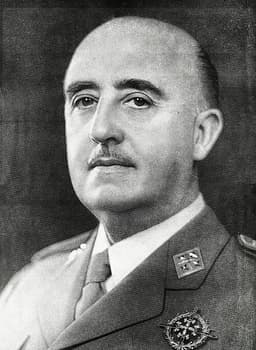
Francisco Franco
General · Modern
61.9Total
Basic Information
Born
1918
1892
Died
2003
1975
Era
Modern
Modern
Nationality
Guatemala
Spain
Occupation
General
General
Civilization
Western
Western
Score Comparison
Military (10%)
45.0
52.5
Political (20%)
32.2
68.0
Influence (20%)
48.6
56.7
Legacy (20%)
41.7
58.0
Leadership (15%)
57.6
78.0
Strategy (15%)
60.0
60.7
TOTAL
46.5
61.9
Carlos Arana Osorio — Complete Timeline
1967 AD
Led the 'Butcher of Zacapa' CampaignWar◆ Major
As military commander in eastern Guatemala, Arana led a counterinsurgency campaign in Zacapa that resulted in the massacre of thousands of civilians. The campaign earned him the nickname 'Butcher of Zacapa' and set a precedent for state terror.
CounterinsurgencyMassacreHuman Rights
Impact: regionaldestructive
1970 AD
Became President of GuatemalaPolitical Action◆ Major
Carlos Arana Osorio assumed the presidency of Guatemala after winning a rigged election. A general known for his brutal counterinsurgency tactics, he was the first of a series of military rulers during the country's civil war.
PresidencyGuatemalaMilitary Rule
Impact: national
Implemented State of SiegePolitical Action◆ Major
Arana declared a state of siege upon taking office, suspending civil liberties and granting the military sweeping powers. The regime carried out widespread arrests, torture, and executions of political opponents and suspected guerrillas.
State of SiegeRepressionAuthoritarianism
Impact: nationaldestructive
Francisco Franco — Complete Timeline
1936 AD
Appointed Generalissimo and Head of StatePolitical Action◆ Major
On October 1, 1936, the Nationalist faction appointed Francisco Franco as Generalissimo and Head of State of the Spanish State. This consolidated his leadership over the Nationalist forces during the Spanish Civil War, giving him supreme military and political authority.
Spanish Civil WarNationalist FactionLeadership
Impact: national
1939 AD
Declared Victory in the Spanish Civil WarOther◆ Major
On April 1, 1939, Franco announced the end of the Spanish Civil War after the Nationalist forces captured Madrid and the last Republican strongholds. This victory established Franco as the undisputed dictator of Spain, leading to a regime that lasted until his death.
Spanish Civil WarDictatorshipVictory
Impact: nationaldestructive
1947 AD
Signed the Law of SuccessionReform◆ Major
Franco enacted the Law of Succession in 1947, which declared Spain a monarchy but left Franco as regent for life with the power to choose his successor. This law institutionalized his personal rule and ensured the continuity of his regime after his death.
SuccessionMonarchyRegime Consolidation
Impact: national
1959 AD
Opened Spain to Foreign InvestmentOther◆ Major
In 1959, Franco approved the Stabilization Plan, which liberalized the Spanish economy, ended autarky, and opened Spain to foreign investment and tourism. This led to the 'Spanish Miracle' of rapid economic growth in the 1960s, transforming Spain from a poor agrarian country to a modern industrial economy.
Economic ReformStabilization PlanGrowth
Impact: nationalconstructive
1969 AD
Appointed Juan Carlos as SuccessorPolitical Action◆ Major
In 1969, Franco formally designated Prince Juan Carlos de Borb
SuccessionMonarchyTransition
Impact: national
Expert Analysis
Origins
Carlos Arana Osorio was born in 1918 in Guatemala, the son of a military officer. He entered the Guatemalan army and rose through the ranks, receiving training in counterinsurgency at the School of the Americas. His early career was shaped by the Cold War context and the U.S. support for anti-communist regimes in Latin America. Francisco Franco was born in 1892 in Ferrol, Spain, into a naval family. He attended the Infantry Academy in Toledo and served in colonial wars in Morocco, where he gained a reputation for efficiency and ruthlessness. Franco's formative years were marked by military discipline and conservative Catholic values.
Rise to Power
Arana came to prominence during the Guatemalan Civil War. In 1966, he was appointed military commander of the Zacapa region, where he launched a brutal counterinsurgency campaign against leftist guerrillas. His tactics included massacres of civilians, forced displacement, and a scorched-earth policy, earning him the nickname "Butcher of Zacapa." In 1970, he won a rigged presidential election, taking office on July 1, 1970. Franco's rise began during the Spanish Civil War (1936-1939). He led the Army of Africa, the most effective Nationalist force, and was appointed Generalissimo and Head of State on October 1, 1936. By April 1, 1939, he had declared victory, consolidating power through the suppression of Republicans and the establishment of a dictatorship.
Leadership & Governance
Arana's leadership was characterized by extreme repression. Upon taking office, he declared a state of siege, suspending civil liberties and granting the military sweeping powers. His regime carried out widespread human rights abuses, including forced disappearances, torture, and extrajudicial killings. He scored 57.6 in leadership and 32.2 in political, reflecting his reliance on force over political skill. Franco's governance was more institutionalized. He established a corporatist state, banning opposition parties and trade unions, but also enacted the Law of Succession in 1947, which declared Spain a monarchy with himself as regent for life. He scored 78.0 in leadership and 68.0 in political, indicating a more stable and enduring regime. Economically, Franco shifted from autarky to liberalization with the 1959 Stabilization Plan, opening Spain to foreign investment, while Arana's economic policies were less notable.
Triumph & Tragedy
Arana's greatest success was his perceived victory against the guerrilla insurgency in the early 1970s, but his legacy is marred by the massacre of thousands of civilians. His regime's human rights record led to international condemnation and long-term instability. He scored 45.0 in military and 60.0 in strategy, reflecting tactical success but strategic failure in terms of national reconciliation. Franco's triumphs include winning the Civil War and maintaining power for 36 years, as well as overseeing economic modernization in the 1960s. However, his regime was built on the suppression of political freedoms and left deep divisions in Spanish society. He scored 52.5 in military and 60.7 in strategy, with a higher overall influence score of 56.7.
Character & Destiny
Arana was known for his ruthlessness and lack of political vision. His decision to use maximum force against civilians alienated the population and created a legacy of fear. His total score of 46.5 reflects a relatively minor historical figure. Franco was a cautious and calculating leader, adept at navigating internal and external pressures. His decision to appoint Juan Carlos as successor in 1969 ensured a transition to democracy after his death, which partially redeemed his legacy. Franco's total score of 61.9 indicates a more significant and complex figure.
Legacy
Arana's legacy is synonymous with state terror in Guatemala. His tactics set a precedent for later governments and contributed to the long civil war that lasted until 1996. He is remembered negatively, with his name associated with the worst abuses of the Guatemalan military. Franco's legacy is more contested. He is criticized for his authoritarian rule but also credited with modernizing Spain's economy and ensuring a peaceful transition to democracy. His influence score of 56.7 reflects his enduring impact on Spanish politics.
Conclusion
Francisco Franco had a greater impact than Carlos Arana Osorio, as reflected in his total score of 61.9 versus 46.5. Franco's rule lasted longer, affected a larger population, and shaped Spain's modern history, including its transition to democracy. Arana's impact was more localized and ultimately destabilizing for Guatemala. While both were brutal dictators, Franco's political and strategic skills allowed him to build a more enduring, if repressive, regime.
Rankings
🥇
Francisco FrancoLeader
Mil: 52.5Pol: 68.0Inf: 56.7
61.9
🥈
Carlos Arana Osorio
Mil: 45.0Pol: 32.2Inf: 48.6
46.5
+15.4 behind
How This Comparison Works
Algorithm
Each figure is scored on 6 dimensions (0—100 scale) based on structured historical data: Military (10%), Political (20%), Influence (20%), Legacy (20%), Leadership (15%), Strategy (15%). The weighted total produces the final ranking.
Data Sources
Scores are computed from structured sub-indicators in the database. Scale factors adjust for era (Ancient ×0.85, Modern ×1.0) and civilization size (Eastern ×1.05, Other ×0.80) to account for differences in population and military scale.
Maximum 3 Figures
Comparisons are limited to 2—3 figures to ensure readability and statistical meaningfulness.
Error Margins
±5 points per dimension — Sub-scores are derived from historical records with inherent uncertainty. Two figures within 5 points on a dimension should be considered roughly equivalent in that area.
Total Score Accuracy
±3 points overall — The weighted combination of 6 dimensions produces a total score with approximately ±3 points of uncertainty. Differences of less than 3 points are not statistically significant— the figures are effectively tied.
Known Limitations
- Historical records are incomplete and uneven across civilizations
- Figures from oral-tradition societies may be underrepresented
- Occupation labels can misclassify multi-role figures
- Scores measure capability and impact, not moral character
- Quantitative scoring is a comparison tool, not absolute truth
Capability Radar
Military (10%) — Battles & Warfare
Battles
30
65
Win Rate
35
70
Expansion
10
20
Political (20%) — Governance & Reform
Reform
15
40
Diplomacy
20
50
Economy
15
45
Influence (20%) — Cultural & Global Reach
Cultural
10
40
Global
10
55
Legacy (20%) — Historical Impact
Historical
25
60
Longevity
15
55
Leadership (15%) — Power & Stability
Tenure
50
90
Stability
10
55
Strategy (15%) — Tactics & Innovation
Strategy
35
65
Tactics
40
60
Reform
20
55
Similar Comparisons
Comments & Discussion
No comments yet. Be the first to share your thoughts!