Loading...
Francisco Franco vs Moussa Traore
Francisco Franco leads by 14.9 pts · 2 figures compared
…
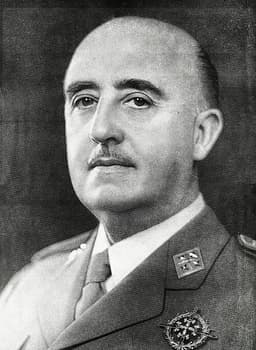
Francisco Franco
General · Modern
61.9Total

Moussa Traore
General · Modern
47.0Total
Basic Information
Born
1892
1936
Died
1975
—
Era
Modern
Modern
Nationality
Spain
Mali
Occupation
General
General
Civilization
Western
Other
Score Comparison
Military (10%)
52.5
50.0
Political (20%)
68.0
36.5
Influence (20%)
56.7
51.0
Legacy (20%)
58.0
40.8
Leadership (15%)
78.0
65.0
Strategy (15%)
60.7
38.6
TOTAL
61.9
47.0
Francisco Franco — Complete Timeline
1936 AD
Appointed Generalissimo and Head of StatePolitical Action◆ Major
On October 1, 1936, the Nationalist faction appointed Francisco Franco as Generalissimo and Head of State of the Spanish State. This consolidated his leadership over the Nationalist forces during the Spanish Civil War, giving him supreme military and political authority.
Spanish Civil WarNationalist FactionLeadership
Impact: national
1939 AD
Declared Victory in the Spanish Civil WarOther◆ Major
On April 1, 1939, Franco announced the end of the Spanish Civil War after the Nationalist forces captured Madrid and the last Republican strongholds. This victory established Franco as the undisputed dictator of Spain, leading to a regime that lasted until his death.
Spanish Civil WarDictatorshipVictory
Impact: nationaldestructive
1947 AD
Signed the Law of SuccessionReform◆ Major
Franco enacted the Law of Succession in 1947, which declared Spain a monarchy but left Franco as regent for life with the power to choose his successor. This law institutionalized his personal rule and ensured the continuity of his regime after his death.
SuccessionMonarchyRegime Consolidation
Impact: national
1959 AD
Opened Spain to Foreign InvestmentOther◆ Major
In 1959, Franco approved the Stabilization Plan, which liberalized the Spanish economy, ended autarky, and opened Spain to foreign investment and tourism. This led to the 'Spanish Miracle' of rapid economic growth in the 1960s, transforming Spain from a poor agrarian country to a modern industrial economy.
Economic ReformStabilization PlanGrowth
Impact: nationalconstructive
1969 AD
Appointed Juan Carlos as SuccessorPolitical Action◆ Major
In 1969, Franco formally designated Prince Juan Carlos de Borb
SuccessionMonarchyTransition
Impact: national
Moussa Traore — Complete Timeline
1968 AD
Led the 1968 Coup d'ÉtatPolitical Action
Moussa Traor
CoupMilitary Rule
Impact: nationaldestructive
1974 AD
Established a One-Party StatePolitical Action◆ Major
Traoré introduced a new constitution that established the Democratic Union of the Malian People as the sole legal party. This consolidated his authoritarian rule and suppressed political opposition.
One-Party StateAuthoritarianism
Impact: nationaldestructive
1979 AD
Re-elected in Single-Party ElectionsPolitical Action
Traoré was re-elected as president in a single-party election with 99.9% of the vote. The election was not competitive, and Traoré continued his repressive rule.
ElectionAuthoritarianism
Impact: national
1991 AD
Overthrown in a Coup d'ÉtatPolitical Action
Traoré was overthrown by a military coup led by Amadou Toumani Touré after months of pro-democracy protests. The coup ended his 23-year rule and led to a transition to democracy.
CoupEnd of Rule
Impact: nationalconstructive
1993 AD
Sentenced to Death for Economic CrimesPolitical Action◆ Major
Traoré was sentenced to death for economic crimes committed during his rule. The sentence was later commuted to life imprisonment, and he was eventually pardoned in 1999.
TrialJustice
Impact: nationaldestructive
Expert Analysis
Origins
Francisco Franco was born on December 4, 1892, in Ferrol, Spain, into a naval family with a tradition of military service. His father was a naval officer, but the family's finances declined, leading Franco to enter the Infantry Academy at Toledo in 1907. He graduated in 1910 and served in colonial campaigns in Spanish Morocco, where he gained a reputation for discipline and bravery. His early career was marked by rapid promotion due to his effectiveness in counterinsurgency operations. Moussa Traoré was born on September 25, 1936, in Kayes, French Sudan (now Mali), into a peasant family. He attended local schools and later the École des Officiers in Fréjus, France, becoming a non-commissioned officer in the French colonial army. After Mali's independence in 1960, he joined the Malian army, rising through the ranks to become a lieutenant by 1968. His formative experiences were shaped by the colonial military structure and the post-independence political instability.
Rise to Power
Franco's rise began during the Spanish Civil War (1936-1939). On July 17-18, 1936, a military uprising against the Republican government failed to seize power nationwide, but Franco quickly emerged as a key leader. On October 1, 1936, he was appointed Generalissimo and Head of State by the Nationalist faction, consolidating his authority. With crucial support from Nazi Germany and Fascist Italy, Franco's forces gradually captured territory. By April 1, 1939, he declared victory after capturing Madrid, establishing a dictatorship that would last until his death. Traoré rose to power through a coup on November 19, 1968, overthrowing President Modibo Keïta. As a lieutenant, he led a group of junior officers who accused Keïta of corruption and mismanagement. Traoré suspended the constitution, banned political parties, and established the Military Committee for National Liberation (CMLN) as the supreme governing body. He became head of state and gradually centralized power, eliminating rivals within the military.
Leadership & Governance
Franco ruled Spain with an iron fist, suppressing political dissent through censorship, secret police, and executions. He established a one-party state under the Falange Española Tradicionalista, but his regime was more personalist than ideological. Economically, Franco initially pursued autarky, leading to stagnation. However, in 1959, he approved the Stabilization Plan, which liberalized the economy, opened Spain to foreign investment, and spurred growth. Politically, Franco enacted the Law of Succession in 1947, declaring Spain a monarchy but naming himself regent for life. In 1969, he appointed Prince Juan Carlos as his successor, ensuring a transition after his death. Traoré's governance was similarly authoritarian. He introduced a new constitution in 1974 that established the Democratic Union of the Malian People as the sole legal party. He was re-elected in single-party elections with 99.9% of the vote, a figure that underscores the lack of competition. Economically, Traoré pursued socialist policies, including state control of key industries, but mismanagement and drought led to economic decline. His regime was marked by corruption and human rights abuses, including the suppression of student protests and the execution of political opponents.
Triumph & Tragedy
Franco's greatest triumph was his victory in the Spanish Civil War and his ability to maintain power for 36 years, navigating World War II without being drawn into the conflict. His economic liberalization in the 1950s and 1960s brought modernization and growth, with Spain's GDP per capita rising significantly. However, his regime's tragedy was its brutal repression: thousands of political opponents were executed, and many more were imprisoned or exiled. The legacy of division and trauma persisted long after his death. Traoré's triumph was his initial stabilization of Mali after the chaotic post-independence period. He maintained power for 23 years, the longest of any Malian ruler. However, his tragedy was economic mismanagement that led to food shortages and a debt crisis. His human rights record was poor, with thousands of political prisoners and executions. Ultimately, he was overthrown in a coup on March 26, 1991, after months of pro-democracy protests. He was later sentenced to death for economic crimes, though the sentence was commuted.
Character & Destiny
Franco was known for his caution, pragmatism, and ruthlessness. He avoided direct involvement in World War II, playing both sides while maintaining neutrality. His decision-making was deliberate and often slow, but he was adept at balancing factions within his regime. His character shaped Spain's destiny by ensuring a peaceful transition to democracy after his death, as he had groomed Juan Carlos to succeed him. Traoré was more impulsive and less strategic. He relied on military force to suppress dissent but failed to build a sustainable political or economic system. His inability to adapt to changing circumstances, including the end of the Cold War and domestic pressures for democracy, led to his downfall. Historians assess Franco's regime as one of the longest-lasting dictatorships in Europe, while Traoré's is seen as a typical African strongman rule that brought little development.
Legacy
Franco's legacy is deeply controversial in Spain. His regime left a legacy of political repression and regional tensions, particularly in Catalonia and the Basque Country. However, the economic modernization he initiated laid the groundwork for Spain's later prosperity. The transition to democracy after his death, with Juan Carlos as king, is often cited as a model of peaceful change. Traoré's legacy is largely negative. Mali's economy remained underdeveloped, and his regime institutionalized corruption. The democratic transition that followed his overthrow was fragile, and Mali experienced coups and instability in subsequent decades. Traoré's scores reflect his limited impact: Military 50.0, Political 36.5, Influence 51.0, Legacy 40.8, Leadership 65.0, Strategy 38.6, Total 47.0. Franco's scores are higher: Military 52.5, Political 68.0, Influence 56.7, Legacy 58.0, Leadership 78.0, Strategy 60.7, Total 61.9.
Conclusion
Francisco Franco had a greater impact than Moussa Traoré, both in terms of duration and significance. Franco's total score of 61.9 is nearly 15 points higher than Traoré's 47.0. Franco shaped Spain's 20th-century trajectory, from civil war to economic modernization and eventual democracy. His influence extended beyond Spain's borders, as he was a key ally of the West during the Cold War. Traoré, by contrast, ruled a small, landlocked African nation with limited global influence. His regime failed to improve living standards or build stable institutions. While both were authoritarian leaders, Franco's longer rule, greater strategic acumen, and more significant economic reforms mark him as the more consequential figure. Traoré's legacy is one of missed opportunities and repression, and his impact was largely confined to Mali's internal politics.
Rankings
🥇
Francisco FrancoLeader
Mil: 52.5Pol: 68.0Inf: 56.7
61.9
🥈
Moussa Traore
Mil: 50.0Pol: 36.5Inf: 51.0
47.0
+14.9 behind
How This Comparison Works
Algorithm
Each figure is scored on 6 dimensions (0—100 scale) based on structured historical data: Military (10%), Political (20%), Influence (20%), Legacy (20%), Leadership (15%), Strategy (15%). The weighted total produces the final ranking.
Data Sources
Scores are computed from structured sub-indicators in the database. Scale factors adjust for era (Ancient ×0.85, Modern ×1.0) and civilization size (Eastern ×1.05, Other ×0.80) to account for differences in population and military scale.
Maximum 3 Figures
Comparisons are limited to 2—3 figures to ensure readability and statistical meaningfulness.
Error Margins
±5 points per dimension — Sub-scores are derived from historical records with inherent uncertainty. Two figures within 5 points on a dimension should be considered roughly equivalent in that area.
Total Score Accuracy
±3 points overall — The weighted combination of 6 dimensions produces a total score with approximately ±3 points of uncertainty. Differences of less than 3 points are not statistically significant— the figures are effectively tied.
Known Limitations
- Historical records are incomplete and uneven across civilizations
- Figures from oral-tradition societies may be underrepresented
- Occupation labels can misclassify multi-role figures
- Scores measure capability and impact, not moral character
- Quantitative scoring is a comparison tool, not absolute truth
Capability Radar
Military (10%) — Battles & Warfare
Battles
65
15
Win Rate
70
20
Expansion
20
10
Political (20%) — Governance & Reform
Reform
40
20
Diplomacy
50
30
Economy
45
15
Influence (20%) — Cultural & Global Reach
Cultural
40
20
Global
55
15
Legacy (20%) — Historical Impact
Historical
60
25
Longevity
55
20
Leadership (15%) — Power & Stability
Tenure
90
70
Stability
55
10
Strategy (15%) — Tactics & Innovation
Strategy
65
20
Tactics
60
15
Reform
55
25
Similar Comparisons
Comments & Discussion
No comments yet. Be the first to share your thoughts!