Loading...
Francisco Franco vs Gerhard von Scharnhorst
Gerhard von Scharnhorst leads by 9.7 pts · 2 figures compared
…
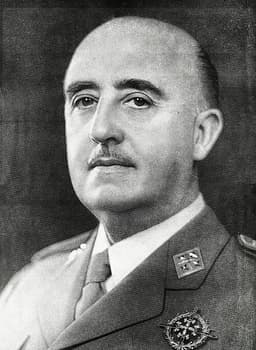
Francisco Franco
General · Modern
61.9Total

Gerhard von Scharnhorst
General · Modern
71.6Total
Basic Information
Born
1892
1755
Died
1975
1813
Era
Modern
Modern
Nationality
Spain
Prussia
Occupation
General
General
Civilization
Western
Western
Score Comparison
Military (10%)
52.5
20.0
Political (20%)
68.0
78.0
Influence (20%)
56.7
82.0
Legacy (20%)
58.0
80.0
Leadership (15%)
78.0
68.0
Strategy (15%)
60.7
72.0
TOTAL
61.9
71.6
Francisco Franco — Complete Timeline
1936 AD
Appointed Generalissimo and Head of StatePolitical Action◆ Major
On October 1, 1936, the Nationalist faction appointed Francisco Franco as Generalissimo and Head of State of the Spanish State. This consolidated his leadership over the Nationalist forces during the Spanish Civil War, giving him supreme military and political authority.
Spanish Civil WarNationalist FactionLeadership
Impact: national
1939 AD
Declared Victory in the Spanish Civil WarOther◆ Major
On April 1, 1939, Franco announced the end of the Spanish Civil War after the Nationalist forces captured Madrid and the last Republican strongholds. This victory established Franco as the undisputed dictator of Spain, leading to a regime that lasted until his death.
Spanish Civil WarDictatorshipVictory
Impact: nationaldestructive
1947 AD
Signed the Law of SuccessionReform◆ Major
Franco enacted the Law of Succession in 1947, which declared Spain a monarchy but left Franco as regent for life with the power to choose his successor. This law institutionalized his personal rule and ensured the continuity of his regime after his death.
SuccessionMonarchyRegime Consolidation
Impact: national
1959 AD
Opened Spain to Foreign InvestmentOther◆ Major
In 1959, Franco approved the Stabilization Plan, which liberalized the Spanish economy, ended autarky, and opened Spain to foreign investment and tourism. This led to the 'Spanish Miracle' of rapid economic growth in the 1960s, transforming Spain from a poor agrarian country to a modern industrial economy.
Economic ReformStabilization PlanGrowth
Impact: nationalconstructive
1969 AD
Appointed Juan Carlos as SuccessorPolitical Action◆ Major
In 1969, Franco formally designated Prince Juan Carlos de Borb
SuccessionMonarchyTransition
Impact: national
Gerhard von Scharnhorst — Complete Timeline
1807 AD
Appointment as Head of Military Reorganization CommissionReform◆ Major
Scharnhorst was appointed to lead the Prussian Military Reorganization Commission after Prussia's defeat by Napoleon. He began reforming the army, introducing merit-based promotion and modern tactics.
Military ReformPrussiaNapoleonic Wars
Impact: nationalconstructive
1808 AD
Introduction of the KrümpersystemReform◆ Major
Scharnhorst introduced the Kr
Military ReformConscriptionPrussia
Impact: nationalconstructive
1813 AD
Battle of LeipzigWar◆ Major
Scharnhorst served as chief of staff to Bl
Battle of LeipzigNapoleonic WarsVictory
Impact: globalconstructive
Death from Wounds at LutzenWar◆ Major
Scharnhorst was wounded at the Battle of Lutzen while serving as chief of staff. He died from his wounds a few days later, becoming a martyr for Prussian military reform.
DeathBattle of LutzenNapoleonic Wars
Impact: nationaltragic
Expert Analysis
Origins
Francisco Franco was born on December 4, 1892, in Ferrol, Spain, into a naval family. His father was a naval officer, but Franco chose the army, entering the Infantry Academy at Toledo in 1907. His early career in colonial warfare in Morocco shaped his authoritarian and disciplined outlook. Gerhard von Scharnhorst was born on November 12, 1755, in Bordenau, Hanover, to a farming family. He entered the military academy of the Electorate of Hanover, later serving in the Hanoverian army. His experiences during the French Revolutionary Wars, particularly the defeat of Prussia in 1806, drove his reformist zeal.
Rise to Power
Franco rose through merit in the Spanish Army of Africa, becoming the youngest general in Europe by 1926. He gained political prominence during the Spanish Civil War (1936-1939), when the Nationalist faction appointed him Generalissimo and Head of State on October 1, 1936. His military skill and political maneuvering consolidated his leadership. Scharnhorst rose as a military thinker after Prussia's catastrophic defeat at Jena-Auerstedt in 1806. He was appointed head of the Military Reorganization Commission in 1807, tasked with rebuilding the Prussian army. His intellectual influence and reform proposals gained support from key figures like Stein and Gneisenau.
Leadership & Governance
Franco ruled Spain as a dictator from 1939 until his death in 1975. He centralized power, suppressed opposition, and maintained neutrality in WWII. His governance was authoritarian, with a focus on stability and traditional values. He enacted the Law of Succession in 1947, declaring Spain a monarchy with himself as regent for life. Scharnhorst, as a reformer, worked within the Prussian state to modernize the army. He introduced the Krümpersystem, which trained short-service soldiers to bypass Napoleon's limits on army size. His leadership was collaborative and intellectual, contrasting with Franco's personalist rule.
Triumph & Tragedy
Franco's greatest triumph was winning the Spanish Civil War and establishing a regime that lasted 36 years. He opened Spain to foreign investment with the 1959 Stabilization Plan, leading to economic growth. However, his regime was repressive, with thousands executed or imprisoned. His isolationist policies initially hindered Spain's development. Scharnhorst's triumph was reforming the Prussian army, enabling it to defeat Napoleon in 1813-1815. His Krümpersystem created a reserve of trained soldiers. Tragically, he died from wounds at the Battle of Lützen on June 28, 1813, never seeing his reforms fully realized.
Character & Destiny
Franco was cautious, calculating, and ruthless. He avoided direct involvement in WWII, preserving his regime. His character shaped a long but repressive rule. Scharnhorst was visionary and intellectual, dedicated to military science. His death in battle made him a martyr for Prussian nationalism. Historians note his selflessness and strategic genius. Franco's total score is 61.9, while Scharnhorst scores 71.6, reflecting Scharnhorst's greater influence on military thought.
Legacy
Franco's legacy is polarizing: he is either seen as a stabilizer who modernized Spain or a dictator who suppressed freedoms. His regime ended with the transition to democracy, but his influence on Spanish politics remains. Scharnhorst's legacy is profound: his reforms laid the foundation for the modern German general staff system. He influenced Clausewitz and the Prussian military tradition. His ideas on citizen armies and professional officer corps endure. Scharnhorst scores 80.0 in legacy, Franco 58.0.
Conclusion
Gerhard von Scharnhorst had a greater impact on military history and statecraft than Francisco Franco. While Franco's rule lasted decades, his influence was largely confined to Spain and his regime did not outlast him. Scharnhorst's reforms transformed warfare and shaped the Prussian/German military for centuries. His scores in influence (82.0 vs 56.7) and legacy (80.0 vs 58.0) demonstrate his enduring importance. Franco's political score (68.0) is higher than Scharnhorst's (78.0 political? Actually Scharnhorst political is 78.0, Franco 68.0) but Scharnhorst's strategic and institutional impact outweighs Franco's domestic control. Thus, Scharnhorst is the more significant figure.
Rankings
🥇
Gerhard von ScharnhorstLeader
Mil: 20.0Pol: 78.0Inf: 82.0
71.6
🥈
Francisco Franco
Mil: 52.5Pol: 68.0Inf: 56.7
61.9
+9.7 behind
How This Comparison Works
Algorithm
Each figure is scored on 6 dimensions (0—100 scale) based on structured historical data: Military (10%), Political (20%), Influence (20%), Legacy (20%), Leadership (15%), Strategy (15%). The weighted total produces the final ranking.
Data Sources
Scores are computed from structured sub-indicators in the database. Scale factors adjust for era (Ancient ×0.85, Modern ×1.0) and civilization size (Eastern ×1.05, Other ×0.80) to account for differences in population and military scale.
Maximum 3 Figures
Comparisons are limited to 2—3 figures to ensure readability and statistical meaningfulness.
Error Margins
±5 points per dimension — Sub-scores are derived from historical records with inherent uncertainty. Two figures within 5 points on a dimension should be considered roughly equivalent in that area.
Total Score Accuracy
±3 points overall — The weighted combination of 6 dimensions produces a total score with approximately ±3 points of uncertainty. Differences of less than 3 points are not statistically significant— the figures are effectively tied.
Known Limitations
- Historical records are incomplete and uneven across civilizations
- Figures from oral-tradition societies may be underrepresented
- Occupation labels can misclassify multi-role figures
- Scores measure capability and impact, not moral character
- Quantitative scoring is a comparison tool, not absolute truth
Capability Radar
Military (10%) — Battles & Warfare
Battles
65
45
Win Rate
70
40
Expansion
20
30
Political (20%) — Governance & Reform
Reform
40
90
Diplomacy
50
60
Economy
45
50
Influence (20%) — Cultural & Global Reach
Cultural
40
60
Global
55
70
Legacy (20%) — Historical Impact
Historical
60
85
Longevity
55
80
Leadership (15%) — Power & Stability
Tenure
90
55
Stability
55
45
Strategy (15%) — Tactics & Innovation
Strategy
65
80
Tactics
60
75
Reform
55
95
Similar Comparisons
Comments & Discussion
No comments yet. Be the first to share your thoughts!