Loading...
Catherine de Medici vs Geoffrey Palmer
Catherine de Medici leads by 12.2 pts · 2 figures compared
…
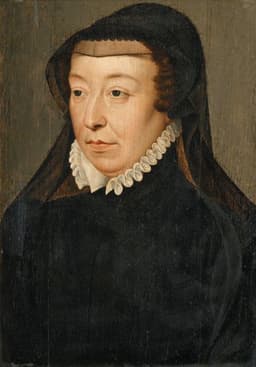
Catherine de Medici
Politician · Modern
60.0Total

Geoffrey Palmer
Politician · Modern
47.8Total
Basic Information
Born
1519
1942
Died
1589
—
Era
Modern
Modern
Nationality
France
New Zealand
Occupation
Politician
Politician
Civilization
Western
Western
Score Comparison
Military (10%)
43.3
50.0
Political (20%)
72.0
55.0
Influence (20%)
68.0
49.4
Legacy (20%)
55.0
41.7
Leadership (15%)
66.0
48.8
Strategy (15%)
42.3
44.2
TOTAL
60.0
47.8
Catherine de Medici — Complete Timeline
1560 AD
Appointed Regent for Charles IXPolitical Action◆ Major
After the death of her son Francis II, Catherine de Medici became regent for her ten-year-old son Charles IX. She assumed control of the French government during the early Wars of Religion, seeking to maintain royal authority and religious peace.
RegencyWars of ReligionPower
Impact: national
1562 AD
Edict of Saint-GermainPolitical Action◆ Major
Catherine issued the Edict of Saint-Germain, granting limited toleration to Huguenots and allowing them to worship outside towns. This edict aimed to reduce religious tensions but was rejected by Catholic hardliners, contributing to the outbreak of the First War of Religion.
EdictReligious TolerationWars of Religion
Impact: nationalconstructive
1572 AD
St. Bartholomew's Day MassacreOther
Catherine de Medici was implicated in the assassination of Huguenot leader Gaspard de Coligny, which triggered a wave of mob violence in Paris that killed thousands of Huguenots. The massacre spread to other cities and deepened the religious conflict in France.
MassacreReligious ViolenceHuguenots
Impact: nationaldestructive
1576 AD
Peace of MonsieurPolitical Action◆ Major
Catherine negotiated the Peace of Monsieur, which granted extensive concessions to Huguenots, including freedom of worship and fortified towns. The peace was opposed by the Catholic League and led to the formation of the Catholic League, escalating tensions.
Peace TreatyReligious TolerationCatholic League
Impact: national
Geoffrey Palmer — Complete Timeline
1989 AD
Appointed Prime Minister of New ZealandPolitical Action◆ Major
Geoffrey Palmer succeeded David Lange as Prime Minister of New Zealand on 8 August 1989. He took office during a period of economic reform under Rogernomics and internal Labour Party tensions.
New ZealandLabour PartySuccession
Impact: national
1990 AD
Passed the Bill of Rights Act 1990Reform◆ Major
As Prime Minister and a constitutional scholar, Palmer oversaw the passage of the New Zealand Bill of Rights Act 1990. This legislation affirmed fundamental rights and freedoms, though it was not entrenched as supreme law.
New ZealandHuman RightsLegislation
Impact: nationalconstructive
Lost the 1990 general electionPolitical Action◆ Major
Palmer led Labour into the 1990 general election against Jim Bolger's National Party. Labour suffered a heavy defeat, winning only 29 seats to National's 67, ending Palmer's tenure as Prime Minister after 16 months.
New ZealandElectionDefeat
Impact: nationaldestructive
2005 AD
Served as President of the Law CommissionPolitical Action
After leaving politics, Palmer served as President of the New Zealand Law Commission from 2005 to 2010. He continued to influence legal reform and constitutional issues, including advocating for a written constitution.
New ZealandLaw ReformConstitution
Impact: nationalconstructive
Expert Analysis
Origins
Catherine de Medici was born on 13 April 1519 in Florence, Italy, to Lorenzo de' Medici, Duke of Urbino, and Madeleine de La Tour d'Auvergne. Orphaned as an infant, she was raised by relatives in a politically turbulent Florence. At age 14, she married Henry, Duke of Orléans (later Henry II of France), cementing a Franco-Italian alliance. Her upbringing in the Medici court, known for its political intrigue and patronage of the arts, shaped her into a shrewd negotiator.
Geoffrey Palmer was born on 21 April 1942 in Nelson, New Zealand, to a farming family. He studied law at Victoria University of Wellington and later at the University of Chicago, where he earned a JSD. Palmer became a constitutional law professor, authoring influential texts on New Zealand's legal system. His academic background gave him expertise in governance but limited exposure to grassroots politics.
Rise to Power
Catherine de Medici became queen consort in 1547 when her husband ascended the throne as Henry II. However, her political influence began after Henry's death in 1559. Her eldest son, Francis II, reigned briefly, and when he died in 1560, Catherine became regent for her 10-year-old son Charles IX. She dominated French politics from 1560 to 1574, navigating the Wars of Religion between Catholics and Huguenots. Her rise was marked by a series of regencies and her role as queen mother, leveraging her sons' minority to wield power.
Geoffrey Palmer entered Parliament in 1979 as a Labour MP. He rapidly rose through the ranks due to his legal expertise, serving as Attorney-General, Minister of Justice, and Deputy Prime Minister under David Lange. When Lange resigned in 1989, Palmer succeeded him as Prime Minister on 8 August 1989. His rise was based on his intellectual credentials and loyalty to the Labour Party, but he lacked the popular appeal of his predecessor.
Leadership & Governance
Catherine de Medici's governance was characterized by pragmatic attempts to maintain royal authority amid religious conflict. She issued the Edict of Saint-Germain (1562), granting Huguenots limited toleration, and negotiated the Peace of Monsieur (1576), which gave extensive concessions. However, her willingness to use violence is exemplified by the St. Bartholomew's Day Massacre (1572), where she was implicated in the assassination of Huguenot leader Gaspard de Coligny, triggering mob violence that killed thousands. Her leadership scored 66.0, reflecting her ability to hold together a fractured kingdom through diplomacy and ruthlessness.
Geoffrey Palmer's leadership style was technocratic and reform-minded. As Prime Minister, he continued the economic reforms of Roger Douglas (Rogernomics), but his major achievement was the New Zealand Bill of Rights Act 1990, which affirmed fundamental rights. He also established the Law Commission. However, his governance was seen as aloof and indecisive; his political score of 55.0 reflects his limited success in maintaining public support. He lost the 1990 election in a landslide, with Labour winning only 29 seats against National's 67.
Triumph & Tragedy
Catherine de Medici's greatest triumph was preserving the French monarchy during the Wars of Religion, ensuring the Valois dynasty continued until her sons died. She successfully managed multiple regencies and negotiated temporary peaces. Her greatest tragedy was the St. Bartholomew's Day Massacre, which damaged her reputation and escalated the conflict. The massacre undermined her goal of religious coexistence and led to further bloodshed.
Geoffrey Palmer's triumph was the passage of the Bill of Rights Act, a landmark in New Zealand's constitutional development. His tragedy was his electoral defeat, which ended Labour's government and his political career. He scored 41.7 in legacy, reflecting the limited immediate impact of his reforms compared to his predecessors.
Character & Destiny
Catherine de Medici was pragmatic, secretive, and determined. She relied on diplomacy and manipulation, often playing factions against each other. Her character shaped her fate: her scheming contributed to the massacre, yet her resilience kept her in power. Historians assess her as a capable but controversial ruler.
Geoffrey Palmer was intellectual, principled, but politically awkward. His academic approach clashed with the rough-and-tumble of politics. His character led to his downfall, as he failed to connect with voters. He scored 48.8 in leadership, reflecting his limitations.
Legacy
Catherine de Medici's legacy is mixed. She is remembered for the St. Bartholomew's Day Massacre, but also for her patronage of the arts and her role in the development of French absolutism. Her influence score of 68.0 reflects her lasting impact on French history. The Valois dynasty ended shortly after her death, but her strategies influenced later monarchs.
Geoffrey Palmer's legacy is more positive but narrower. The Bill of Rights Act remains a cornerstone of New Zealand law, and his work on the Law Commission shaped legal reform. However, his political legacy is overshadowed by the Labour government's economic reforms. His influence score of 49.4 is modest.
Conclusion
Catherine de Medici had greater impact than Geoffrey Palmer. Her total score of 60.0 exceeds Palmer's 47.8 by 12.2 points. She navigated a period of intense religious conflict, preserving the French monarchy through cunning and force. Palmer, while a skilled constitutionalist, failed to translate his expertise into lasting political success. Catherine's influence on French governance and her role in the Wars of Religion make her a more significant historical figure. Palmer's achievements are important but limited to New Zealand's legal framework. Therefore, Catherine de Medici had greater impact.
Rankings
🥇
Catherine de MediciLeader
Mil: 43.3Pol: 72.0Inf: 68.0
60.0
🥈
Geoffrey Palmer
Mil: 50.0Pol: 55.0Inf: 49.4
47.8
+12.2 behind
How This Comparison Works
Algorithm
Each figure is scored on 6 dimensions (0—100 scale) based on structured historical data: Military (10%), Political (20%), Influence (20%), Legacy (20%), Leadership (15%), Strategy (15%). The weighted total produces the final ranking.
Data Sources
Scores are computed from structured sub-indicators in the database. Scale factors adjust for era (Ancient ×0.85, Modern ×1.0) and civilization size (Eastern ×1.05, Other ×0.80) to account for differences in population and military scale.
Maximum 3 Figures
Comparisons are limited to 2—3 figures to ensure readability and statistical meaningfulness.
Error Margins
±5 points per dimension — Sub-scores are derived from historical records with inherent uncertainty. Two figures within 5 points on a dimension should be considered roughly equivalent in that area.
Total Score Accuracy
±3 points overall — The weighted combination of 6 dimensions produces a total score with approximately ±3 points of uncertainty. Differences of less than 3 points are not statistically significant— the figures are effectively tied.
Known Limitations
- Historical records are incomplete and uneven across civilizations
- Figures from oral-tradition societies may be underrepresented
- Occupation labels can misclassify multi-role figures
- Scores measure capability and impact, not moral character
- Quantitative scoring is a comparison tool, not absolute truth
Capability Radar
Military (10%) — Battles & Warfare
Battles
10
27
Win Rate
10
29
Expansion
5
36
Political (20%) — Governance & Reform
Reform
60
65
Diplomacy
80
55
Economy
50
50
Influence (20%) — Cultural & Global Reach
Cultural
60
20
Global
55
15
Legacy (20%) — Historical Impact
Historical
70
30
Longevity
65
20
Leadership (15%) — Power & Stability
Tenure
85
30
Stability
30
55
Strategy (15%) — Tactics & Innovation
Strategy
20
40
Tactics
15
41
Reform
15
47
Similar Comparisons
Comments & Discussion
No comments yet. Be the first to share your thoughts!