Loading...
Catherine de Medici vs Koprulu Huseyin Pasha
Catherine de Medici leads by 7.1 pts · 2 figures compared
…
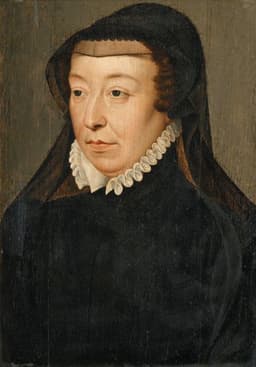
Catherine de Medici
Politician · Modern
60.0Total

Koprulu Huseyin Pasha
Politician · Modern
52.9Total
Basic Information
Born
1519
1644
Died
1589
1702
Era
Modern
Modern
Nationality
France
Ottoman Empire
Occupation
Politician
Politician
Civilization
Western
Middle Eastern
Score Comparison
Military (10%)
43.3
14.9
Political (20%)
72.0
68.0
Influence (20%)
68.0
58.0
Legacy (20%)
55.0
50.0
Leadership (15%)
66.0
68.0
Strategy (15%)
42.3
39.6
TOTAL
60.0
52.9
Catherine de Medici — Complete Timeline
1560 AD
Appointed Regent for Charles IXPolitical Action◆ Major
After the death of her son Francis II, Catherine de Medici became regent for her ten-year-old son Charles IX. She assumed control of the French government during the early Wars of Religion, seeking to maintain royal authority and religious peace.
RegencyWars of ReligionPower
Impact: national
1562 AD
Edict of Saint-GermainPolitical Action◆ Major
Catherine issued the Edict of Saint-Germain, granting limited toleration to Huguenots and allowing them to worship outside towns. This edict aimed to reduce religious tensions but was rejected by Catholic hardliners, contributing to the outbreak of the First War of Religion.
EdictReligious TolerationWars of Religion
Impact: nationalconstructive
1572 AD
St. Bartholomew's Day MassacreOther
Catherine de Medici was implicated in the assassination of Huguenot leader Gaspard de Coligny, which triggered a wave of mob violence in Paris that killed thousands of Huguenots. The massacre spread to other cities and deepened the religious conflict in France.
MassacreReligious ViolenceHuguenots
Impact: nationaldestructive
1576 AD
Peace of MonsieurPolitical Action◆ Major
Catherine negotiated the Peace of Monsieur, which granted extensive concessions to Huguenots, including freedom of worship and fortified towns. The peace was opposed by the Catholic League and led to the formation of the Catholic League, escalating tensions.
Peace TreatyReligious TolerationCatholic League
Impact: national
Koprulu Huseyin Pasha — Complete Timeline
1697 AD
Appointed Grand VizierPolitical Action◆ Major
Sultan Mustafa II appointed K
AppointmentOttoman Politics
Impact: national
1698 AD
Implemented Fiscal ReformsReform
Köprülü Hüseyin Pasha introduced measures to address the Ottoman treasury deficit, including reducing the size of the Janissary corps and reforming tax collection. These reforms aimed to restore financial stability after the costly war with the Holy League.
Fiscal PolicyAdministration
Impact: nationalconstructive
1699 AD
Negotiated the Treaty of KarlowitzPolitical Action
As Grand Vizier, K
TreatyOttoman DeclineDiplomacy
Impact: regional
Expert Analysis
Origins
Catherine de Medici was born on April 13, 1519, in Florence, Italy, to Lorenzo de Medici, Duke of Urbino, and Madeleine de la Tour d'Auvergne. Orphaned as an infant, she was raised in convents and later married to Henry II of France at age 14. Her upbringing in the Medici court exposed her to political intrigue, but she was often marginalized as a foreigner and commoner by French nobles.
Koprulu Huseyin Pasha was born around 1644 in the village of Koprulu in the Ottoman Empire. He was of Albanian origin and rose through the ranks of the Ottoman bureaucracy, likely through the devshirme system. His family, the Koprulu dynasty, had produced several grand viziers, and Huseyin benefited from their patronage and political connections.
Rise to Power
Catherine de Medici's rise to power began after the death of her husband Henry II in 1559. She initially served as regent for her young son Francis II, but after his death in 1560, she became regent for her second son, Charles IX, from 1560 to 1563. During this period, she dominated French politics, attempting to balance the Catholic and Huguenot factions. Her political score of 72.0 reflects her ability to maintain control despite religious strife.
Koprulu Huseyin Pasha was appointed grand vizier in 1697 by Sultan Mustafa II, following the Ottoman defeat at the Battle of Zenta. His appointment was part of an effort to stabilize the empire after military setbacks. He quickly took charge of negotiations with the Holy League, leading to the Treaty of Karlowitz in 1699. His political score of 68.0 reflects his diplomatic skill, though his military score of 14.9 indicates limited martial prowess.
Leadership & Governance
Catherine de Medici's leadership style was pragmatic and often manipulative. She sought to preserve the monarchy and her own influence by playing Catholic and Huguenot factions against each other. Her governance included issuing the Edict of Saint-Germain in 1562, which granted limited toleration to Huguenots, and negotiating the Peace of Monsieur in 1576, which gave extensive concessions to Protestants. However, her reliance on shifting alliances and secret dealings often led to unintended violence, such as the St. Bartholomew's Day Massacre in 1572, where thousands of Huguenots were killed. Her strategy score of 42.3 indicates a reactive rather than proactive approach.
Koprulu Huseyin Pasha's leadership focused on fiscal and military reforms. He reduced the size of the Janissary corps to cut costs and reformed tax collection to address the treasury deficit. His governance was more systematic than Catherine's, emphasizing administrative efficiency. However, his reforms were limited in scope and did not reverse the empire's long-term decline. His leadership score of 68.0 reflects his effectiveness in crisis management, but his total score of 52.9 is lower than Catherine's 60.0.
Triumph & Tragedy
Catherine de Medici's greatest success was maintaining the French monarchy's authority during the Wars of Religion, ensuring the succession of her sons. She also promoted the arts and culture, including the Valois Tapestries. Her greatest failure was the St. Bartholomew's Day Massacre, which sparked widespread violence and damaged her reputation. The massacre killed an estimated 5,000-30,000 Huguenots and undermined her efforts at conciliation.
Koprulu Huseyin Pasha's triumph was negotiating the Treaty of Karlowitz, which ended the Great Turkish War and ceded Ottoman territories to the Holy League. This treaty marked the first major territorial loss for the Ottoman Empire and set a precedent for diplomacy. His failure was his inability to implement lasting reforms; after his death in 1702, the empire continued its decline. His legacy score of 50.0 reflects his mixed impact.
Character & Destiny
Catherine de Medici was known for her intelligence, resilience, and duplicity. She was a master of political intrigue but often lacked foresight. Her character led her to prioritize short-term stability over long-term peace, contributing to the cycle of violence. Historical assessments often portray her as a Machiavellian figure, though some argue she was a pragmatic ruler in a difficult position.
Koprulu Huseyin Pasha was described as cautious and diplomatic, preferring negotiation to warfare. His character was shaped by the Koprulu family tradition of competent administration. However, his reluctance to confront the empire's deeper problems meant his reforms were superficial. His destiny was to preside over the Ottoman Empire's retreat from Europe, a role he accepted with pragmatism.
Legacy
Catherine de Medici's legacy is complex. She is remembered for her role in the St. Bartholomew's Day Massacre, which tarnished her reputation, but also for her patronage of arts and her efforts to maintain the French monarchy. Her influence on French politics persisted through the Bourbon dynasty. Her influence score of 68.0 reflects her lasting impact on French history.
Koprulu Huseyin Pasha's legacy is tied to the Treaty of Karlowitz, which reshaped Eastern European borders. He is remembered as a capable diplomat who managed a difficult transition. However, his reforms did not prevent the empire's decline. His legacy score of 50.0 is lower than Catherine's 55.0.
Conclusion
Catherine de Medici had a greater overall impact than Koprulu Huseyin Pasha, with a total score of 60.0 versus 52.9. While both were skilled politicians, Catherine navigated a more complex and volatile political landscape, and her actions had profound consequences for France and Europe. Koprulu Huseyin Pasha's achievements were significant but confined to a single treaty and limited reforms. Catherine's influence on statecraft and religious conflict surpasses Huseyin's diplomatic legacy.
Rankings
🥇
Catherine de MediciLeader
Mil: 43.3Pol: 72.0Inf: 68.0
60.0
🥈
Koprulu Huseyin Pasha
Mil: 14.9Pol: 68.0Inf: 58.0
52.9
+7.1 behind
How This Comparison Works
Algorithm
Each figure is scored on 6 dimensions (0—100 scale) based on structured historical data: Military (10%), Political (20%), Influence (20%), Legacy (20%), Leadership (15%), Strategy (15%). The weighted total produces the final ranking.
Data Sources
Scores are computed from structured sub-indicators in the database. Scale factors adjust for era (Ancient ×0.85, Modern ×1.0) and civilization size (Eastern ×1.05, Other ×0.80) to account for differences in population and military scale.
Maximum 3 Figures
Comparisons are limited to 2—3 figures to ensure readability and statistical meaningfulness.
Error Margins
±5 points per dimension — Sub-scores are derived from historical records with inherent uncertainty. Two figures within 5 points on a dimension should be considered roughly equivalent in that area.
Total Score Accuracy
±3 points overall — The weighted combination of 6 dimensions produces a total score with approximately ±3 points of uncertainty. Differences of less than 3 points are not statistically significant— the figures are effectively tied.
Known Limitations
- Historical records are incomplete and uneven across civilizations
- Figures from oral-tradition societies may be underrepresented
- Occupation labels can misclassify multi-role figures
- Scores measure capability and impact, not moral character
- Quantitative scoring is a comparison tool, not absolute truth
Capability Radar
Military (10%) — Battles & Warfare
Battles
10
20
Win Rate
10
20
Expansion
5
10
Political (20%) — Governance & Reform
Reform
60
40
Diplomacy
80
70
Economy
50
45
Influence (20%) — Cultural & Global Reach
Cultural
60
30
Global
55
50
Legacy (20%) — Historical Impact
Historical
70
60
Longevity
65
40
Leadership (15%) — Power & Stability
Tenure
85
50
Stability
30
55
Strategy (15%) — Tactics & Innovation
Strategy
20
30
Tactics
15
25
Reform
15
15
Similar Comparisons
Comments & Discussion
No comments yet. Be the first to share your thoughts!