Loading...
Catherine de Medici vs Napoleon Bonaparte
Napoleon Bonaparte leads by 10.9 pts · 2 figures compared
…
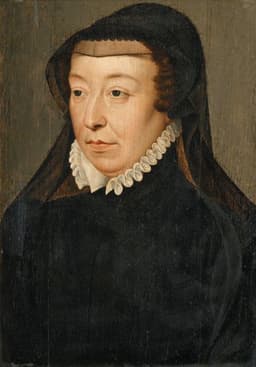
Catherine de Medici
Politician · Modern
60.0Total

Napoleon Bonaparte
General · Modern
70.9Total
Basic Information
Born
1519
1769
Died
1589
1821
Era
Modern
Modern
Nationality
France
France
Occupation
Politician
General
Civilization
Western
Western
Score Comparison
Military (10%)
43.3
94.0
Political (20%)
72.0
72.0
Influence (20%)
68.0
40.0
Legacy (20%)
55.0
80.0
Leadership (15%)
66.0
78.0
Strategy (15%)
42.3
90.0
TOTAL
60.0
70.9
Catherine de Medici — Complete Timeline
1560 AD
Appointed Regent for Charles IXPolitical Action◆ Major
After the death of her son Francis II, Catherine de Medici became regent for her ten-year-old son Charles IX. She assumed control of the French government during the early Wars of Religion, seeking to maintain royal authority and religious peace.
RegencyWars of ReligionPower
Impact: national
1562 AD
Edict of Saint-GermainPolitical Action◆ Major
Catherine issued the Edict of Saint-Germain, granting limited toleration to Huguenots and allowing them to worship outside towns. This edict aimed to reduce religious tensions but was rejected by Catholic hardliners, contributing to the outbreak of the First War of Religion.
EdictReligious TolerationWars of Religion
Impact: nationalconstructive
1572 AD
St. Bartholomew's Day MassacreOther
Catherine de Medici was implicated in the assassination of Huguenot leader Gaspard de Coligny, which triggered a wave of mob violence in Paris that killed thousands of Huguenots. The massacre spread to other cities and deepened the religious conflict in France.
MassacreReligious ViolenceHuguenots
Impact: nationaldestructive
1576 AD
Peace of MonsieurPolitical Action◆ Major
Catherine negotiated the Peace of Monsieur, which granted extensive concessions to Huguenots, including freedom of worship and fortified towns. The peace was opposed by the Catholic League and led to the formation of the Catholic League, escalating tensions.
Peace TreatyReligious TolerationCatholic League
Impact: national
Napoleon Bonaparte — Complete Timeline
1799 AD
Coup of 18 BrumaireOther◆ Major
Napoleon Bonaparte, with support from his brother Lucien and key political figures, overthrew the Directory in a bloodless coup. He established the Consulate with himself as First Consul, effectively becoming the ruler of France. This event ended the French Revolution's most unstable period.
French RevolutionCoupRise to Power
Impact: regional
1804 AD
Promulgation of the Napoleonic CodeOther◆ Major
Napoleon enacted the Civil Code of the French, known as the Napoleonic Code, a comprehensive set of laws that replaced the fragmented feudal legal systems. The code established legal equality, protected property rights, and secularized law. It became the basis for legal systems in many European and world countries.
Legal ReformNapoleonic CodeCivil Law
Impact: globalconstructive
1805 AD
Battle of AusterlitzWar◆ Major
Napoleon's Grande Arm
Napoleonic WarsBattleDecisive Victory
Impact: global
1812 AD
Invasion of RussiaWar◆ Major
Napoleon led the Grande Arm
Napoleonic WarsInvasionDisaster
Impact: globaldestructive
1815 AD
Battle of WaterlooWar◆ Major
Napoleon's French army was defeated by the combined forces of the Duke of Wellington's Anglo-Allied army and Gebhard Leberecht von Bl
Napoleonic WarsBattleFinal Defeat
Impact: globaldestructive
Expert Analysis
catherine-de-medici-vs-napoleon-bonaparte
# The Art of Power: Napoleon’s Conquest and Catherine’s Survival
On a summer morning in 1815, Napoleon Bonaparte stood on a ridge near Waterloo, watching the Duke of Wellington’s red-coated infantry form squares against his cavalry. He had gambled everything on a single, thunderous blow—and lost. Two hundred and fifty years earlier, another French ruler faced a different kind of battlefield. Catherine de Medici, a Florentine queen in a foreign court, sat in the Louvre Palace as Paris erupted in the St. Bartholomew’s Day Massacre of 1572. She did not command armies; she maneuvered through marriages, edicts, and assassinations. One man sought to conquer Europe with cannon and cavalry; one woman struggled to keep a fractured kingdom from tearing itself apart. Both wielded power, but their paths could not have diverged more dramatically. What explains the difference between a conqueror and a survivor, a general and a strategist of the shadows?
Origins
Napoleon was born in 1769 on the island of Corsica, a rocky Mediterranean outpost that had only recently become French. His family was minor nobility, but poor. At the age of nine, he entered military school in mainland France, where classmates mocked his thick Corsican accent and provincial manners. The humiliation forged a will of iron. He devoured books on military history and artillery tactics, emerging as a second lieutenant at sixteen. The French Revolution, which began when he was twenty, shattered the old order and opened doors that birth alone could never unlock.
Catherine de Medici was born in 1519 in Florence, Italy, into a family of bankers and popes. Orphaned as an infant, she was raised as a pawn in the power games of Renaissance Italy. At fourteen, she was married to Henry, the second son of King Francis I of France. She arrived in Paris a foreigner, plain-faced and overshadowed by the king’s glamorous mistress. For a decade, she was nearly invisible, a quiet Italian girl in a glittering court. But she watched, learned, and waited. Her era was one of religious war, not revolution—a time when the question was not what system would rule France, but which God would claim its soul.
Rise to Power
Napoleon’s ascent was meteoric. In 1793, at the age of twenty-four, he drove British forces from the port of Toulon with a brilliant artillery barrage. By 1796, he was commanding the French army in Italy, where he won a series of stunning victories against the Austrians. Each triumph was a stepping stone. In 1799, he seized power in a coup d’état, becoming First Consul of France. Five years later, in 1804, he crowned himself Emperor in Notre-Dame Cathedral, taking the crown from the Pope’s hands and placing it on his own head. His rise was a story of pure ambition, fueled by talent and the chaos of revolution.
Catherine’s rise was slower, quieter, and more painful. When her husband Henry II died in a jousting accident in 1559, their eldest son Francis II became king—but Francis was frail and fifteen. He died the next year. Catherine was appointed regent in 1560 for her second son, the ten-year-old Charles IX. She had not sought power; it had been thrust upon her by death. Her rise was not a conquest but a stewardship, a holding action in a kingdom where Catholics and Protestants (Huguenots) were already sharpening their swords.
Leadership & Governance
Napoleon governed like a general on campaign. He reorganized France into efficient departments, centralized the tax system, and founded the Bank of France. His greatest domestic achievement was the Napoleonic Code of 1804—a comprehensive legal framework that enshrined equality before the law, protected property rights, and secularized the state. It was a revolutionary document, exported across Europe wherever his armies marched. But his rule was also autocratic. He suppressed dissent, censored newspapers, and crowned himself emperor. His political score of 75 reflects a brilliant administrator who never trusted democracy.
Catherine governed like a diplomat in a burning house. She issued the Edict of Saint-Germain in 1562, granting limited toleration to Huguenots and allowing them to worship outside city walls. It was a cautious attempt to defuse religious tension. When that failed, she negotiated the Peace of Monsieur in 1576, which gave Huguenots extensive concessions, including freedom of worship. Her political score of 81 is higher than Napoleon’s, and for good reason: she kept France intact through decades of civil war, balancing factions she could not defeat. Her strategy score of 41 reflects a weakness for military matters, but her leadership score of 82 shows she understood that survival sometimes requires bending, not breaking.
Triumph & Tragedy
Napoleon’s greatest moment was the Battle of Austerlitz in 1805, where he crushed the combined armies of Russia and Austria in a single day. It was a masterpiece of deception and timing, a victory so complete that it forced the Austrian emperor to sue for peace. His military score of 94 is the highest of any figure in this comparison, and Austerlitz was the summit of his genius.
His tragedy was the invasion of Russia in 1812. He marched 600,000 men into the vastness of the Russian winter and returned with fewer than 100,000. The disaster broke his aura of invincibility. In 1814, he was forced to abdicate and was exiled to the island of Elba. He escaped in 1815, rallied France for a hundred days, and met his final defeat at Waterloo. He died in 1821 on the remote island of Saint Helena, a prisoner of the British.
Catherine’s greatest moment was the Edict of Saint-Germain—a fragile peace that proved that a woman could hold the center against fanatics on both sides.
Her tragedy was the St. Bartholomew’s Day Massacre of 1572. She had approved the assassination of Huguenot leader Gaspard de Coligny, fearing his influence over her son. The killing triggered a wave of mob violence that left thousands of Protestants dead in Paris and across France. Catherine has been blamed for the massacre ever since, and the stain has never washed away. Her legacy score of 55 reflects this shadow.
Character & Destiny
Napoleon was driven by an insatiable hunger for glory. “I am not a man,” he once said, “I am a thing—a force.” His personality was a weapon: charismatic, tireless, and ruthless. He believed that destiny was something to be seized, not awaited. This drove him to heights no Corsican boy could have dreamed of—and to depths no emperor should have fallen to.
Catherine was driven by survival. She was cautious, patient, and pragmatic. She believed that politics was the art of the possible, not the heroic. As a woman in a man’s world, she could not command armies or lead charges. She had to manipulate, negotiate, and endure. Her personality was shaped by necessity: she was a mother who lost three sons to early deaths, a queen who was never loved, a ruler who did what she had to do to keep her family on the throne.
Legacy
Napoleon left behind a transformed Europe. The Napoleonic Code influenced legal systems from France to Japan. He redrew national borders, spread nationalism, and inspired revolutions long after his death. He is remembered as both a liberator and a tyrant, a genius and a megalomaniac. His legacy score of 78 reflects this ambivalence: he changed the world, but at a terrible cost.
Catherine left behind a France that had survived. She did not win the Wars of Religion; they continued after her death in 1589. But she kept the monarchy intact through the worst of the storm. Her legacy is more contested: some see her as a Machiavellian poisoner, others as a capable regent in impossible circumstances. Her influence score of 71 reflects her quiet, enduring impact on French statecraft.
Conclusion
Napoleon and Catherine de Medici both ruled France, but they inhabited different worlds. One was a conqueror who believed history was made by force of will; the other was a survivor who knew that history is often made by force of circumstance. Napoleon’s story is a symphony of triumph and tragedy, a grand opera of ambition and downfall. Catherine’s story is a quiet drama of endurance, a chess game played with human lives. In the end, Napoleon’s empire crumbled, while Catherine’s dynasty—the Valois—faded into history. Yet both remind us that power is not a single thing. It is a sword, a pen, a whisper, a roar—and the hands that wield it are as different as the souls that hold them.
Rankings
🥇
Napoleon BonaparteLeader
Mil: 94.0Pol: 72.0Inf: 40.0
70.9
🥈
Catherine de Medici
Mil: 43.3Pol: 72.0Inf: 68.0
60.0
+10.9 behind
How This Comparison Works
Algorithm
Each figure is scored on 6 dimensions (0—100 scale) based on structured historical data: Military (10%), Political (20%), Influence (20%), Legacy (20%), Leadership (15%), Strategy (15%). The weighted total produces the final ranking.
Data Sources
Scores are computed from structured sub-indicators in the database. Scale factors adjust for era (Ancient ×0.85, Modern ×1.0) and civilization size (Eastern ×1.05, Other ×0.80) to account for differences in population and military scale.
Maximum 3 Figures
Comparisons are limited to 2—3 figures to ensure readability and statistical meaningfulness.
Error Margins
±5 points per dimension — Sub-scores are derived from historical records with inherent uncertainty. Two figures within 5 points on a dimension should be considered roughly equivalent in that area.
Total Score Accuracy
±3 points overall — The weighted combination of 6 dimensions produces a total score with approximately ±3 points of uncertainty. Differences of less than 3 points are not statistically significant— the figures are effectively tied.
Known Limitations
- Historical records are incomplete and uneven across civilizations
- Figures from oral-tradition societies may be underrepresented
- Occupation labels can misclassify multi-role figures
- Scores measure capability and impact, not moral character
- Quantitative scoring is a comparison tool, not absolute truth
Capability Radar
Military (10%) — Battles & Warfare
Battles
10
95
Win Rate
10
90
Expansion
5
95
Political (20%) — Governance & Reform
Reform
60
95
Diplomacy
80
80
Economy
50
85
Influence (20%) — Cultural & Global Reach
Cultural
60
85
Global
55
90
Legacy (20%) — Historical Impact
Historical
70
95
Longevity
65
90
Leadership (15%) — Power & Stability
Tenure
85
85
Stability
30
70
Strategy (15%) — Tactics & Innovation
Strategy
20
95
Tactics
15
98
Reform
15
92
Similar Comparisons
Comments & Discussion
TheACRates6/17/2026
Catherine de Medici’s “massacre” myth is overblown—she was a desperate survivalist, not a bloody schemer. The Saint Bartholomew’s Day killings spiraled beyond her control; she didn’t order 3,000 deaths. Napoleon, despite his glitzy legend, lost over 500,000 men in Russia alone, many to his own arrogant timetable. A general who can’t feed his army is a butcher, not a genius. Catherine kept France intact; Napoleon shattered Europe for his ego. I’d take a cunning survivor over a reckless conqueror
凯撒不配6/17/2026
拿破仑就是个自恋的暴发户,靠大炮和征兵令堆出帝国,结果自己把自己流放两次。凯瑟琳·德·美第奇至少懂政治是妥协的艺术,她在1572年之后还活了17年,把儿子们扶上王位,而拿破仑呢?滑铁卢一败就彻底凉凉,连个继承人都没保住。论治国,凯瑟琳在宗教战争里拉扯出一个法兰西,拿破仑却把国家掏空送进坟墓。历史总吹战功,但真正该吹的是在废墟里还能掌舵的人。
MilanArchivist6/17/2026
Data point: Napoleon won 54 of his 60 battles, but his strategic collapse was total—Waterloo was a tactical blunder where he split his forces and let Blücher’s Prussians arrive. Catherine de Medici? She orchestrated the Edict of Beaulieu in 1576, the first real peace in a decade of civil war. One built on conquest’s brittle glory; the other on patience and legalisms. Numbers favor Napoleon for raw impact, but Catherine’s “margin of defeat” is zero—she died in her bed, still queen mother. Stamina
ChevalierNoir6/17/2026
别把两个类型硬凑一起——拿破仑是军事天才,凯瑟琳是政治蜘蛛。看具体成就:拿破仑的《民法典》1804年统一了法国法律,至今影响欧洲;凯瑟琳在1559年签署《卡托-康布雷齐和约》,结束了长达65年的意大利战争,保住了法国边界。一个靠剑,一个靠笔,但凯瑟琳的“剑”是嫁女儿和买通贵族。她没打过仗,却活过了三代国王。事实是,国家崩溃时可以不需要将军,但一定需要一个婆婆式的操盘手。