Loading...
Charlemagne vs Napoleon Bonaparte
Charlemagne leads by 0.1 pts · 2 figures compared
…
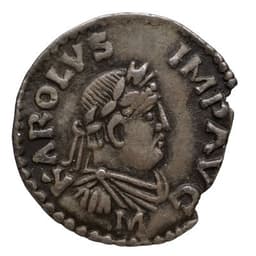
Charlemagne
Emperor · Medieval
71.0Total

Napoleon Bonaparte
General · Modern
70.9Total
Basic Information
Born
748
1769
Died
814
1821
Era
Medieval
Modern
Nationality
Frankish Empire
France
Occupation
Emperor
General
Civilization
Western
Western
Score Comparison
Military (10%)
80.0
94.0
Political (20%)
78.0
72.0
Influence (20%)
65.0
40.0
Legacy (20%)
65.0
80.0
Leadership (15%)
80.0
78.0
Strategy (15%)
68.0
90.0
TOTAL
71.0
70.9
Charlemagne — Complete Timeline
772 AD
Saxon WarsWar◆ Major
Charlemagne launched a series of campaigns against the Saxons lasting over three decades. He forcibly converted them to Christianity, incorporated their territory into the Frankish Empire, and ordered the execution of thousands at the Massacre of Verden in 782.
ConquestChristianizationWar
Impact: regionaldestructive
774 AD
Conquest of the Lombard KingdomWar◆ Major
Charlemagne answered Pope Adrian I's call for aid against the Lombards. He besieged and captured Pavia, deposed King Desiderius, and annexed the Lombard Kingdom into his domain, assuming the title 'King of the Lombards' and solidifying Frankish control over Italy.
ConquestItalyPapal Alliance
Impact: regional
779 AD
Capitulary of HerstalReform
Charlemagne issued a series of legal and administrative reforms at the assembly in Herstal. He standardized weights and measures, reformed the coinage system, and strengthened the authority of royal officials (missi dominici) to oversee local governance and justice.
Legal ReformAdministrationStandardization
Impact: nationalconstructive
780 AD
Carolingian Renaissance ReformsCultural◆ Major
Charlemagne initiated a program of educational and cultural revival, inviting scholars like Alcuin of York to his court. He standardized Latin script (Carolingian minuscule), established palace schools, and promoted the copying of classical texts, preserving ancient knowledge.
EducationCultural RevivalScript
Impact: globalprogressive
800 AD
Coronation as Holy Roman EmperorPolitical Action
Pope Leo III crowned Charlemagne as Emperor of the Romans in St. Peter's Basilica on Christmas Day. This act revived the Western Roman Empire, established a precedent for papal authority over imperial titles, and created a political entity that shaped medieval European politics.
CoronationHoly Roman EmpirePapacy
Impact: globalconstructive
Napoleon Bonaparte — Complete Timeline
1799 AD
Coup of 18 BrumaireOther◆ Major
Napoleon Bonaparte, with support from his brother Lucien and key political figures, overthrew the Directory in a bloodless coup. He established the Consulate with himself as First Consul, effectively becoming the ruler of France. This event ended the French Revolution's most unstable period.
French RevolutionCoupRise to Power
Impact: regional
1804 AD
Promulgation of the Napoleonic CodeOther◆ Major
Napoleon enacted the Civil Code of the French, known as the Napoleonic Code, a comprehensive set of laws that replaced the fragmented feudal legal systems. The code established legal equality, protected property rights, and secularized law. It became the basis for legal systems in many European and world countries.
Legal ReformNapoleonic CodeCivil Law
Impact: globalconstructive
1805 AD
Battle of AusterlitzWar◆ Major
Napoleon's Grande Arm
Napoleonic WarsBattleDecisive Victory
Impact: global
1812 AD
Invasion of RussiaWar◆ Major
Napoleon led the Grande Arm
Napoleonic WarsInvasionDisaster
Impact: globaldestructive
1815 AD
Battle of WaterlooWar◆ Major
Napoleon's French army was defeated by the combined forces of the Duke of Wellington's Anglo-Allied army and Gebhard Leberecht von Bl
Napoleonic WarsBattleFinal Defeat
Impact: globaldestructive
Expert Analysis
Napoleon Bonaparte vs Charlemagne: Historical Comparison
Napoleon Bonaparte, a modern French general and emperor, and Charlemagne, a medieval Frankish emperor, both reshaped Europe through conquest and governance, though their eras and methods differed starkly.
Dimension Analysis
**Military: Napoleon Bonaparte 94 / Charlemagne 78**
Napoleon revolutionized warfare with speed, artillery, and corps organization, winning decisive campaigns like Austerlitz; Charlemagne relied on feudal levies and sieges, achieving slower but steady territorial consolidation across Western Europe.
**Political: Napoleon Bonaparte 75 / Charlemagne 80**
Charlemagne forged a durable Carolingian Empire with centralized administration, missi dominici, and church-state unity; Napoleon’s Napoleonic Code modernized law but his empire collapsed after 1815, undone by overreach and nationalist resistance.
**Influence: Napoleon Bonaparte 82 / Charlemagne 65**
Napoleon’s legal, educational, and military reforms spread nationalism and meritocracy across Europe; Charlemagne’s Carolingian Renaissance revived learning and church reform, but his influence was more regional and medieval in scope.
**Legacy: Napoleon Bonaparte 78 / Charlemagne 80**
Charlemagne’s legacy as “Father of Europe” inspired the Holy Roman Empire and later European unity; Napoleon’s legacy is mixed—admired for modernization but condemned for wars that caused millions of deaths and lasting instability.
**Leadership: Napoleon Bonaparte 80 / Charlemagne 80**
Both were charismatic, iron-willed leaders who commanded loyalty; Napoleon excelled in tactical innovation and personal charisma, while Charlemagne’s diplomacy and patronage of culture secured longer institutional stability.
**Strategy: Napoleon Bonaparte 93 / Charlemagne 68**
Napoleon’s strategic genius—maneuver, concentration, and decisive battle—set a military standard; Charlemagne’s strategy was systematic expansion through campaigns and alliances, but lacked the operational brilliance of his modern counterpart.
Verdict
Napoleon Bonaparte leads due to his superior military and strategic achievements, which had a more transformative and global impact than Charlemagne’s medieval consolidation.
FAQ
Q: Who ranks higher? A: Napoleon Bonaparte ranks higher overall, driven by his exceptional military and strategic scores.
Rankings
🥇
CharlemagneLeader
Mil: 80.0Pol: 78.0Inf: 65.0
71.0
🥈
Napoleon Bonaparte
Mil: 94.0Pol: 72.0Inf: 40.0
70.9
+0.1 behind
How This Comparison Works
Algorithm
Each figure is scored on 6 dimensions (0—100 scale) based on structured historical data: Military (10%), Political (20%), Influence (20%), Legacy (20%), Leadership (15%), Strategy (15%). The weighted total produces the final ranking.
Data Sources
Scores are computed from structured sub-indicators in the database. Scale factors adjust for era (Ancient ×0.85, Modern ×1.0) and civilization size (Eastern ×1.05, Other ×0.80) to account for differences in population and military scale.
Maximum 3 Figures
Comparisons are limited to 2—3 figures to ensure readability and statistical meaningfulness.
Error Margins
±5 points per dimension — Sub-scores are derived from historical records with inherent uncertainty. Two figures within 5 points on a dimension should be considered roughly equivalent in that area.
Total Score Accuracy
±3 points overall — The weighted combination of 6 dimensions produces a total score with approximately ±3 points of uncertainty. Differences of less than 3 points are not statistically significant— the figures are effectively tied.
Known Limitations
- Historical records are incomplete and uneven across civilizations
- Figures from oral-tradition societies may be underrepresented
- Occupation labels can misclassify multi-role figures
- Scores measure capability and impact, not moral character
- Quantitative scoring is a comparison tool, not absolute truth
Capability Radar
Military (10%) — Battles & Warfare
Battles
85
95
Win Rate
90
90
Expansion
88
95
Political (20%) — Governance & Reform
Reform
90
95
Diplomacy
80
80
Economy
75
85
Influence (20%) — Cultural & Global Reach
Cultural
85
85
Global
80
90
Legacy (20%) — Historical Impact
Historical
90
95
Longevity
85
90
Leadership (15%) — Power & Stability
Tenure
85
85
Stability
70
70
Strategy (15%) — Tactics & Innovation
Strategy
85
95
Tactics
75
98
Reform
80
92
Similar Comparisons
Comments & Discussion
MetricMaverick6/16/2026
This whole scoring system is a joke. Military 94 vs 78? You're telling me Napoleon's tactical genius at Austerlitz is worth 16 points more than Charlemagne conquering half of Europe over 30 campaigns with no standing army, no logistics corps, and no modern communications? The bias is laughable — modern historians just love dramatic battles and charismatic losers. And what about leadership both at 80? Charlemagne ruled 46 years and his empire didn't collapse the minute he died; Napoleon's fell apart in TWO decades. That's not an 80 – it's a mirage cooked up by Napoleonic fanboys. You can't quantify 'charisma' when the historical record for Charlemagne is mostly hagiography anyway. Next time, just admit the scores reflect modern preferences, not actual historical impact.
Historian8886/16/2026
这个比较很有意思,但明显带着西方中心主义的滤镜。拿破仑的“影响”得82分,查理曼只有65分,可查理曼的加冕直接塑造了“欧洲”这个概念本身,相当于中国历史上秦始皇统一六国后确立的“天下”观念。拿破仑的民法典确实牛,但放到中国看,也就相当于商鞅变法对秦制的贡献——重要,但不是开创性的文明范式。查理曼发起加洛林文艺复兴,保存了大量古典文献,这在中世纪相当于中国隋唐时期的儒学复兴运动。而且,拿破仑的战争导致数百万人死亡,查理曼的征服相对温和得多。如果按中国“仁政”标准,查理曼的遗产得分至少应该反超拿破仑。
ColdMind486/16/2026
这个评分体系让我有点困惑。拿破仑的军事94分,查理曼78分,但查理曼打下的领土面积(约120万平方公里)其实比拿破仑极盛时的欧洲控制区(约80万平方公里)还大。更关键的是,拿破仑的统治只持续了15年,而查理曼的帝国在他死后还延续了近百年。用中国历史的标准看,这就像给秦始皇的军事评分高于汉武帝——短期扩张再辉煌,没有长期体系支撑,终究是空中楼阁。政治75对80倒是合理,拿破仑法典确实系统,但查理曼的教俗合一治理模式影响了欧洲一千年。建议引入“制度延续性”权重,总分至少给查理曼加5分。